
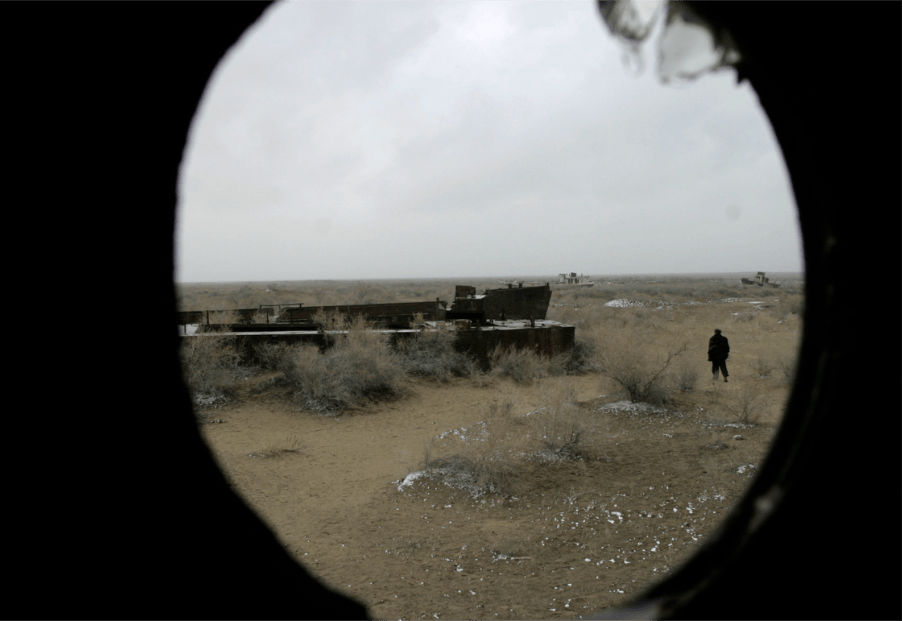
Stranded boats in a dried up seabed. Once a major fishing port on the southern shore of the Aral Sea, Moynaq now stands roughly 150km from the sea and suffers as a result economically as well as environmentally.
Written by Darcie Rogers
19/10/2025
A few years ago, coming home from a day out and checking the tags on the clothes I had bought, I absent-mindedly absorbed the assurance that these products were not made using cotton from Uzbekistan. At the time I thought nothing of it, but a while ago it came back into my head, as these things sometimes do: why specifically Uzbek cotton?
In Central Asia, straddling Kazakhstan and Uzbekistan, lies a smattering of small lakes and a vast, inhospitable dustbowl. This is all that remains of the Aral Sea. Once the fourth largest lake in the world, trumped only by the Caspian Sea, Lake Superior and Lake Victoria, sixty years of devastating environmental mismanagement by first the Soviet Union and then the brutal Uzbek dictator Islam Karimov contributed to its near-complete demise. Described as a ‘quiet Chernobyl’, the Sea went from having a surface area comparable to the size of Ireland to that of Cyprus in decades.
The desert surrounding the Aral Sea is arid and unsympathetic, with little rainfall – not ideal for farming, excepting the area around the lake’s tributaries – and so, in the past, the sea supported a predominantly nomadic fishing population of known as the Karakalpaks. In 1867, Imperial Russia gained control of the entirety of what is now modern-day Uzbekistan. It was incorporated into the Russian province of Turkistan, and in the Aral Sea basin the Russians saw significant agricultural potential. If the desert could be irrigated, and the population forcibly settled, it would provide a massive area for production of heat-loving, water-hungry but most of all profitable crops like cotton.
By the dawn of the twentieth century, over 3 million hectares of Aral Sea basin was under irrigation. A shift was to come with the 1917 Bolshevik Revolution, however; with a renewed interest in stimulating Central Asian cotton production, Vladimir Lenin issued a demand for more cotton from the region in 1918. By the 1930s, cotton was produced to the neglect of other crops, and the diversion of the Amu Dar’ya and Syr Dar’ya rivers only intensified. It is difficult to stress enough how integral these rivers are to the existence of the Sea – flowing from the Tien Shan mountain range thousands of kilometres away, these two rivers have almost exclusively sustained the Aral Sea for millennia. Nevertheless, the Soviet project continued, and in the late 1940s the Syr Dar’ya was diverted further to irrigate more of the Uzbek desert.
In 1959, Soviet premier Nikita Kruschev pushed this approach to its logical end: to introduce a policy of cotton monoculture, making it Uzbekistan’s primary export, and achieve true self-sufficiency in the crop for the USSR by any means necessary. There is almost total historical consensus that this was the final nail in the coffin for the Aral Sea, what academic Ruel R. Hanks refers to as the beginning of ‘the death spiral’ for the lake. Both the Amu Dar’ya and the Syr Dar’ya were diverted away from the Aral Sea. This proved an incredibly successful economic initiative for the USSR; Uzbekistan was the world’s primary exporter of cotton until 1988, and the Soviet administration didn’t care much for the ramifications of cutting off the waterflow to the fourth largest lake in the world. Indeed, Soviet scientists frequently referred to the Aral as an ‘error of nature’. Before 1965, more than 2000 square kilometres of freshwater flowed into the Aral Sea every year; by the early 1980s, it received next to none.
As the lake continued to shrivel and recede, it split into two separate bodies in 1987. The North Aral Sea (or the ‘Small Aral’, as it used to be called until the southern lake evaporated so much it became the smaller half) lies in Kazakhstan, while the rest of the sea lies in Uzbekistan.
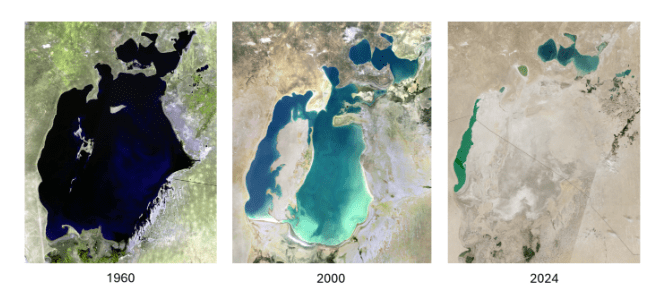
The Aral Sea is a saltwater lake, but freshwater flows into it from the Syr and Amu Dar’ya rivers. Accordingly, the lake was once home to around twenty-four species of both freshwater and saltwater fish, contributing to a thriving fishing economy and sustaining the many communities on its banks. In 1960, over forty-three thousand metric tonnes of fish were caught in the Aral Sea; by 1982, all commercial fishing had ground to a halt. The sudden halt of any freshwater into the lake, and decades of extra salts, pesticides, herbicides, fertilisers and other agricultural chemicals pouring into the Sea as runoff led to a huge increase in its salt content. In 1960, the Aral Sea had a salinity of ten grammes per litre. By the late 1970s, this had increased significantly; so significantly, in fact, that many species of freshwater fish had died off. In a desperate attempt to replenish the marine population, in 1979, flounder-gloss (a saltwater fish) was introduced to the Aral from the Black Sea. By the late 1990s it had gone extinct again – because of high salinity. There are now no fish left in the Uzbek part of the Aral Sea; all twenty-four endemic species were confirmed extinct in 2014, owing to the fact that the water in that part of the lake is now classed as ‘hypersaline’ and is three times saltier than the Mediterranean Sea.
Because of the complete collapse of the fishing industry, the Uzbek economy is now essentially propped up by cotton production. Around a fifth of the population ‘work’ in that sector. I place ‘work’ in quotation marks, because that implies the Uzbek people were being paid for this labour. The reason the clothing companies from the beginning of the article were boycotting cotton from Uzbekistan was not because of the environmental degradation of the Aral Sea (it is difficult to imagine fast-fashion companies caring too much about environmental degradation, looking at images of South-East Asian and West African coastlines buried under textile waste); it was because of the slavery.
Throughout its history, the USSR had sent people to work in the cotton fields in Uzbekistan. Upon its collapse in 1992, however, the difficulties of transitioning away from communism meant that although the state no longer technically had ownership of farmland, workers were still practically indentured to the state. The government set quotas for each region to fulfil, bought the cotton at ridiculously cheap prices, then sold it on for huge profits to international buyers. If farmers did not fulfil the state’s demands, they would be kicked off the land. Thus, short of money and employees, the Uzbek government sent public employees, university students and schoolchildren to harvest cotton, for two months every year. Ruel Hanks visited the university of Tashkent in 1995 only to find the building deserted. ‘After several inquiries,’ he writes, ‘I was informed that all the students, numbering several thousand, had been placed on buses and sent to local farms to assist in harvesting the cotton crop […] most of my students had been required to perform this task since they were in high school’. In 2013, eleven people died during the cotton harvest, including a six-year-old child.
The situation has marginally improved in the last decade. A 2020 UN report concluded ninety-four per cent of cotton pickers ‘worked voluntarily’ in the 2019 harvest, up forty percent from the previous year, and in 2022 the Global Cotton Campaign ended its call for a boycott of Uzbek cotton, saying it had found no evidence of ‘central government-imposed’ labour in 2021.
Recently, there has been a positive story to be told about the North Aral Sea, too: in 2005, the Kazakh government constructed the Dike Kok-Aral, which allowed the water level of the lake to increase from thirty metres to forty-two. Salinity levels are back under control too, returning to their pre-1960 levels, along with twenty-four species of fish.
After around a century of Soviet agricultural and environmental practises, and three decades of relentless continuity under the post-USSR Uzbek government, what was once the fourth largest lake in the world has been turned into an inhospitable desert of carcinogenic dust and a stagnant strip of water so salty that re-introduced saltwater fish species died out again within a decade. Frequent salt-storms whip carcinogenic dust into local towns, which suffer from devastating health outcomes as well as extreme economic hardship. This environmental catastrophe was completely enacted by humans specifically for ‘self-sufficiency’ or ‘profit’ or ‘economic growth’ and was furthered by the exploitation of a dictator’s own impoverished populace.
What lesson is there to take from this? It is easy to feel powerless in the face of destruction on such an immense scale. But, as climate activist Mikaela Loach says in her 2023 book ‘It’s Not That Radical’, ‘whenever you’re reading this, whatever has happened, it is never too late to begin to take the actions that will make the world a better place.’
Bibliography
https://www.jstor.org/stable/4412601
https://www.jstor.org/stable/1702713
https://en.wikipedia.org/wiki/Aral_Sea#
https://en.wikipedia.org/wiki/History_of_Uzbekistan#
https://www.nationalgeographic.com/magazine/article/vanishing-aral-sea-kazakhstan-uzbekistan
https://www.economist.com/banyan/2013/10/16/in-the-land-of-cotton
Image credit
cover photograph and caption: Christopher Herwig
 Retrospect Journal