
Written by Peiqi An
19/10/2025
This article is concerned with the recreation of Queen Cleopatra VII (69-30 BC)—the legendary Pharaoh of Egypt—as portrayed in two nineteenth-century French paintings. The Egyptian ruler, who fascinated many people in her time, continues to enchant many others through successive ages. Created fifty years apart, the two oil paintings, Cleopatra and the Peasant (1838) by Eugène Delacroix (1798-1893) and Cleopatra Testing Poisons on Condemned Prisoners (1887) by Alexandre Cabanel (1823-1889), are publicly recognised works of art depicting Cleopatra’s death during a period when Egyptomania in art and literature had reached its peak. On many occasions, artists’ treatment of their subject varies according to the learned perspectives of their culture and education, and the raw, intuitive choices of their innate creativity. This article, however, will not delve into artists’ insights regarding their subject matter. Centred around strikingly distinct art styles and techniques shown in the two artworks, the article will mainly look at the visual devices that might help viewers formulate a conception of “Cleopatra” that encompasses her image, temperament, and death.
For centuries, countless portrayals of Cleopatra’s life—some real and some fictitious—have thrived across various forms of media, creating elements that have circulated throughout time and become identifiable traits of the Pharaoh. She is often remembered as very beautiful (albeit some descriptions of her appearance are more measured), a passionate lover, and a skillful ruler who prolonged the independence of her kingdom. Meanwhile, as is often the case with historical figures, much of what is known about Cleopatra has been manipulated and distorted over time, casting her as a complex figure that oscillates between heroic and villainous, a devoted lover and a calculating seductress who embodies both positive and negative ideals. This interplay of consistency and diversity is reflected in Delacroix’s and Cabanel’s artworks depicting the Pharaoh. While sharing certain conventions, the two artists capture very different natures of Cleopatra: on the one hand a charismatic female sovereign, radiating a blend of grandeur and human frailty, as in Cleopatra and the Peasant, and on the other a cunning, ruthless, and seductive “femme fatale”, entwined with stories of conspiracy, poison, and sex, as exemplified by Cleopatra Testing Poisons on Condemned Prisoners.
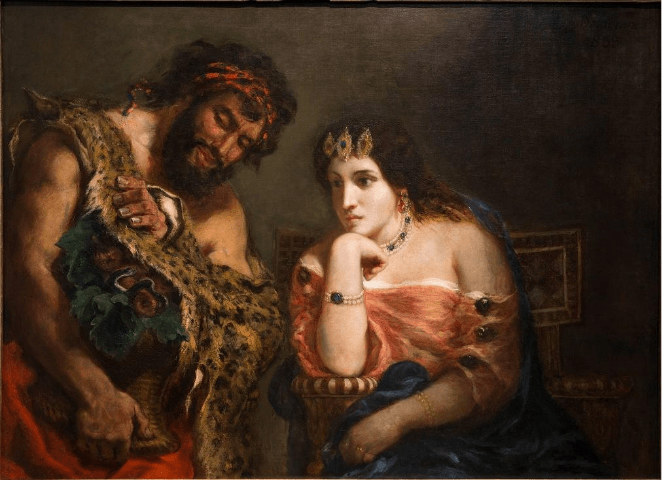
Cleopatra and the Peasant (Cover Image) is inspired by Act V, Scene 2, of Shakespeare’s Antony and Cleopatra, in which the play comes to a climactic finale as the Pharaoh commits suicide via the bite of an asp. The oil on canvas captures the very instant when a peasant approaches Cleopatra and shows her an asp of the Nile, coiled in a basket, that “kills and pains not”. The Pharaoh, resting her elbow elegantly on the chair’s arm, seems to gaze less at the asp than at the invisible silhouettes of life’s aftermath. She is clad in a shimmering saffron-hued gown and a robe of deep indigo, with a distinctive diadem of precious stones. Her attire likely mirrors that of Isis, the ancient Egyptian goddess of fertility, with whom Cleopatra is often identified. The venomous snake, emblematic both of Isis and of the royal house in Egyptian tradition, reinforces Cleopatra’s divine majesty.
This painting is a strong demonstration of Delacroix’s skilful combination of art and literature to create emotional intensity. Influenced by his youthful passion for Shakespeare’s dramas, Delacroix sought to infuse his subjects with the psychological depth inherent in Shakespeare’s portrayals, a quality commonly seen in his paintings of the bard’s characters. In Cleopatra and the Peasant, Delacroix recreates the dramatic encounter between Cleopatra and the Peasant in Shakespeare’s play, rendering the scene with layers of emotion. On the canvas, the Peasant, portrayed with a rough and joyful presence, contrasts with and accentuates Cleopatra’s melancholy and sacred nobility. This chiaroscuro of figures evokes a thoughtful meditation on Cleopatra’s fate, juxtaposing comedy and tragedy, life and death, hope and despair, mortal frailty and divine eternity. Meanwhile, the painting casts Cleopatra’s defiant composure in a light that underscores the grandeur of her final act. Through his loose and expressive brushwork, Delacroix not only stages a spectacle in which Cleopatra resolutely waits for the fatal bite of the asp but also affirms the transcendence of a goddess-sovereign’s divine majesty.
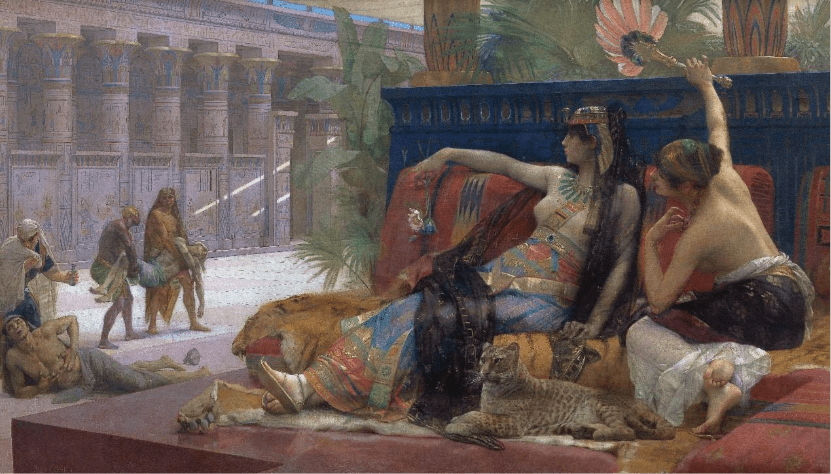
First exhibited in 1887, Cabanel’s Cleopatra Testing Poisons on Condemned Prisoners (also known as Cleopatra) presents a very different version of Cleopatra’s final moments. The details of the scene draw on both the Greek historian Plutarch’s account of Cleopatra’s death and the artist’s own imagination. It offers a brief narrative: Cleopatra tests the efficacy of her poisons on condemned prisoners. In this portrayal, Cabanel adheres strictly to the Academic conventions, evident in the polished layout, the smooth surface with meticulously defined contours, and the idealised representation of his subject. The dim room in Cleopatra and the Peasant is replaced by a well-illuminated palace hall with extravagant ornaments, attesting to the vast wealth that the Pharaoh held. Cabanel also renders his figures, particularly Cleopatra, with picturesque quality. Reclining languidly amidst opulent fabrics, Cleopatra’s regal sensuality is on full display. She wears a gown of intricate patterns and glittering jewels; her breasts are exposed, and her lips are painted in striking crimson. The sumptuous objects surrounding her, from the animal pelt to the leopard, collectively amplify the Pharaoh’s image of extravagance and decadence.
While Delacroix crowns Cleopatra with tragic yet sublime spirits, Cabanel, in an alternative manner, recasts her as a femme fatale—a deadly woman to be both desired and feared. At first glance, the painting is about a cruel scene of death, in which the Pharaoh watches indifferently as the prisoners succumb to her poisons. Yet the Queen herself is also an object of the viewer’s gaze, firstly for the sensualized depiction of her body, and secondly for her perceived moral corruption. She appears as an irresistible temptress, through whom Cabanel warns of the danger veiled in erotic allure: Cleopatra is the ruthless monarch, sly and calculating. This resonates with a number of accounts of her in which she ensnares two powerful Roman heroes (Caesar and Antony) and undermines men’s control over their own domains. This persona is reinforced by the snake sculpture coiled upon her throne. In Cabanel’s vision, the snake symbolises beauty that is cold-blooded and evil—its meaning is opposite to that in Delacroix’s metaphor. The self-made poisons connote witchcraft and deceit. Taken together, these elements frame Cleopatra’s end as far less dignified than the swift, almost ceremonial asp bite. In Cabanel’s hands, her death becomes not a noble act of sovereignty but a tableau of calculated decadence and moral corruption.
In their portrayal of the Egyptian Pharaoh Cleopatra, both Delacroix and Cabanel have used many vehicles in common. These elements include Pharaoh’s appearance, the dramatic finality of her life, and several symbolic objects such as the asp. Yet the visions of the two artists diverge profoundly in mood, narrative framing, and moral implication, resulting in the transformation of Cleopatra from an emblem of noble ruin to a dangerous seductress. Of course, neither of the two paintings offer a truly “authentic” recording of the event; however, they demonstrate the interpretive power offered by the “myth” of Cleopatra. While history provides the raw materials, myths select, amplify, and reconfigure fragmentary facts into narratives that are consumed by future audiences. In Cleopatra’s case, the interplays of historical orthodoxies and intellectual engagements transform each highlighted episode of the Pharaoh’s life, her relationship with the Romans, along with a number of anecdotes, into an open field of mass imagination and recreation. This dynamic might help explain Cleopatra’s perpetual popularity for cultural interpretation. The social contexts and public discourses that shape responses to the Egyptian queen, such as the popular exoticism of the Orient in the nineteenth century, deserve further investigation. Finally, the two artworks remind us of their function beyond pure historical recordings. By integrating their visual languages into a system of signs that has consistently been read, repeated, and reinvented, both Delacroix and Cabanel engaged in a broader dialogue within the “Cleopatra universe” that affects not only their contemporaries but also later generations.
Bibliography:
Fogg Art Museum. David to Corot: French drawings in the Fogg Art Museum. Cambridge, Mass.: Harvard University Press, 1996.
Hughes-Hallet, Lucy. Cleopatra: Histories, Dreams, and Distortions. New York: Harper Perennial. 1991.
Hughes-Hallett, Lucy. “Article: About Cleopatra”. Royal Shakespeare’s Company. 2017. https://www.rsc.org.uk/antony-and-cleopatra/about-the-play/article-about-cleopatra. Accessed August 5, 2025.
Jones, Prudence. Cleopatra: A Sourcebook. Norman: University of Oklahoma Press, 2006.
Jones, Prudence. “Cleopatra VII” in Dictionary of African Biography ed. Henry Louis Gates and Emmanuel Akyeampong. Oxford University Press (2011): 101-104.
Pelling, Christopher. Plutarch: Life of Antony. Cambridge University Press, 1988.
Rifkin, Adrian D. “Ingres and the Academic Dictionary: An Essay on Ideology and Stupefaction in The Social Formation of the ‘Artist’”. Art History 6, no.2 (1983): 153–170. https://doi.org/10.1111/j.1467-8365.1983.tb00803.x
Rodetis, George A. “Delacroix and Shakespeare: A Struggle between Form and the Imagination.” Journal of Aesthetic Education 20, no. 1 (1986): 27-39. https://doi.org/10.2307/3332310.
Royal Museum of Fine Arts. “Cleopatra”. https://kmska.be/en/masterpiece/cleopatra. Accessed July 15, 2025.
Verdier, Philippe. “Delacroix and Shakespeare.” Yale French Studies no. 33 (1964): 37–45. https://doi.org/10.2307/2929588.
Cover Image:
Eugène Delacroix. Cleopatra and the Peasant, 1838. Public domain. Wikimedia Commons. https://commons.wikimedia.org/wiki/File:Cleopatra_and_the_Peasant.jpeg. Accessed July 15, 2025.
Content Image:
Alexandre Cabanel. Cleopatra, 1887. Royal Museum of Fine Arts, Antwerp. https://kmska.be/en/masterpiece/cleopatra. Accessed July 15, 2025.
 Retrospect Journal