
Written by Finley Farrell
19/10/2025
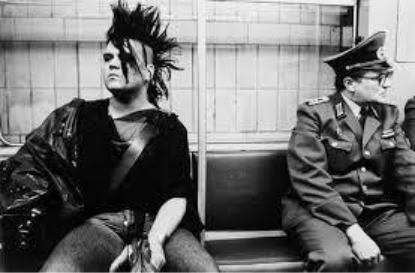
The drama of Punk’s rise and fall lives strongly today in the British cultural memory of the 1970s. Looking across the Iron Curtain, however, the DIY aesthetic, anti-establishmentarianism, and thrashing music found another home in late 1970s and early 1980s Communist East Germany. This small yet loud community co-opted Western punk ideals to suit their own struggles: contradictory education, restrictions on space and movement, and isolating Cold War dichotomies. Study of punk in East Germany has often centred around the oppression faced by the Stasi. This focus on Stasi sources has often discredited the subculture as a purely Western import or common degeneracy, of which it was neither. East German punks emerged due to the dissonance between messages of “existing socialism” and their material reality: rising Nazi skinhead culture, consumer good shortages, and restrictions on areas to socialise, drink, and meet similarly othered youths. Youths in the GDR were uniquely suited to punk ideals due to their already strong communal DIY fashion scene, a clear and oppressive authority and establishment to resist, and a state ideal of a ‘socialist youth’ that was diametrically opposed to rowdy and loud punks. Some West Germans even said when meeting their peers over the wall that East Germans were “the perfect punks.” The recounts from East German punks also show how opposition to the GDR was not necessarily opposition to socialism, or a desire to re-unify. Through the lens of this subculture, it becomes possible to explore the issues that drove Berlin youths to risk disownment, imprisonment, and violence for the love of Punk.
The GDR’s emphasis on the new youth and its potential to, as Walter Ulbricht said in 1952, ‘accelerate [the] construction of socialism’ had by the 1970s evolved into a stricter attempt to build an “all-round developed socialist personality”. Punk, in its alcoholic, violent, and outspoken manner was partly a way out of these tram-tracks, but also a reaction to the longer-term failures in the ambitious GDR education system. Much Western historiography has come across the same issue the Stasi did when analysing GDR punks: if there was no unemployment crisis, and a plethora of schemes pushed upon the youth, why did punk resonate? London Reggae and Punk grew from the contradiction between the Windrush promise of a rebuilt country and the real economic decay. In the same way, East Berlin Punk grew from a contradiction between the rhetoric of classless superiority over the West and material shortages, neo-Nazi growth, and social alienation. It is because of these rhyming dissonances that hearing the Sex Pistols and Ideal was described as “knocking me down so much I never wanted to hear anything else ever again.” The background of East German Punk was hugely varied, linked by a common alienation which ‘should not exist’ in the classless society but became manifest through varying recounts of disownment, queer alienation, disability, abuse from Nazis. To remedy this, Punk seemed perfect. A strong DIY communal culture was already in existence, founded on the pooling of youths’ money to collectively afford the cost of zines, cassettes, buttons, and speakers. Punk’s anti-authoritarianism suited clear clashes with the Stasi, with events shut down and organisers arrested. Politically, the ideals were open enough for East Germans to bend this anti-authoritarianism to suit them, the vast majority being against unification as supporters of socialism but against the normative and punitive measures they had faced. Contrary to what the Stasi and many historians believed, punks “never held the West as a goal or ideal” as a bandmember later said. Finally, London Punk’s focus on communal spaces which stemmed from Reggae’s sound system culture, resonates with the GDR youth’s struggles with restrictions of space, especially in East Berlin.
The restriction of space was a motif in Punk’s establishment and growth in East Berlin. Travel across the wall was essential to the community, to play shows, sell zines, celebrate birthdays, even attend Punk weddings. But spaces to meet within East Berlin were rare, resulting in an unlikely alliance with the Lutheran Church to poke holes in the imposed spatial order. ‘The politics of space’ here examines one dimension of the attempted social order, mapped onto physical areas. The ways Punks found and re-seized social islands reveals the tensions that birthed the Punk scene and the social order it subverted. The Berlin Wall explicitly represented the East/West, Communist/Capitalist dichotomies entrenched on either side, now physically manifest. In this socialisation across the border East Berlin Punks rejected the government’s exclusionary East German identity while maintaining a generally socialist and East-Berlin specific subculture. Punks from both sides of the wall, as one West German remarked, “were not as different as would be expected… lots of hanging out and lots of drinking.” Yet the Punk of East Berlin held its own distinct styles, with differing ways of organising, and political stances due to the vastly different material and social conditions encompassed. They were simultaneously East Berlin Punks, East German Punks, and German Punks. The border crossings and identity sharing represented by a wider trend of sharing Western music undermined the SEC’s policy which tried to create isolation and hatred over the wall. Organising spaces to perform and meet was a struggle for non-conforming Punks, with most social spaces reserved for members of the GDR Youth sector (FDJ) – within which Punks and non-conformists were not welcome. Initially people met on the streets, or in neutral areas of Berlin like Alexander Platz, but this too was politicised. Street fights with Nazis, arrests for public nuisance, and public abuse made these spaces full of the conformity Punks wished to avoid. A solution to which was provided through an unlikely alliance with the Lutheran Church, where shows and meets went on to be staged all over East Germany. These spaces were both non-conformist and politicised, also hosting queer, social justice, and anarchist groups. They also were able to host space for West German bands, recordings, zine circulation, and cultural exchange between groups. This support catapulted the subculture into more active agitation, with members attending protest marches, setting up tours for their bands to other socialist countries, and playing louder and more ambitious shows. However, it also paradoxically triggered greater repression of spaces and pressure on conformity. Some Punk bands survived by leveraging relations between Blocs, but by many East German Punk was proclaimed dead.
Punk in East Germany was a small movement, estimating 1,000 active members and 10,000 sympathisers in 1981, but it offers valuable insight into cultural tensions and unique conditions within the country. These youths latched onto the same rift between top-down governmental ideals and material alienation that Westerners faced, yet on remarkably different terms. These youths used the aesthetics from Western radio, visitors from across the wall, and magazines to mould their own protest and non-conforming identity. The ways in which they went about this show the wider failures in the GDR’s focus on educating a “socialist personality” by the late 70s. The conditionality of space based on membership to GDR youth programs, specifically FDJ, was also a key motivator of Punks to explore new social spaces. The desperation for private spaces, which they eventually found in the Church, shows how restricted access to non-conforming spaces was for alienated youths. This restricted space in East Berlin alongside the frequent cultural exchange and social occasions with West Berliners across the wall, shows the failure from both governments to build distinctive West/East German ideological identities. However, these meeting also show the specificity of East Berlin and East German Punk to their independent conditions. This breaks down the argument that Punk was just a capitalist export, which trivialises East German Punk as simply wanting West German style capitalism. These youths stood for the ‘ethos’ of underground and DIY movements, and in the cultural memory that is Punk, East Germans deserve their own distinct place.
Bibliography
Brauer, Juliane. “Clashes of Emotions: Punk Music, Youth Subculture, and Authority in the GDR (1978-1983),” Social Justice 38, no. 4 (2011): 53-70.
Gerrard, Kate. “Punk and the State of Youth in the GDR.” In Youth and Rock in the Soviet Bloc, edited by William Jay Risch. Lexington Books, 2017.
Hayton, Jeff. “Crosstown Traffic: Punk Rock, Space and the Porosity of the Berlin Wall in the 1980s.” Contemporary European History 26, no. 2 (2017): 353–77. https://doi.org/10.1017/S0960777317000054.
Howes, Seth. “Culture from the Slums: Punk Rock in East and West Germany.” Seminar — A Journal of Germanic Studies 59, no. 3 (September 2023): 308–10.
Mohr, Tim. Burning Down the Haus: Punk Rock, Revolution, and the Fall of the Berlin Wall. Algonquin Books, 2018.
Rodden, John. Repainting the Little Red Schoolhouse. OUP, 2002.
Saunders, Anna. Honecker’s Children. Manchester University Press, 2007.
Featured Image Credit: https://www.punktuationmag.com/the-punks-who-took-on-the-east-german-stasi-and-brought-down-the-berlin-wall/
 Retrospect Journal