
Written By Arianna North Castell
12/10/25
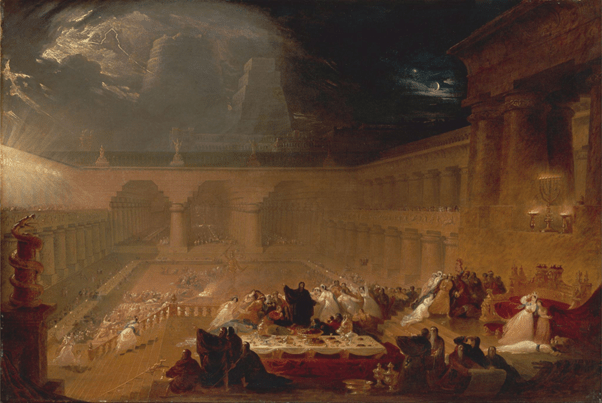
John Martin, Belshazzar’s feast, 1820.
Within the vast, flickering expanse of John Martin’s Belshazzar’s Feast (1820), a world at the brink of destruction swirls. If you look closely, the gold-glinting scene reveals an opulent Babylonian feast. Gilded tables, toppling goblets, faces bathed in a warm glow but frozen in terror. Their eyes are cast in fear to the left, where a spectral hand writes across the wall, gleaming Hebrew letters that refract the shine of stolen relics. They’re unreadable to all but one man, Daniel, who stands at the centre, hand raised, delivering the prophecy. The writing is on the wall—Babylon will fall.
This vision, the exact moment of condemnation born from the Book of Daniel, has haunted artists for centuries. But no two have rendered it quite like John Martin and Rembrandt van Rijn. In their hands, the same story becomes two very different spectacles: one cosmic and cataclysmic, the other, intimate and panic-stricken.
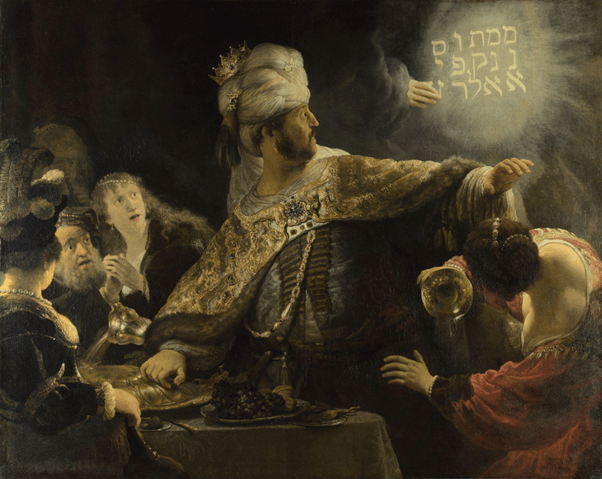
Rembrandt, Belshazzar’s Feast, c. 1635-38.
The Book of Daniel takes place in the 6th century BC but was likely composed around the 2nd century BC in Aramaic. It follows Daniel, a Jewish exile in Babylon, and details his experiences and prophetic visions (the episode of Belshazzar’s feast takes place in Chapter 5). Though much of the narrative finds roots and reflections in real history, its focus is not documentary and leans allegorical and apocalyptic. Details of the text reveal this: Nebuchadnezzar is positioned as Belshazzar’s father, whereas historically this was Nabonidus, and there does not appear to be a historical counterpart for Darius the Mede. A historical account, while intriguing, is not the aim of the text—the morality behind the narrative takes centre stage. Belshazzar’s feast presents a clear warning: hubris leads to divine judgement.
The feast begins with a mood of indulgence and excess—King Belshazzar surrounded by his nobles, boasting of his decadent lifestyle. In his arrogance, he calls for the sacred vessels looted from the Jerusalem Temple to be filled with wine—an act of deliberate desecration. Belshazzar is described as acting “in the taste of wine”. In the Aramaic, this likely does not mean that he was under the influence (and acting impulsively), but rather that the vessels are to be brought to pair with the wine. They are to be used in a pagan manner, for revelry and praising Babylonian idols—a blasphemy that is purposeful. Then a sudden apparition: the glowing “palm of a hand” appears to write on the wall. These mysterious fingers echo the “finger of God” that scribed the covenant tablets on Mount Sinai (Exod. 31:18; Deut. 9:10). However, what Belshazzar sees with terror is not the solitary finger, but rather a disembodied hand. His reaction is uniquely physical—“the knots of his hips loosened” (that is, either he collapses, or he loses control of his bowels), and his knees knock. His fear cannot be kept internal. He calls for his soothsayers (diviners) to interpret, and they fail. The Queen intervenes, calling for Daniel to be summoned. If the writing names judgement, the Queen’s brief role names something softer: memory. She remembers what the Babylonian court has forgotten, either wilfully or haphazardly: Daniel, who interpreted for the late king. Daniel obliges, delivering the prophecy while refusing reward. His words have no price and are divinely sanctioned. That night, Babylon is destroyed and Belshazzar dies. The chapter ends with a startling quiet: no battle scene, only the flat fact of a life and a city weighed and finished.
The moment the prophecy is read, the Babylonians know that there is no hope. Their fate is sealed. To capture that depth of emotion in a snapshot is perhaps what has challenged so many artists to pick up their brushes; the most polarising have to be Martin’s and Rembrandt’s. Martin’s borders on cinema: apocalyptic grandeur, architectural vastness, looming meteorology. Rembrandt’s is almost uncomfortably intimate—a dark, candlelight moment, frozen by fear. Martin provides a macrocosm that one can lose oneself in and become immersed in the moral spectacle, whereas Rembrandt displays a microcosm of moral introspection and genuine human fear. The detailed face of Belshazzar in the latter is perhaps what makes it so famous—the emotions are palpable, and many argue that this makes it more impactful than Martin’s. However, feeling exists even if you must look closely for it, and Martin captures the full depth of a civilisation on the brink of collapse, both physically and emotionally. When you reckon with the scale of the scene, feeling its emotional weight is inevitable.

[Detail] John Martin, Belshazzar’s feast, 1820.
The phrase “the writing on the wall”, meaning an obvious, immovable truth, finds its origin in this scene. Though when the letters appear, they are not obvious to those who read them. Why? It’s unclear whether the writing is in Hebrew or Aramaic, but either way, Belshazzar is unable to read it himself, and his soothsayers are equally perplexed. Only Daniel can decipher the meaning. There are four words written (though, in other versions, the first is not repeated, leaving only three): “(mene), mene, tekel, parsin”. At first glance, it’s three nouns, referring to monetary weights (imagine a list: a pound, then fifty pence, then twenty pence). However, instead of interpreting the letters with their value as nouns, Daniel interprets them in their roots as verbs, literally meaning to number, to weigh and to divide. He explains the meaning to Belshazzar thus: “Numbered: God has numbered the days of your reign. Weighed: you have been weighed on the balances and have been found wanting. Divided: your kingdom has been divided and given to the Medes and Persians.”
Despite the vagueness of the actual words, Rembrandt contributes another layer—more complexity to the script to explain the Babylonians’ inability to interpret it. Firstly, he chooses to use Hebrew script (instead of Aramaic, the main Babylonian language). He lived in the Jewish Quarter of Amsterdam, and was said to have consulted Menasseh ben Israel, a Rabbi and printer, to ensure the Hebrew was correct. However, the text contains errors, and many believe them to be intentional. One of the letters is mis-transcribed, and they are arranged in columns, rather than the Hebrew right-to-left. The Talmud (later rabbinic commentary) suggests the script was rearranged to confuse the Babylonians, and Rembrandt brings this to life.
Numbered, weighed, divided is brutal and cutting, but its force is emotional: awe, dread, and the thinness of pride. Martin makes the consequences vast—the architectural choices are steeped with what is to be lost: the Hanging Gardens of Babylon, a ziggurat, loom in the shadows of the painting. Rembrandt makes it private—terror written in a pupil’s shine and the gleam of spilling wine.

[Detail] John Martin, Belshazzar’s feast, 1820.


[Detail} Rembrandt, Belshazzar’s Feast, c. 1635-38.
In both paintings, time stands still. We gaze upon the exact moment of realisation and terror, and it draws us in. What is it about the figures, toppled in dismay, visible by their glinting jewellery, that pulls us deeper into Martin’s vast scene? What is it about the eyes, wide with fear and illumination, that makes us lean closer to Rembrandt’s canvas?
We can almost step into the minds of the artists as they turned the biblical text over before putting brush to surface. Martin, painting in the early nineteenth century, might have felt the enormity of a civilisation on the verge of collapse. In an age of political and social unrest across Europe, that sense of impending ruin must have struck close to home. Rembrandt, centuries earlier, may have imagined something smaller and more personal: how it feels to have one’s fate read aloud, so absolute and unchangeable that even light itself seems to recoil.
Each artist reflects a different kind of fear—one collective, one individual—yet both are guided by the same ancient words. They use the biblical story not as decoration but as compass, grounding their visions of ruin and revelation. In doing so, they never lose sight of what makes the tale endure: the moment of recognition itself. That instant when spectacle collapses into consequence, and conscience—whether belonging to king, painter, or viewer—is finally weighed.
Images
Rembrandt Harmenszoon van Rijn. Belshazzar’s Feast. ca. 1635–1638, oil on canvas, 167.6 × 209.2 cm. The National Gallery, London. Wikimedia Commons,
https://commons.wikimedia.org. Accessed 25 Sept. 2025.
John Martin. Belshazzar’s Feast. 1820, oil on canvas, 90.2 × 130.2 cm. Yale Center for British Art, New Haven, CT. Wikimedia Commons,
https://commons.wikimedia.org. Accessed 25 Sept. 2025.
Bibliography
The Bible Project. The Book of Daniel, Chapter 5. New Living Translation,
https://bibleproject.com/bible/nlt/daniel/5/. Accessed 25 Sept. 2025.
The Talmud. “Sanhedrin, Chapter 2, 22a.” Chabad.org,
https://www.chabad.org/torah-texts/5457980/The-Talmud/Sanhedrin/Chapter-2/22a. Accessed 1 Oct. 2025.
Widder, Wendy L. “What Does ‘Mene, Mene, Tekel, Parsin’ Mean?” Zondervan Academic Blog, 4 Oct. 2018,
https://zondervanacademic.com/blog/mene-mene-tekel-parsin. Accessed 26 Sept 2025.
Seow, C. L. Daniel. Louisville: Westminster John Knox Press, 2003, pp. 74–83.
“Aramaic Word Study: The Party’s Over (Mene Mene Tekel Upharsin).” Chaim Bentorah Ministries, 3 Aug. 2022, https://www.chaimbentorah.com/2022/08/aramaic-word-study-the-partys-over-mene-mene-tekel-upharsin/. Accessed 1 Oct. 2025.
“The Story in Paintings: Belshazzar’s Feast.” The Eclectic Light Company, 22 Mar. 2016,
https://eclecticlight.co/2016/03/22/the-story-in-paintings-belshazzars-feast/. Accessed 1 Oct. 2025.
 Retrospect Journal