
Written By: Abby Hughes
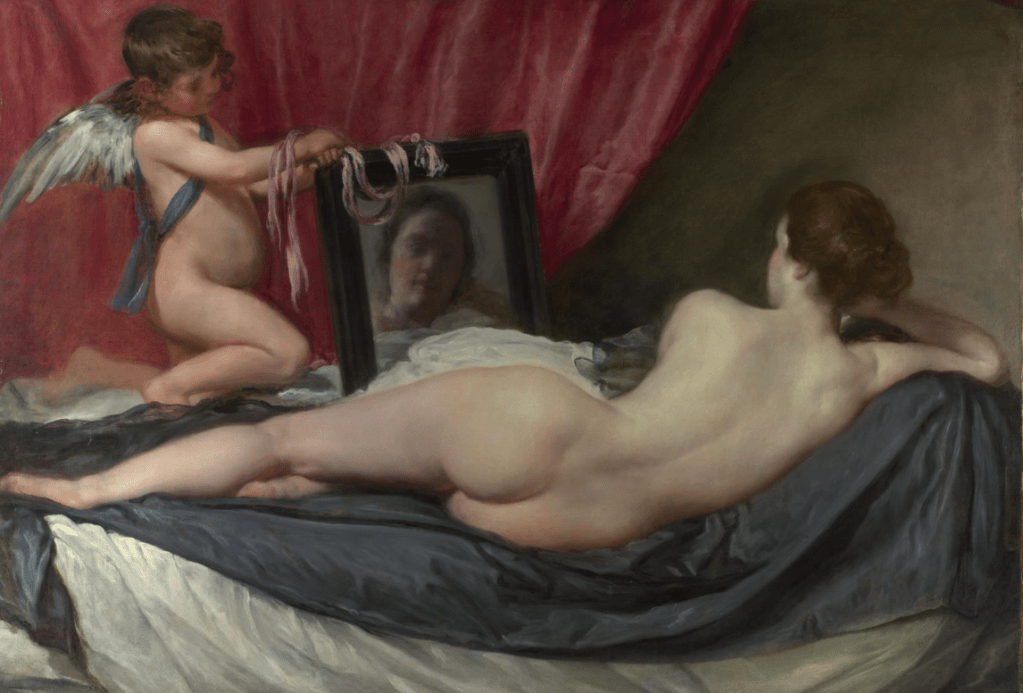
On a Tuesday in March 1914, Canadian suffragette Mary Richardson strolls into London’s National Gallery. With a slow-moving purpose, she works her way through the crowd, standing still at last before Diego Velazquez’s Rokeby Venus. Across from her lay the reclining nude lounges on plush satin sheets, gazing vaguely back through a fogged mirror. Richardson does not ponder the image long. She reaches beneath the folds of her coat and plants the blade of a meat cleaver right between Venus’ painted shoulders. The thud of a knife through canvas stirs an uproar in the gallery, and Richardson finds herself restrained by a riotous crowd but not before she has slashed through the painting seven times over.
This was not the first time Velazquez’s last surviving nude had been the subject of controversy. At the time of its painting, in mid-seventeenth century Spain, the nude was a highly contested art form – the female nude in particular. Velazquez himself was drawing on a rich history of artistic practice. The nude had been a celebrated art form for centuries, with particular popularity under the brush of sixteenth-century artists Titian and Rubens, whose own depictions of Venus reflect a rich, classical tradition. However, created in the midst of the Spanish Inquisition, the Rokeby Venus found itself in an active and fraught debate on the art’s purpose within society. While some Spanish nobility enjoyed private collections that celebrated the nude genre, King Philip IV, notably Velazquez’s patron, and others campaigned vehemently for its condemnation. To some, depictions of the nude form were a mortal sin, stirring viewers to lust. Perhaps even more concerning in this case is the classical symbolism of the mirror; not only is Venus a naked woman, but she is a naked woman who appears to be viewing and even enjoying her own nakedness. The suggestion that a woman could recognize and employ her own sexuality was often regarded with careful apprehension, if not open distaste. Poet and preacher Fray Hortensio Félix Paravicino went as far as to propose the destruction of all nude paintings. A connoisseur of art himself, he believed that power lays in visual icons, stating “the finest paintings are the greatest threat: burn the best of them.” Despite this vivid controversy, the Rokeby Venus survived through the seventeenth century and was eventually moved to the UK, where it would find itself in the National Gallery, at a similarly tumultuous time when British suffragettes ran bold campaigns for women’s right to vote.
The Rokeby Venus was swiftly and skillfully repaired to a point where no suggestion of the slashes now remains. Meanwhile, Mary Richardson was sentenced to six months in jail for her outburst; the maximum sentence afforded to art vandals. She would defend her actions to The Times newspaper, stating “I have tried to destroy the picture of the most beautiful woman in mythological history as a protest against the Government for destroying Mrs. Pankhurst.” In a visceral response to the recent arrest of prominent suffragette, Emmeline Pankhurst, Mary Richardson had jumped into action, attacking the Rokeby Venus to direct attention towards the campaign for women’s vote. However, this might not have been the sole motivation behind her destructive act. Richardson would later expand on the motives behind her iconoclasm. In a 1952 interview, she noted that she “didn’t like the way men visitors gaped at the painting all day long.”
Many have since lauded Richardson for her bold, sacrificial act in the name of feminism, while others have critiqued her brutality towards a universal cultural heritage. What are we as an audience to make of Venus? Does she stand in place for women everywhere, as critic Natasha Wallace has argued, given her softly blurred face? Or does she make for an exemplar – the ever-elegant and constantly posed goddess that women everywhere should be compared to? Is she painted in a private moment, admiring herself in the confines of a satin-clad room which we voyeuristically impose ourselves on? Or is she aware of us, her dark eyes catching ours through the fogged mirror as she awaits our inevitable judgement of her elegance and beauty? The answer, of course, depends on the viewer sitting before her.
There is a sympathy, perhaps, in Richardson’s revised motive, which might suggest to us that early 20th century women looked pitifully at Venus as a woman doomed forever to lie in wait for her next male admirer. In their struggle to attain a measure of political independence and be recognized as autonomous social actors, we can suggest a parallel between the suffragettes and the static Rokeby Venus. If, as Richardson had argued, Venus was created and lived solely to be leered at by her male audience, then perhaps we can interpret her cleaver not as an iconoclast weapon but as the brute force needed to free yet another prisoner of stringent social convention.
The question of whether iconoclasm can ever be justified or indeed be the preferred course of action in the name of social advancement, remains an avid debate. In 2023, the Rokeby Venus was once again the subject of iconoclastic attention when Just Stop Oil activists broke the screen of its protective glass in protest against Oil and Gas contracts in the U.K. No permanent damage was done to the piece itself, which continues to stand as a controversial centerpiece while the debate around it forever shifts with the times.
Certainly, I now see one thing only when looking at Velazquez’s masterpiece. The image of seven neat gashes dotted about the slope of her back. The knowledge of the piece’s history itself transforms the image from an example in a larger artistic tradition to a symbol of iconoclasm. To some, the Rokeby Venus now prompts a question: how far are we required to engage with the art, which is not only reflective of but constructive to the world we live in?
Bibliography
Bull, Duncan and Harris, Enriqueta. “The companion of Velázquez’s Rokeby Venus and a source for Goya’s Naked Maja”. The Burlington Magazine, 1986
Portús, Javier. Nudes and Knights: A Context for Venus, in Carr, Dawson. “Velazquez”, 2006
Prater, Andreas. Venus at Her Mirror: Velázquez and the Art of Nude Painting. Prestel, 2002.
Wallace, Natasha. “Venus at her Mirror”. JSS Virtual Gallery, 2000.
Featured Image Credit: Diego Velázquez, The Rokeby Venus, c. 1647–1651. Oil on canvas. The National Gallery, London
 Retrospect Journal