
Written by Harry Child
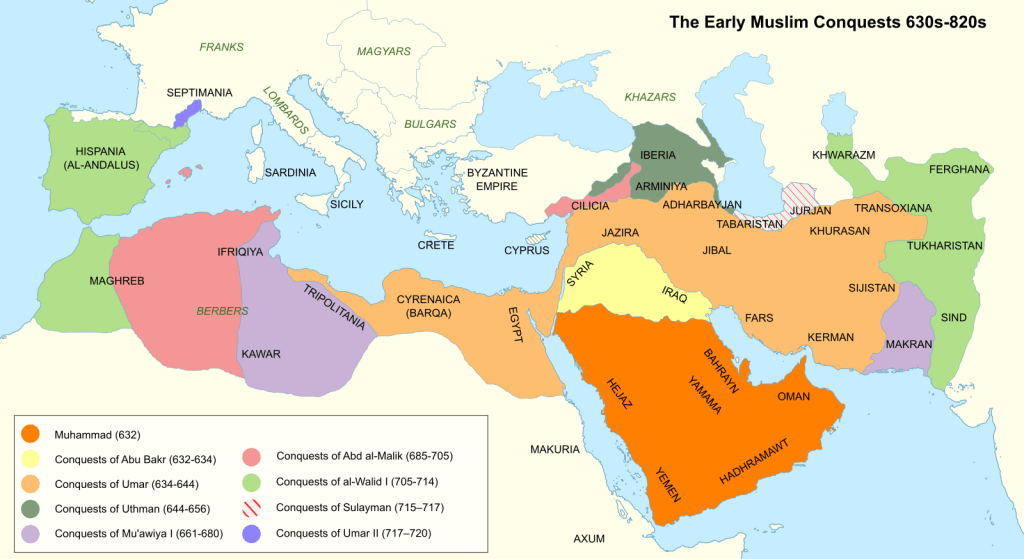
I think that when we in the West envisage the Arab conquests and the subsequent Islamic world that emerged from them, we see them in very negative terms – a brutal force seeking to stamp out Christianity. This is at least the popular image that events like the Crusades present, and even a bit earlier, Charles Martel’s defeat of the Arab forces. However, at the same time, there is a growing perspective that seeks to challenge this negative portrayal, one that presents the conquests and the Islamic world they created as developing, in their own right, a global centre of exchange and idea development. My article here is not designed to be novel; I am not trying to purport a new way of understanding the Arab conquests and the medieval Islamic world, as other scholars have pioneered this. However, what I would like to do here is present why I buy into this perspective, using two case studies that have fascinated me: the invention and migration of paper and medical knowledge. It is about time, in my view, that we complicate our narrative in the West of this society, especially of the Arab conquests, and start seeing them holistically rather than our current narrow, negative focus.
My inspiration to write this came from a lecture which completely transformed the way I view history. Last year, as part of my first year at university, I had the privilege of attending a lecture on the ‘Mongol World Empire’. Previously, I had simply seen the Mongols as this barbarous force who were solely intent on destruction and the expansion of their empire. However, what this lecture did was present me with another perspective on this world. Yes, the Mongols were invaders, but the vast empire they created also allowed for a certain degree of stability. By creating a massive landmass, all under the same or similar rule, that stretched across the world, it enabled ideas to flow from the East to the West and vice versa, a centre for global exchange. Subsequent reading has brought me to the same conclusion as this regarding the Arab invasions and the Islamic world in the Early-to-High Middle Ages; undoubtedly, there was significant violence, but the extent of these conquests enabled the Islamic world they created to be in contact with many diverse societies across the East and West. Consequently, it too became a global centre for exchange and, alongside its high cultures, a centre of idea preservation and development.
The Islamic World as a Centre for Global Exchange: The Invention and Migration of Paper
Anyone want to hazard a guess where paper was invented? If you said China, you would be correct.
Paper first appeared in second-century China during the Han dynasty, where it is said that a eunuch at the court of Emperor He discovered the paper-making process. The eunuch had realised that he could take old bits of plant matter – particularly bamboo, but occasionally old bits of rag and textile too – boil it up, pulverise it into a paste, then stretch it out like a canvas and leave it to dry, forming a large sheet of what can accurately be called paper. It was not until the twelfth century that the first paper-making facility developed in Latin Christendom. Rightfully, you might be asking: Why did it take so long, and who brought it across? Well, in both cases, the answer is the Arab conquests and the subsequent Islamic world.
In his enthralling book about the dynasties of China, Bamber Gascoigne tells us that papermaking had developed in many of the other East Asian regions outside of China before the mid-eighth century, although not yet much further west. However, this was all about to change, for in the eighth century, as Gascoigne attests to, the Chinese met their military match: the Arab conquerors, moving eastwards from their centre in the modern Middle East. For context, the then-Tang dynasty in China sought to expand its borders, gaining authority over more kingdoms in Central Asia, and getting as far as the Talas River in modern-day Kyrgyzstan, where it met the Arab forces coming the other way. What ensued was the Battle of Talas.
The battle was brought on after the King of Ferghana (a Central Asian kingdom) requested the assistance of the Chinese in dealing with his neighbour, the Kingdom of Shah. Subsequently, the kingdom of Shah was besieged by the Chinese, who killed its king. This led to members of the kingdom fleeing east to the Abbasid court (which at the time governed the Islamic Empire) and requesting help, which was duly sent. The Chinese were ultimately overwhelmed when the Abbasids launched a direct attack on them, which was devastating as they were also dealing with their allies, the Qarluq Turks, who had turned on them. Defeat was just a matter of time.
So, the Abbasids won. In this victory, they took prisoners from the Chinese ranks, including papermakers. This brought the paper-making process into the Arab world, the result of which was the gradual movement of the process across the Islamic territories over the succeeding four centuries, with it passing through their empire, presumably across North Africa, up the Iberian peninsula and into modern-day France, the South of which saw the first paper-making facility in Latin Christendom.
Consequently, the extent of the Arab conquests and the subsequent Islamic world they created provided an area over which developments that had happened in the East could be brought over to the West, as is most evident in this case study of paper. Hence, the Arab conquests can be seen as a force that brought about greater exchange throughout the known world in the Middle Ages, with the Islamic world they created at the centre of this.
The Islamic World as a Centre for the Preservation and Development of Ideas: Medical Knowledge
The Arab conquests and the Islamic world they created were also significantly involved in the preservation and development of medical knowledge during the Early-to-High Middle Ages. In antiquity, scholars like Galen, and even before him, the likes of Aristotle, wrote down medical knowledge and interpretations that were then applied in the ancient world. However, during the period that followed the fall of Rome in the West, these texts were largely lost, or perhaps ignored, though there were some exceptions. However, as William Bynum points out, these texts were not lost in the newly formed Islamic world.
Bynum indicates that a lot of the texts of antiquity, or at least copies of them, ended up in the Eastern Roman Empire and Byzantium. As the Arab conquests began to take more territory from this empire over the course of the Middle Ages, these texts were translated and used by the new Islamic world, keeping the written medical tradition alive much more so than what was seen in the West, with the original Latin versions being translated, for example, into Arabic.
However, Bynum illustrates that this was not just the preservation of such ideas, but that Islamic scholars actively developed the ideas that existed within them, coming up with their own theories. He gives the fascinating example of Rhazes, who was the first to highlight, in his writings, the difference between smallpox and measles.
It was these texts that the Islamic world had translated en masse that then formed the basis of their renewed interest in the West, particularly when the texts began to be translated back into Latin for Western use, with Bynum suggesting that it was such re-translations that informed the first medical schools that emerged in Medieval Europe.
It only seems fair to judge, therefore, that the Arab conquests which created this Islamic world were, through the paradigm of medical texts, forces for the preservation and development of knowledge in the Middle Ages. Not only did they preserve through translation what had been written before, but they also applied their own understandings to the subject, arguably developing the medical tradition significantly, especially that which emerged in Europe in the later years of the Middle Ages.
Concluding Thoughts
I hope that if you take anything away from this article, it might be an increased interest in the Arab conquests, the Islamic world, and their role in the wider history of the Middle Ages. I hope that through these two case studies, you can see that the Arab conquests, whilst undoubtedly violent, created a world that connected the East to the West in a much more thorough way, allowing for the exchange of technology to occur, such as paper. Equally, through the large extent of this empire and the high cultures that emerged within it, the Arab conquests formed a world that was a centre of idea preservation and development, as the case study into medical knowledge attests – something which would become fundamental for Western thought on the subject. As I reiterate here, this perspective is far from an original one, but by writing this article and putting my present perspective on this topic into words, I hope to have presented why I buy into these ideas. I also hope, perhaps, that if you have read this, you might be interested in looking further into the subject.
Bibliography
Ali, Adam. ‘The Battle of Talas’, on Medievalists.net, retrieved from: https://www.medievalists.net/2020/02/battle-talas/.
Bynum, William. History of Medicine: A Very Short Introduction, (Oxford: Oxford University Press, 2008).
Gascoigne, Bamber. A Brief History of The Dynasties of China, (London: Robinson, 2003).
Hotson, Howard. ‘The ancient papermaking process’, on cabinet, (2019), retrieved from: https://www.cabinet.ox.ac.uk/ancient-papermaking-process.
Matheou, Nik. ‘The Mongol World Empire’, lecture given on Medieval Worlds: A Journey through the Middle Ages (2024-2025) at the University of Edinburgh. [NOT AVAILABLE PUBLICLY].
Sandbrook, Dominic, and Holland, Tom. ‘Warlords of the West: A Clash of Ice and Fire (Part 3)’, on The Rest is History, (2024), retrieved from: https://open.spotify.com/episode/1XA6dVVKhRR6fkgBgjKQ5Z?si=dOxR_7nDSfOA-EZc5HBUQQ&nd=1&dlsi=333dd90c65ff4c5b.
Featured image credit: The extent of the Arab conquests between the 7th-9th centuries, by Amitchell125, 2023, retrieved from Wikimedia Commons: https://commons.wikimedia.org/wiki/File:The_Early_Muslim_Conquests_630s_to_820s.svg.
 Retrospect Journal