
Written by Eva Beere
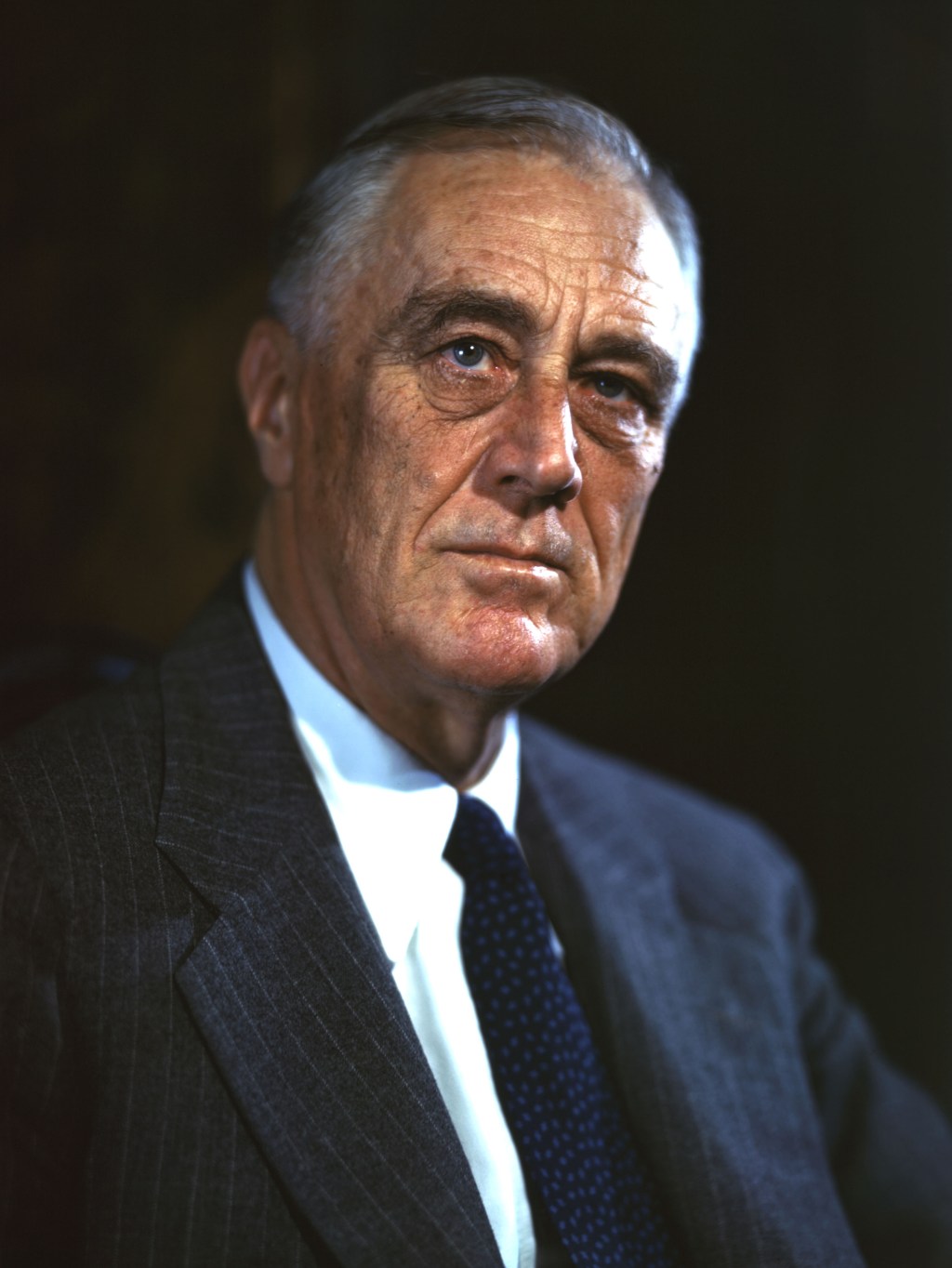
The longest tenure in American History was held by a man named Franklin Delano Roosevelt (FDR), who came to office amid a national economic depression and left behind a legacy as one of the most effective wartime Presidents.
FDR’s presidency can often be split into two sections: pre- and post-1939. Undeniably, Hitler’s invasion of Poland in September created a systemic shift across Europe, yet this also signalled a significant change in American foreign policy, as FDR abandoned America’s neutral position in international affairs and began to prepare for the nation’s potential involvement in the war against Germany.
In the early years of his administration, FDR’s approach to international affairs mirrored that of his predecessor, Herbert Hoover. During World War I, Hoover played an active role in America’s domestic relief effort, particularly after American intervention, when he oversaw the shipment of more than £5 billion in food and supplies to American soldiers. This instilled in him a pessimistic view of European relations, prompting his ideology, ‘pacifism if possible, isolationism if necessary.’ Although Hoover agreed with Wilson’s principle of spreading capitalism and diplomacy across the world, he believed that Hoover had been overly optimistic in America’s capabilities, and that America should proceed with caution when engaging in overseas efforts.
Therefore, when FDR won the presidential election in 1932, he inherited a generation of politicians, as well as a nation, that was geared towards pacifism. His adherence to his predecessor’s policies was reflected in his first term. During his first year at the London Disarmament Conference, FDR declared that the US would make no commitment to using armed force to settle disputes, leading to the Neutrality Acts of 1935 and 1937, which prohibited the sale of weapons and lending of money to countries at war. Along with the administration’s efforts to pursue a more cautious and detached approach to overseas military campaigns, public sentiment had shifted in favour of non-interventionist policies. For example, a 1937 poll concluded that seventy-one per cent of Americans thought US intervention in World War I had been a mistake. This demonstrated the overwhelming desire in America to protect US interests and security against the violence and aggression building in Europe.
However, after Hitler invaded Poland in 1939, a cleavage formed between the nation’s sentiment towards American foreign policy and Roosevelt’s own personal beliefs. Roosevelt had always been a particularly deceptive character. In the summer of 1921, FDR suffered from a severe bout of polio, leaving him partially paralysed. Nevertheless, Roosevelt retained the image of a strong politician, often relying on an aide to help him stand upright when making public appearances. Yet, in the wake of Hitler’s invasion. FDR’s deceptive techniques began to extend before his own personal health.
Although FDR had reassured the American public that there were no plans to intervene, he began to steadily increase America’s involvement. For example, after France fell to Nazi rule, Roosevelt sent the UK fifty destroyers in exchange for military bases in the Western Hemisphere, violating the Neutrality Acts he had signed less than five years before. Furthermore, in May 1941, Roosevelt declared an ‘unlimited national emergency’ and in July of the same year, he sent four thousand Marines, without congressional approval, to Greenland and Iceland, in an attempt to prevent Nazi takeover. This not only signalled a retreat from Hoover’s policies, but also from Wilson, who had consistently maintained the position that the US had little personal motivation to become involved overseas.
In fact, Roosevelt had been playing a cunning waiting game. Roosevelt knew that to enter the war, and thus survive his presidency, he would need public approval. Therefore, as Hitler began to occupy more territory in Europe, such as France and Denmark, he attempted to convince the public that Germany was an encroaching threat to American security, whilst waiting to intervene until a moment came that would make this threat undeniable to the American public.
This moment came in December 1941 when Japan attacked the US naval base of Pearl Harbor, resulting in the death of 2,403 American servicemen and women. Pearl Harbor was the deadliest attack on US soil that the nation had ever seen and perfectly exemplified what FDR had been trying to convince the public: that Germany and its allies were a threat to American security. Therefore, by waiting until an attack like Pearl Harbor, FDR could then justify American intervention, which he had been planning since 1939.
In his book The Icarus Syndrome, Peter Beinart identified the main difference between the presidencies of Wilson and FDR; the former’s was plagued by a hubris of reason, whilst the latter’s was built on the hubris of toughness. FDR viewed Wilson’s presidency as more of a cautionary tale than an example to follow, arguing that reason could not be used to rebuild Europe after an unreasonably horrific global war. Instead, FDR envisioned a world built on power, where the main global powers enjoyed their own spheres of influence. Thus, in August 1941, off the coast of Greenland, Churchill and Roosevelt formulated an ‘Atlantic Charter’ which declared that the US and UK should ‘police the world themselves.’ Along with establishing peace after the Nazi defeat, the Charter also sought to restore self-government in countries where this had been forcefully removed and promote the disarmament of nations.
As the war raged on, FDR began to expand his idea of the Atlantic Charter, envisioning a postwar United Nations. This vision is interesting regarding FDR’s relationship with the Soviet Union. Wilson had left US-Russian relations particularly sour, whereby he viewed the overthrow of Kerensky and the establishment of a Bolshevik government as the complete antithesis of American democracy. Despite William Bullitt’s offer of a peace treaty, this was rejected by Wilson, prompting the start of sixteen years of non-recognition of the Russian Bolshevik government by the US.
This hostile period was ended by Roosevelt as soon as he took office, in a bid to establish diplomatic relations with the Soviet Union. This move was motivated mainly by hopes that the USSR could serve US strategic interests by limiting Japanese expansionism in Asia.
Where Roosevelt began to diverge from previous presidents was his recognition, after the Tehran conference in 1943, that the Soviet Union’s power could not be ignored, and thus to create a peaceful post-war Europe, the US had to recognise, rather than fear, their influence. So, instead of continuing with the hostile relations which had existed between successive American presidents and Stalin, Roosevelt struck up a close personal relationship with the Soviet leader, allowing for a collaboration to end the war. At the Tehran Conference, the date of the D-Day invasion was agreed upon as 6 June 1944, and the Russians allowed the US to establish three air bases in Ukraine, thereby after bombing German targets, American pilots would land in Ukraine, and then bomb Germany on their way back to their home bases.
From here emerged the Four Policeman theory, a vision which clearly envisioned spheres of influence, where Britain controlled Western Europe, the Soviet Union controlled Eastern Europe, America helped guard the West and Pacific, and China controlled the mainland of Asia. This organisation would emerge after Germany’s defeat, alongside a larger organisation consisting of thirty-five members of the United Nations, allowing peace to be achieved through an overwhelming force and alliance of the global powers.
As one of the primary architects of the United Nations, FDR established the importance of international alliances, particularly with Russia, and acknowledged how force was still an important element of maintaining global peace. Although FDR departed from Wilson’s neutrality principle, the two presidents’ approaches to foreign policy held the same undying principle: that the US was an exceptional nation that had the power and skills to bring peace to Europe.
On 12 April 1945, FDR died from a brain haemorrhage, and Truman was sworn in later that day. Truman’s presidency would prove a disaster for US-Soviet relations, reversing his predecessors’ efforts to collaborate with Stalin’s growing paranoia around spheres of influence. Under Truman, American foreign policy advisors would shift from a World War II outlook to a Cold War mindset, which, by ignoring the basic facts, would allow them to justify their aggressive approach to relations with the Soviets.
Bibliography
Beinart, Peter. The Icarus Syndrome: A History of American Hubris. New York: HarperCollins, 2010.
Cross, Graham. “Franklin D. Roosevelt and US Foreign Relations.” Oxford Research Encyclopedia of American History. 29 May. 2020; Accessed 30 Sep. 2025. https://oxfordre.com/americanhistory/view/10.1093/acrefore/9780199329175.001.0001/acrefore-9780199329175-e-741.
Imperial War Museums. “What Happened at Pearl Harbor?” IWM. Accessed September 30, 2025. https://www.iwm.org.uk/history/what-happened-at-pearl-harbor
Zoellick, Robert B. America in the World: A Definitive History of U.S. Diplomacy and Foreign Policy. New York: Twelve, 2020.
Featured Image Credit: By Leon Perskie – Flickr (FDR Presidential Library & Museum) – Info – Pic, CC BY 2.0, https://commons.wikimedia.org/w/index.php?curid=171293476
 Retrospect Journal