
Written by George Jefferson
In my (so far slightly limited) interaction with ancient Greek professors, the ’emergence of the hero’ always comes up. It is an interesting topic; would human societies consistently create fictional (or at least fictionalised) heroic figures?
What is even more interesting to me is the way that ‘the hero’ evolves over the course of Greek mythology. It is a slow, subtle shift, away from purity and strength and towards cunning and trickery. This can be seen in a number of ways—maybe what is most interesting is that the distance between the hero and the gods grows at the same time.
For example, Perseus is widely considered to be the first hero. His mother, Danaë, conceived with Zeus (who at the time was a puddle of golden rain) the first true demigod. Perseus grew up to be strong, fast, smart and handsome; honest, clear and true. A bit of a boy scout, really.
And he only killed monsters.
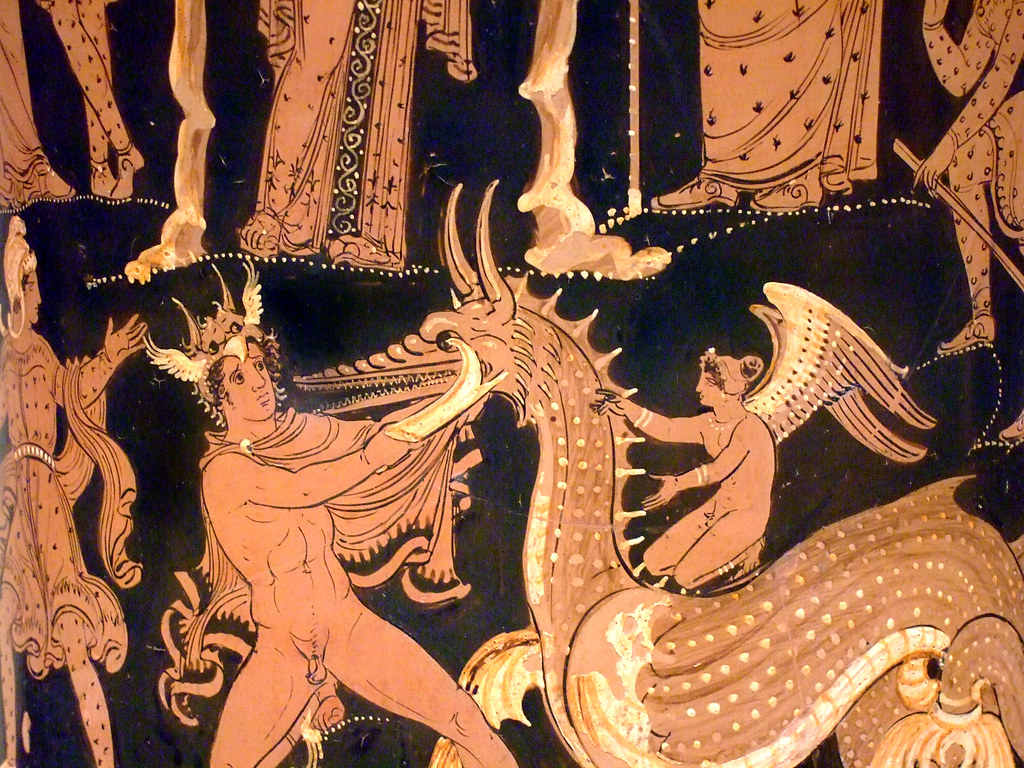
Medusa—walloped her head off. The Gorgons—indisposed, looking for their shared bits. Cetus, the terrible sea creature sent to kill Andromeda, turned to stone by the aforementioned severed head.
And yes, he killed people, I hear you cry. He killed Phineus! Polydectes!
But these people were cartoonish villains. They were as evil as the snake haired ladies, with no redeeming or understandable features, and that makes them monsters. Grotesque caricatures, not relatable people.
But Odysseus, arriving all those years later after Herakles, Jason, and Theseus, was a different beast. He was no stronger than your average hoplite. In fact, he was a far cry from his more able colleague Achilles.
He was not rich in any noteworthy way, and he did not have sandals that let you fly or caps that turned you invisible. In fact, it is worth noting that the gods are far more absent from the Iliad and the Odyssey than earlier myths. Odysseus himself could not even claim divine parentage (however, his grandfather was the son of Hermes, so some points there).
This is evidence of the shift in zeitgeist among the ancient Greeks. Odysseus was not renowned for his strength. Instead, it was his intelligence which made him popular, both to real ancient Greeks and to his patron goddess, Athena.
He was spiteful, too. Now, human flaws are very apparent in the hero. He has a personal agenda and personal vendettas with anyone who interrupts it.
Take poor Palamides, for example. He just ticked Odysseus off and got killed for it.
This might sound pointless, but I think it is strikingly relevant today. The growth and change of the hero could easily be said to represent man’s desire to transcend limits, with the gradual process of fearing nature, accepting nature, questioning nature, then challenging and rejecting nature, all to ultimately beat it.
What would the Greeks think if they knew we had gotten to the Moon? Would Homer be inspired to write some kind of, say, ‘Space Odyssey’? (Sorry.)
The Greeks, whether knowingly or not, captured man’s ascent from an internal being, controlled by and fearing of the natural order (characterised through the gods), to being essentially gods themselves: removed from the food chain, forming the way the world looks, being able to travel great distances, building great monuments, and overcoming anything.
Perseus set us on this journey by becoming more than what he necessarily believed he could be: a hero. But Odysseus showed us that the limits for growth just are not there.
Featured image credit: “Ritual Water Jar (loutrophoros) with Perseus Battling the Sea Monster Ketos Greek made in Apulia South Italy 340-330 BCE Terracotta (1)” by mharrsch is licensed under CC BY 2.0.
 Retrospect Journal