

Written by Elizabeth Hill
13/10/2025
In 1987, Margaret Thatcher declared, “there is no such thing as society” – a sentiment that, after eight years of her policies, certainly rang true. Her radical conservative agenda brought immense social and economic upheaval, especially in industrial areas of the North. Yet nowhere was her government’s impact more keenly felt than in Manchester’s music scene. Bands such as Joy Division, The Smiths, and The Stone Roses mark chapters in the North West’s history that are unmistakably shaped by Thatcher’s policies. In many ways, Manchester became the perfect environment for a distinctive, oppositional musical culture to emerge amid socioeconomic depression and political neglect. The Smiths’ politically charged lyrics and Joy Division’s bleak, desperate sound would be nothing without their geographic origins, not to mention The Stone Roses’ later sense of rebellious optimism reflecting the disillusionment of a generation staring down a collapsing world order in 1989. None of these bands would have resonated so powerfully – or found such success – without channelling, resisting, and seeking escape from the grim realities of Thatcherism. They carved out a cultural identity for the North West in defiance of the London-centric society Thatcher so passionately sought to dismantle.
Thatcher’s Britain was full of harsh realities; on one hand her socio-economic policies – including the dismantling of the welfare state, the rise of privatisation and the introduction of free-market economics – reshaped the nation. On the other, deep social and cultural tensions ran parallel. Mounting nuclear anxieties, skyrocketing unemployment (with those affected dubbed ‘Maggie’s Millions’), race riots across the country, and perhaps the most striking symbol of Thatcher’s impact: the 1984 miners’ strike.
Given how disproportionately Thatcher’s policies affected young, working-class men in the North, it is no surprise that this generation would come to define 1980s culture through their music What other outlet could capture the alienation of a ‘perpetually depressed’ North if not art? This cultural climate made the 1980s, the “most politically volatile period in the history of music”, with Thatcher serving as the primary target of artistic criticism. No other Prime Minister has provoked as many commercially successful songs attacking them by name – a legacy that endures as recently as 2024, with Fontaines D.C.’s “Favourite”. The already widespread disenfranchisement and rising political unrest of the late 1970s, exacerbated by the introduction of Thatcherism, created musical subcultures that opened political discussions unprecedented ways. Alienation became not just a theme but an aesthetic, as communities fractured and the government appeared ever more distant. No band captured this more starkly than Joy Division.
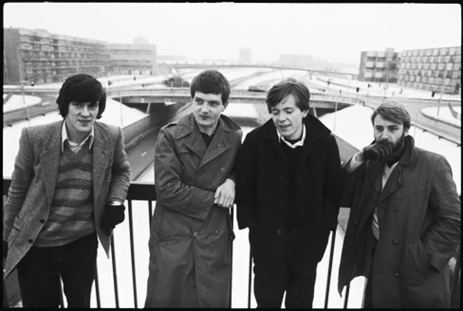
Joy Division, shot by Kevin Cummins, January 1979
Joy Division’s bleak soundscapes at the beginning of the Thatcher era, encapsulated the stereotype of the “miserable” North in a romanticised, existentialist black-and-white image. In January 1979, Kevin Cummins immortalised the band through intense, apocalyptic imagery that captured the industrial and mental decay of the era just as decisively as their music. They became emblematic of the outsider: the alienated, emotionally repressed working-class man who defined much of Thatcher’s disaffected youth. Their sound aligned with the rise of broody and goth subcultures and resonated with those disillusioned by both the Winter of Discontent under Callaghan and the looming arrival of Thatcherism.
Cummins’ imagery, as described by The Telegraph, as evoking ‘connotations of a bleak Eastern Europe’ – offered no optimism for either the Callaghan present or the Thatcherite future. In retrospect, it acted as a stark foreshadowing of what would culminate in the late 1980s, alongside Thatcher’s political downfall. Joy Division’s success, particularly with the emotional poignancy of Love Will Tear Us Apart following Ian Curtis’ suicide in May 1980, firmly established Manchester, in contrast to London, as an alternative music capital with its own distinctive sound and cultural landscape.
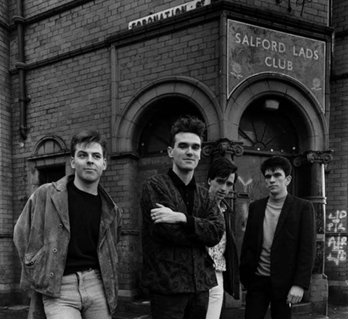
Steven Wright, The Smiths’ ‘The Queen is Dead’ inside cover
In 1983, The Smiths emerged as an aesthetic rejection of the new pop scene that was increasingly dominated by “smug, narcissistic London style-mongers”. With a persona defined by awkward sincerity and the band’s very name, evocative of white, working-class English identity, positioned them as champions of the “ordinary man.” Their lyrics were bitter and lamenting, expressing loneliness, disillusionment, and frustration at the state of the country. In Still Ill (1984), Morrissey sings:
I decree today that life
Is simply taking and not giving
England is mine, it owes me a living
But ask me why, and I’ll spit in your eye
Oh, ask me why, and I’ll spit in your eye
But we cannot cling to the old dreams anymore
No, we cannot cling to those dreams
The band’s roots in Manchester served as a form of cultural opposition to the Conservative government’s nationalist ideology as early as their first album. As Still Ill suggests, those in the North were just as “English” as everybody else, but they were cruelly disadvantaged in their ‘living’. Morrissey believed that in a society where most major art forms were “dying”, music remained the most effective means of engaging in political discourse. In an interview with Tony Wilson, perhaps the figure most closely associated with Manchester’s musical renaissance, Morrissey asked, “If popular singers don’t say these things, who does?”. The Smiths, in many ways, came to represent a new era of social realism in which “the ordinary folk of the world” could make political statements and challenge Thatcher’s policies. The release of their self-titled debut in early 1984, just a month before the beginning of the miners’ strike, symbolically aligned their music with this wave of resistance.
Songs like How Soon is Now express the band’s deep regional roots. Its opening line, “I am the son and the heir”, plays on George Eliot’s Middlemarch: “To be born the son of a Middlemarch manufacturer, and inevitable heir to nothing in particular.” Here, the industrial decay of the North and the experience of mass unemployment are embedded in both the lyricism and Johnny Marr’s now-iconic guitar riff.
Though their career lasted only five years, The Smiths’ Manchester identity remains central to both their legacy and the city’s. Immortalised in the now-infamous photo outside Salford Lads Club, they became lasting symbols of Northern, working-class identity – and of cultural resistance to Thatcherism.
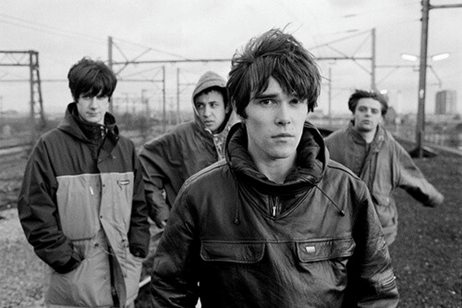
The Stone Roses, unknown photographer.
In the mid-to-late 1980s, the cultural landscape began to shift. The rise of dance music sparked criticism that hedonism was “rampant” and that culture was capitulating to Thatcher’s politics of self-interest. In 1989, the Madchester scene emerged, a fusion of older rock revivalism fusing with the “new quest for danceability”. Bands like New Order, the Happy Mondays, and The Stone Roses mounted what was described as a “challenge from the North to the North/South cultural and financial divide”. The Stone Roses’ music in particular, made broader political statements at a time of heightened tensions under Thatcher. As disillusionment deepened and hope seemed increasingly distant for much of Britain’s youth, the band channelled rebellion through sound, image, and metaphor. Despite not overtly known for their politics, they used symbolism drawn from the 1968 Paris riots – most notably the lemon, which appeared on their album cover and, in their lyrics, to express resistance within the hedonistic Madchester aesthetic. This symbolism is most evident in Bye Bye Badman, but many of their songs were often “cloaked in metaphors” For example, Waterfall, though not explicitly political, critiques the class divides exacerbated under Thatcher and Britain’s alignment with the United States during the Cold War. The lyric “free from the filth and the scum” reflects anger at the erosion of community and Thatcher’s attempt to dismantle the notion of “society”. It is immediately followed by “this American satellite’s won”, a pointed reference to the Reagan–Thatcher alliance and Britain’s perceived subservience to U.S. foreign policy: “whipped by the winds of the West”. Other songs, such as Shoot You Down and Elizabeth My Dear are similarly characterised by the inevitability of rebellion against those in power. Though the band’s lyrics captured the frustration, tension and unrest of 1989, The Stone Roses offered a glimmer of optimism to a new generation Their confidence and “euphoric melodies” suggested change was possible. Lines like “the past was yours, but the future’s mine” carried a sense of liberation – not only from Thatcher’s grip on the North, but from the crumbling political orders across Europe as the decade drew to a close.
Writing in The Guardian, David Barnett summed up the atmosphere after The Stone Roses’ infamous Spike Island gig: “Well, that’s the 80s over.” Whether through the bleak confrontation of post-punk Joy Division, the critical realism of The Smiths, or the hedonistic, rebellious optimism of The Stone Roses, these Northern bands forged a powerful and coherent cultural identity – an alternative voice for a region struggling under unprecedented socioeconomic pressure. In many respects, Manchester defined the 1980s – and Thatcher’s premiership – through its artistic output. The musical legacy established by Joy Division, The Smiths, and The Stone has echoed across generations, resonating in the music of bands like Oasis and Arctic Monkeys. While it may be reductive to credit Margaret Thatcher as the direct catalyst for Manchester’s musical renaissance, her policies are so deeply woven into the city’s cultural history that her impact is impossible to ignore.
Bibliography:
Atkinson, Peter. “Doing Things Differently: Contested Identity across Manchester’s Arts Culture Quarters.” In Developing a Sense of Place: The Role of the Arts in Regenerating Communities, edited by Tamara Ashley and Alexis Weedon, 227–39. UCL Press, 2020.
Barnett, David. “Spike Island at 30.”The Guardian. 27 May 2020. https://www.theguardian.com/music/2020/may/27/spike-island-at-30
Braholli, Anton. “Every Member of Parliament Is Still Tripping On Glue: The Stone Roses and their Politics.” Sleeve Magazine. 21 May 2025. https://sleevemagazine.com/2025/05/21/every-member-of-parliament-is-still-tripping-on-glue-the-stone-roses-and-their-politics/
Hann, Michael. “Five Songs About Margaret Thatcher.” The Guardian, 8 April 2013. https://www.theguardian.com/music/musicblog/2013/apr/08/five-songs-about-margaret-thatcher
Martínez, Robert. “Punk Rock, Thatcher, and the Elsewhere of Northern Ireland: Rethinking the Politics of Popular Music.” The Journal of the Midwest Modern Language Association 48, no. 1 (2015): 193–219.
Nehring, Neil. 2007. “‘Everyone’s Given Up and Just Wants to Go Dancing’: From Punk to Rave in the Thatcher Era.” Popular Music and Society 30 (1): 1–18.
Stringer, Julian. “The Smiths: Repressed (But Remarkably Dressed).” Popular Music 11, no. 1 (1992): 15–26
Waltz, Mitzi, and Martin James. “The (Re)Marketing of Disability in Pop: Ian Curtis and Joy Division.” Popular Music 28, no. 3 (2009): 367–80.
Image Credits:
https://www.bbc.co.uk/news/entertainment-arts-59010115
https://readersrecommend.wordpress.com/2023/03/26/the-most-classic-song-by-the-stone-roses/
 Retrospect Journal