
Written by Kayla Greer
Few contrasts could be more jarring than the whimsical tea parties of Wonderland and the blood-soaked streets of Whitechapel. Yet in 1996, author Richard Wallace proposed one of the most shocking theories in literary history: that Lewis Carroll, the beloved creator of Alice’s Adventures in Wonderland, was actually Jack the Ripper, Victorian London’s most notorious serial killer. On one side stands Charles Dodgson, the Oxford mathematician who enchanted generations with tales of talking rabbits and grinning cats. On the other, lurks the unidentified murderer who terrorized London’s East End in 1888, leaving behind a legacy of brutality that continues to fascinate and horrify.
While the evidence linking Carroll to the Ripper murders remains circumstantial and has been thoroughly debunked by scholars and investigators, examining this controversial theory reveals fascinating insights into Victorian society, the psychology of conspiracy thinking, and the methods, both sound and flawed, of literary and historical analysis.
To understand this theory, we must first establish the historical context of both figures. Charles Lutwidge Dodgson, better known by his pen-name Lewis Carroll, was born in 1832 to a respectable middle-class family. A brilliant mathematician, he spent most of his adult life as a lecturer at Christ Church, Oxford, where he also pursued photography and writing. His masterpiece, Alice’s Adventures in Wonderland, published in 1865, established his reputation as one of Victorian England’s most celebrated children’s authors. By all accounts, Carroll was a shy, stammering bachelor who found comfort in the company of children and academic pursuits.
Jack the Ripper, by contrast, remains history’s most enigmatic serial killer. Between August and November of 1888, this unidentified murderer killed at least five women in London’s impoverished Whitechapel district. The victims—Mary Ann Nichols, Annie Chapman, Elizabeth Stride, Catherine Eddowes, and Mary Jane Kelly—were all involved in prostitution and lived in desperate poverty.
The timeline places Carroll at age fifty-six during the canonical murders, living primarily in Oxford but maintaining connections with London through his publisher and social circles. This geographic mobility between Oxford and London, approximately sixty miles apart, forms a crucial element in conspiracy theorists’ arguments, as Victorian rail connections made such travel feasible for someone of Carroll’s social standing.
The Carroll-Ripper theory emerged in 1996 with Richard Wallace’s controversial book “Jack the Ripper, Light-Hearted Friend.” Wallace, a film and television writer, claimed to have discovered hidden confessions within Carroll’s published works through systematic anagram analysis. His methodology involved rearranging letters from sentences and paragraphs in Carroll’s texts to form new messages that allegedly revealed the author’s guilt.
Wallace focused particularly on “The Nursery Alice,” Carroll’s 1890 adaptation of his famous work for younger children. He claimed that anagrams extracted from this text spelled out confessions such as “I, Lewis Carroll, slew the Juwes” as well as detailed descriptions of the murders. Wallace also alleged that Carroll embedded clues in his photographs and even suggested that missing diary pages from 1888 had been deliberately destroyed to hide evidence.
Following Wallace’s publication, other enthusiasts emerged to support the theory. Some pointed to Carroll’s documented presence in London during certain periods in 1888, while others analysed his photography for supposed evidence of anatomical knowledge or suspicious imagery.
However, the academic and investigative communities responded with overwhelming scepticism. Carroll scholars, Ripperologists and historians quickly identified fundamental flaws in Wallace’s methodology, noting that anagram analysis could theoretically extract virtually any message from any sufficiently long text, making such “evidence” meaningless without additional corroboration.
Proponents of the Carroll-Ripper theory point to several circumstantial elements they claim link the author to the murders. Records show that Carroll visited London on multiple occasions during 1888, including stays with his uncle Skeffington Lutwidge and visits to his publisher Macmillan. While these trips coincided with some of the murder dates, they were however part of Carroll’s regular pattern of London visits for business and family reasons.
Theory supporters also highlight Carroll’s scientific background and photography hobby as evidence of anatomical knowledge that could have facilitated the mutilations described of Ripper crime scenes. As a mathematician and photographer, Carroll had access to chemical knowledge and precision instruments. Additionally, his photography work required understanding of human form and positioning.
Psychologically, proponents suggest that Carroll’s well-documented shyness with adults, combined with his comfort around children, indicated repressed sexuality and potential for violent outlets. They theorize that his bachelor status and stammering represented deeper psychological disturbances that could have manifested in murderous rage against adult women, particularly those involved in prostitution.
The most elaborate claims centre on alleged hidden messages within Carroll’s literary works. Beyond Wallace’s anagram methodology, supporters point to various passages in the Alice books that supposedly reference violence, death, and dismemberment. They note the Queen of Hearts’ frequent cries of “Off with their heads!” and interpret the Mad Hatter’s riddles as coded references to murder techniques. The timing of Carroll’s publications also features in the theory. “The Nursery Alice,” published in 1890, came after the murders, leading theorists to claim it served as Carroll’s confession vehicle.
Symbolism interpretations extend to playing card imagery, suggesting that Carroll’s use of card characters reflected the Ripper’s alleged habit of leaving playing cards near crime scenes—though no such evidence exists in actual police records. Carroll’s extensive photography collection becomes another source of alleged evidence. Theorists claim that certain photographs demonstrate suspicious anatomical knowledge or contain hidden messages, pointing to gaps in his photographic records as proof of deliberate concealment.
The Carroll-Ripper theory crumbles under serious historical scrutiny. Most damaging to the hypothesis is Carroll’s documented whereabouts during key murders. Church records, university documents, and personal correspondence place Carroll in Oxford or with family members during several of the canonical Ripper killings. For instance, on the night of Mary Jane Kelly’s murder, the most brutal of the series, Carroll was probably at Christ Church, Oxford, having attended evening chapel services.
Character witnesses uniformly contradict the psychological profile required for such crimes. Colleagues, students, family members and friends consistently described Carroll as gentle, kind, and incapable of violence. His relationships with children, far from being suspicious, were openly conducted with parental approval and often in public settings. The Victorian context of these relationships has been misunderstood by modern theorists applying contemporary suspicions anachronistically.
Perhaps most importantly, no physical evidence whatsoever connects Carroll to the crimes. Police files, medical examiner reports, and contemporary investigations contain no mention of anyone matching Carroll’s description, despite extensive witness accounts and suspect descriptions from the Whitechapel area.
Wallace’s anagram analysis represents perhaps the most egregious example of confirmation bias in amateur historical investigation. Linguists and mathematicians have demonstrated that sufficiently long texts can yield virtually any predetermined message through selective letter arrangement. By Wallace’s methodology, one could equally “prove” that Charles Dickens, Alfred Tennyson, or any prolific Victorian author was Jack the Ripper.
The literary interpretation of Alice’s Adventures in Wonderland as containing violent themes ignores the rich tradition of darkness in children’s literature and fairy tales. The Queen of Hearts’ threats, the Mad Hatter’s riddles and Carroll’s word play represent standard Victorian literary conventions, not criminal confessions.
The scholarly consensus overwhelmingly rejects the Carroll-Ripper connection. Leading Ripperologists – including Paul Begg, Stewart Evans, and Donald Rumbelow – to have systematically dismantled the theory’s claims. Carroll biographer Edward Wakeling has documented the numerous factual errors in Wallace’s work, while literary scholars have criticized the fundamental misunderstanding of Victorian literary conventions underlying the theory.
Victorian society’s complex relationship with sexuality and violence creates fertile ground for such speculation. Modern audiences often misinterpret Victorian social conventions, particularly regarding adult-child relationships, through contemporary lenses of suspicion. Carroll’s bachelor status and comfort with children trigger modern anxieties that would have seemed unremarkable to his contemporaries.
The theory also benefits from confirmation bias and pattern-seeking behaviour. Once someone accepts the possibility of Carroll’s guilt, they begin finding “evidence” everywhere— a psychological phenomenon that explains why conspiracy theories persist despite factual refutation. Popular culture has amplified these tendencies through sensationalised documentaries and books that prioritise entertainment over historical accuracy.
The Carroll-Ripper theory illuminates broader issues about historical methodology, media responsibility and the ethics of posthumous character assassination. It demonstrates how superficial research combined with compelling narrative can gain traction despite scholarly refutation. This case serves as a cautionary tale about the importance of applying rigorous standards to historical claims, particularly those targeting beloved cultural figures.
This controversy also reveals modern anxieties about hidden darkness beneath respectable facades, a theme that resonates in an era of exposed scandals involving trusted public figures. However, projecting contemporary suspicions onto historical figures without evidence represents a form of historical injustice that scholars have a responsibility to challenge.
Protecting historical figures from unfounded speculation serves both truth and justice. Carroll’s legacy as a brilliant mathematician and beloved children’s author deserves defence against character assassination based on flawed methodology and sensationalised claims. Ultimately, this controversy reminds us that separating fact from fiction requires vigilance, critical thinking and respect for evidentiary standards that protect both historical truth and individual reputation.
Bibliography
Begg, Paul. Jack the Ripper: The Definitive History. London: Pearson Longman, 2003.
Cohen, Morton N. Lewis Carroll: A Biography. New York: Knopf, 1995.
Evans, Stewart P., and Donald Rumbelow. Jack the Ripper: Scotland Yard Investigates. Stroud: Sutton Publishing, 2006.
Leach, Karoline. “The Carroll Myth: Lewis Carroll, Victorian Photography, and Modern Mythmakers.” Victorian Literature and Culture 31, no. 2 (2003): 345-362.
Leach, Karoline. “Nonsense and Nightmares: The Persistence of Lewis Carroll Myths.” The Carrollian 8 (2001): 1-17.
Sugden, Philip. The Complete History of Jack the Ripper. London: Robinson, 2002.
Wakeling, Edward. Lewis Carroll: The Man and His Circle. London: I.B. Tauris, 2015.
Wakeling, Edward. “The Myth of Lewis Carroll.” The Carrollian 13 (2004): 3-28.
Wallace, Richard. Jack the Ripper, Light-Hearted Friend. Melrose, MA: Gemini Press, 1996.
Bakewell, Michael. “Lewis Carroll and Jack the Ripper: An Analysis of the Wallace Theory.” Ripperologist 34 (2001): 12-18.
Douglas, John, and Mark Olshaker. “The Jack the Ripper Profile.” In The Anatomy of Motive. New York: Scribner, 1999.
Fido, Martin. “The Crimes, Detection and Death of Jack the Ripper.” Criminal Investigation 3, no. 4 (1987): 15-23.
Gordon, R.M. “Anagram Analysis in Historical Investigation: Methodological Problems.” Historical Methods 32, no. 3 (1999): 134-141.
Carroll Society of North America. “Statement on the Wallace Theory.” Knight Letter 57 (1996): 2-3.
Ripperologist Editorial Board. “The Carroll Connection: A Critical Assessment.” Ripperologist 35 (2001): 2-11.
Woolf, Jenny. “Lewis Carroll Myths and the Lessons of the Snark.” The Carrollian 15 (2005): 76-87.
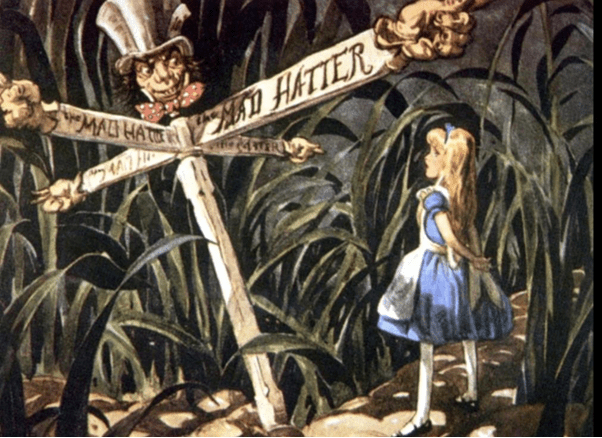
Featured Image Credit: Alice in Wonderland. Directed by Clyde Geronimi, Wilfred Jackson, and Hamilton Luske. Walt Disney Productions, 1951. Animation production artwork.
 Retrospect Journal