
By Connie Greatrix
29/09/2025
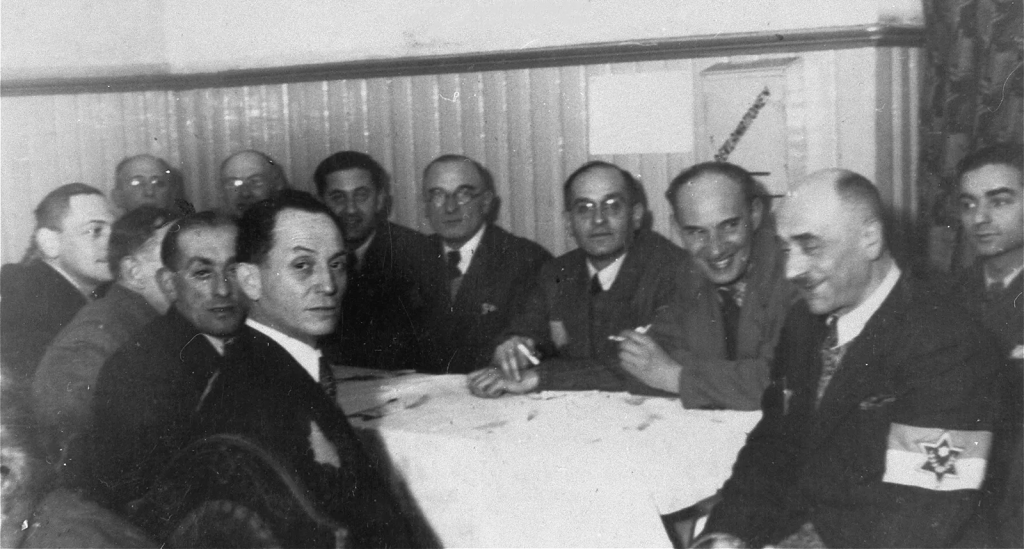
Jewish Councils or Judenrat were set up by the Third Reich in order to control the Jewish community through their own leaders. The Councils were often forced to implement Nazi policies and were often involved in the facilitation of their own deportations. This created a layer of administration within the community itself that became a buffer and a liaison between the Nazis and Jewish people. This was met with many different responses by those involved, responses that have come under a great deal of scrutiny in their aftermath. There are many moral dilemmas raised about the involvement and complicity of the Councils in the destruction of the Jewish people across Europe, but these often seem to hold a degree of presentism – the idea that these Councils knew the result of their work would be the death camps. This essay will not explore the moral question of whether the Judenrat should have cooperated or not and if this makes them perpetrators, but instead focus upon how they acted when put into these difficult positions of both power and weakness, of agency and choiceless choices.
The inherent differences between the Jewish Councils in Eastern Europe and Western Europe must also be recognised. In Eastern Europe the Judenrat were established in 1939 and only had authority over their local regions, whereas in the West, these became national authorities covering their entire countries’ borders (more apparent in Belgium and France, with the Dutch council mainly focussed upon Amsterdam, which eventually extended to cover the Netherlands as a whole in 1941). In the East, the Councils were also forced into positions of direct responsibility for deportations and the provision of forced labour, and killed if these were not up to Nazi standards. This was demonstrated in the murder of Joseph Parnas, chairman of the Judenrat in Lwow, who refused to provide thousands of Jews for forced labour. These organisations were a blueprint for their Western counterparts, yet acted in very different ways depending on their circumstances.
Often the focus of investigations into the Judenrat is their position as collaborators or enforcers of Nazi policy, but for some, the welfare of the community remained at the heart of their actions. This was shown in the great interest and responsibility certain Councils took on across Europe for children’s homes, health, and education, all at a time in which the community was being denied such things in public life. Others have been criticised as self-serving and facilitating persecution, but in his book, Ordinary Jews, Evgeny Finkel defines the difference as ‘the intended goal of the actions taken’.
Some Jewish Councils focussed upon becoming ‘productive ghettos’, seeking to make the ghettos so invaluable that they could not be dissolved due to their link to the war effort. This provided false hope and helped maintain order within the ghettos. The Lodz ghetto was the most prominent in taking this response, with the leader of the Council, Chaim Rumkowski, notorious for his attempts at keeping the ghetto from dissolution. He made an infamous speech, ‘Give Give me your children’, in which he demanded parents should give up their children to fulfil the quotas for Nazi deportations, in order for the work in established textile factories to continue. The ghetto made German uniforms, contributing to the war effort in the hopes it would save them. It did prolong the life of the ghetto for a short time in comparison to similar, less productive areas but still resulted in its dissolution, and the deportation of all inhabitants. The productivity of the ghetto was also necessary for the survival of its inhabitants more generally due to its geographic position, surrounded by areas incorporated into the Reich. This meant their were fewer opportunities to smuggle goods and food in necessary for survival in the ghetto.
The response in the Warsaw ghetto was to help maintain order and as good a standard of living as possible in the dire living conditions. Here, Adam Czerniakow looked to provide social services, particularly focused upon improving the standard of life for children. He was successful in some such initiatives like soup kitchens, healthcare (including a children’s hospital), and the organisation of secret classes and orphanages, even when education was banned. These could even be recognised as acts of resistance, but eventually the ghetto was dissolved, and Czerniakow took his own life instead of organising the deportations.
To call all Jewish Councils collaborators ignores the interactions between Councils and resistance, and expects a level of passivity from all Jews across the continent. Instead, leadership often supported the push for dignity for Jewish people in the face of their dehumanisation. If Jews were completely passive in the face of Nazi policy, they would likely have all been killed. Through small acts of resistance, their lives continued in the face of this extreme adversity. Whether this was smuggling food into ghettos to avoid starvation or armed rebellion, these remained acts of resistance. To call steps that leadership within the Judenrat took resistance is difficult, as it was often balanced with collaboration, yet the welfare and assistance they provided for their communities was often the difference between extinction and survival. This went against German views and orders, with much of this assistance deemed unnecessary and even illegal by the Nazis. This alleviation of suffering saved some lives, even if the ‘collaboration’ did not.
In the Netherlands, the lack of resistance under the guise of the Jewish Council can be explained through the early breakup of the Council in comparison to others, the lack of resistance present throughout the country (due to little immigration of undesirables with previous experience of resistance like communists that mostly escaped to France or Belgium at the start of the war, or lack of experience through previous occupation), or the integration of Jews into Dutch society, something that provided a false sense of security. There was little known by Jewish Councils in the Netherlands about illegal activity, making such efforts to assist or partake in activities limited. Instead, the Council attempted to limit deportations through negotiation with the Nazi occupiers, sometimes reducing the list of names going to the camps by half. This does not seem admirable and caused much resentment for Asscher and Cohen and the Amsterdam Council in the resulting trials after the Holocaust, but it is a difficult action to judge. The Dutch Judenrat attempted to resist through the excessive issuing of work permits, something they thought would prevent deportations. This did not work, with nearly all Jews not in hiding deported by 1943, including the Council themselves. The Amsterdam Judenrat has received many accusations about their role in collaborating with the Nazis, mainly due to their work in drawing up lists of people that would be deported to Westerbork and then onto Auschwitz and Sobibor. There is also much criticism about who they chose to shield until the final deportations, which mainly became the intellectual class and those that worked for the Council – an incredibly complex moral dilemma in itself.
The term ‘cloaking’ is one that has come to be used to describe resistance activity that occurred under the organisation of the Council. There were different levels of activity, with the French Council (particularly in the South, led by Raymond-Raoul Lambert) able to use their independence from the Nazi framework to provide social assistance, and gain access to internment camps, and develop relationships with non-Jewish relief organisations. This led to organisations working within the French Jewish Council becoming involved in the illegal rescue of Jewish children from deportations. The Council set up an entirely parallel-yet-illegal counterpart to carry out such operations, involving the manufacturing of fake identity papers and ration cards, and the illegal placement of Jewish children. This developed into many separate resistance groups outside of the Council’s framework. This action can be seen as effective mostly due to the leadership that Lambert offered in negotiating with resistance groups, and his direct involvement in the actions himself. After his deportation in 1943, these acts diminished within the Council, and instead developed further outside of it.
These acts of resistance can be seen as incredibly admirable, yet many were based upon their circumstances. Other Councils attempted similar acts to Lambert, and instead paid the ultimate price. This is shown most prominently in the case of the Minsk Judenrat that worked alongside Soviet partisans to help potential deportees flee to the surrounding forests, where they built further resistance groups. The majority of the Council was murdered in response.
The acts of the different councils were based upon the limits of their environments and their interactions with the Nazi bureaucracy as a whole. In the West, a greater degree of autonomy was granted for a much wider region, making resistance movements in areas that already had an active underground, somewhat easier. In the East, the Judenrat aimed to limit the suffering of their communities through social welfare or under the false hope that productivity would save them. Deportations happened everywhere, no matter the actions the Councils took, so to blame a certain method is trivial, and many of the Councils were sent to a similar fate as the rest of their communities.
Bibliography
Epstein, B. (2008). The Minsk Ghetto 1941-1943. Univ of California Press.
Finkel, E. (2019). Ordinary Jews : Choice and Survival during the Holocaust. Princeton University Press. https://www.jstor.org/stable/10.2307/j.ctt1vwmgtr
Trunk, I. (1996). Judenrat : the Jewish councils in Eastern Europe under Nazi occupation (First Bison Books printing.). University of Nebraska Press, Bison Books.
Michna, P. (2023). The Processing of Used Clothing as a Survival Strategy: The Łódź Ghetto Textile Industry in Official Visual Documents of the Judenrat. Textile : The Journal of Cloth and Culture, 21(3), 720–745
Vastenhout, L. (2022). Between Community and Collaboration: “Jewish Councils” in Western Europe under Nazi Occupation. Cambridge: Cambridge University Press.
Vice, S. (2021). Ghetto rescue and resistance: Tadeusz Pankiewicz, Hersh Smolar and Leib Garfunkel: Holocaust Rescue and Resistance (pp. 83–120). Bloomsbury Academic.
Featured Image Credit; https://www.britannica.com/topic/Judenrate
 Retrospect Journal