
Written by Fleur O’Reilly
It is a rare honour for a monarch to earn the epithet “the Great,” in England’s long history, only one king holds this distinction: Alfred of Wessex. Born in AD 849 in Oxfordshire, the youngest son of Æthelwulf, King of the Anglo-Saxons, Alfred ruled for 28 years, from 871 until his death in 899. His reign marked a turning point in English history: he defeated the Viking threat at the Battle of Edington (878), secured peace, promoted education, and laid the foundation for the eventual unification of England. As a reward for his 28-year reign, he secured his reputation as the only English monarch with the epithet of Great, enjoying the reputation and title for his illustrious role in English history; some even deem him the first monarch of England. This distinction reflects not only his achievements during his 28-year reign but also the centuries of mythmaking and nationalist sentiment that shaped his legacy.
Alfred’s epithet “the Great” first emerged in the mid-thirteenth century, with the earliest written reference found in a marginal note in Matthew Paris’ Deeds of the Abbots of St Albans Monastery, an early thirteenth-century text. Over time, Alfred’s legacy grew, his reputation solidifying as a symbol of English greatness. For those interested in the evolution of his reputation, Matthew Firth’s 2024 article, What’s in a Name?, offers a comprehensive exploration of Alfred’s positive reputation from the time of his death onwards. By the late fourteenth century, Alfred had even become linked with the founding of Oxford University; in 1384, his name was used in a legal strategy by University College Oxford, hoping to gain royal favour in a court case. Alfred’s reign marked a pivotal moment in the formation of a unified England. Initially the king of the West Saxons, his significant victories—such as the decisive defeat of the Danes at the Battle of Edington in 878 and the fall of Ceolwulf, King of the Mercians, around 879—played key roles in this unification. Furthermore, Alfred was a patron of the English language, advocating its use over Latin, most notably in the production of the Anglo-Saxon Chronicles, the first major book written entirely in English. His contributions laid the foundations for modern laws and urbanisation, cementing his legacy as one of England’s most influential monarchs.
The celebrations of Alfred’s death’s millenary in 1901 reveal the extent of this fascination and the Victorian interest about their past. Marking what they mistakenly believed to be the thousandth anniversary of his death (having accepted the traditional but incorrect date of 901 after a long debate in 1898, with W.H. Stevenson arguing for the correct date of 899), the Victorians turned Alfred into a larger-than-life figure. The celebrations were centred in Winchester, once Alfred’s capital, and three days of festivities took place between the 18th and 20th of September, the peak of which was on the 20th. The event was even declared a public holiday in Winchester, with streets filled with dignitaries and military figures, including soldiers recently returned from the Boer War. Their presence was a deliberate link between Alfred’s struggle against the Danes and Britain’s contemporary conflicts, reflecting how the millenary became not only a commemoration of a medieval king but also a patriotic demonstration of British imperial strength.
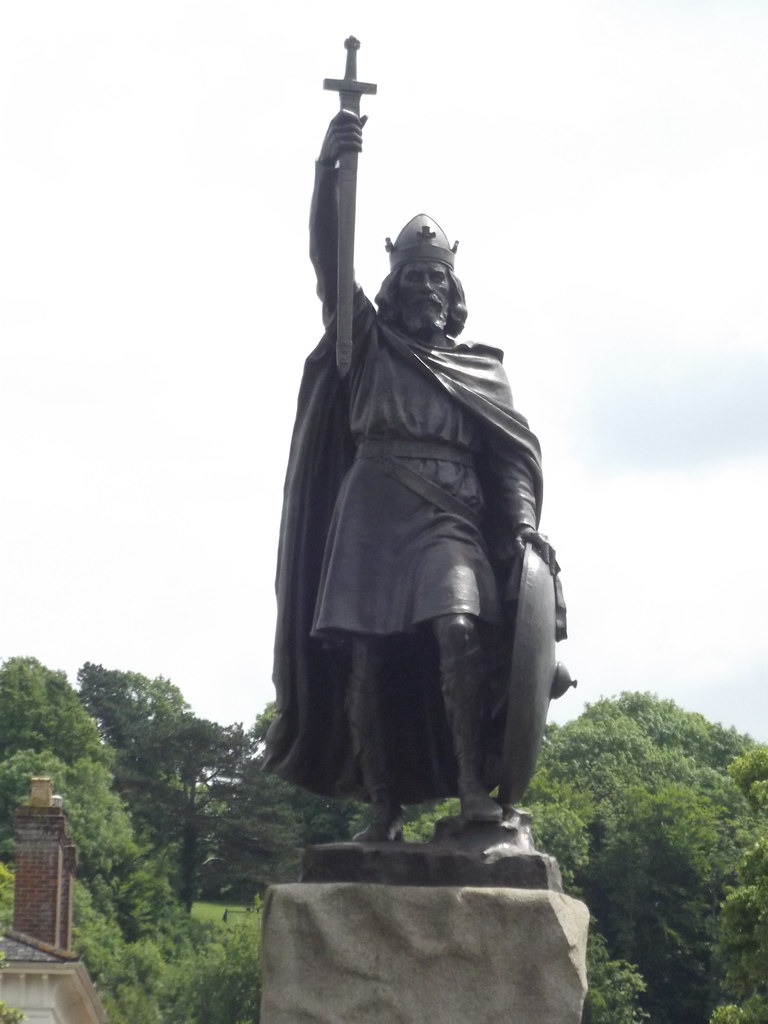
The celebrations featured a range of symbolic acts designed to elevate Alfred’s image. A statue of the king was unveiled in Winchester, serving as a permanent tribute to his legacy, inscribed ‘Aelfred, To the Founder of the Kingdom and Nation’. Public speeches emphasised Alfred’s virtues as a model for contemporary leadership. Alongside this, there were pageants of famous stories from Alfred’s life, magnificent window displays, and lectures on Anglo-Saxon heritage.
An article published in The Guardian during the commemoration of Alfred’s death highlighted the profound significance of his reign and why it stood out to Victorians. The article emphasises his commission of the Anglo-Saxon Chronicles. It also underscores Alfred’s Christian values, contrasting his leadership with the pagan invasions that threatened his kingdom. The article concludes by drawing a comparison between Alfred and Queen Victoria, describing both as “glorious,” “pure,” and “honourable.” The piece also reflects on Alfred’s legal reforms, which laid the groundwork for English law. This contemporary account, published during the millenary celebrations of Alfred’s death, paints a picture of a monarch whose legacy was deeply woven into the fabric of England’s national identity at the time.
After three years of meticulous planning by a committee that included historians Frederic Harrison and Lord John Acton, Mayor Alfred Bowker, actor Henry Irving, and writers Walter Besant, Alfred Austin, and Arthur Conan Doyle, the city of Winchester hosted the three-day international celebration. The celebrations were designed to be inclusive, intended to be embraced by all “without distinction of creed, race, nation or party.” In line with this spirit of inclusivity, both Cardinal Vaughan and a rabbi were invited to join the committee, symbolising religious inclusiveness. Additionally, care was taken to ensure that leaders of both the Conservative and Liberal parties, Lord Salisbury and Lord Rosebery, contributed identical donations of £50 to the Millenary fund, reflecting a bipartisan commitment to the commemoration. After extensive deliberation over the location for the festivities, Winchester, the city where Alfred was originally buried, was chosen as the most fitting venue. The event attracted a large crowd, with a significant portion of Winchester’s population, as well as visitors from London and beyond. Among the attendees were representatives from both Houses of Parliament, detachments from several army and navy regiments, and other notable figures. The celebrations culminated on 20th September 1901 with a keynote address by the former Prime Minister Lord Rosebery and the public unveiling of a statue of King Alfred.
Influential British writer of the Sherlock Holmes mysteries, Arthur Conan Doyle, spoke of the celebrations, remarking “What we are really commemorating is not merely the anniversary of the death of King Alfred but the greatness of those institutions which he founded. This anniversary may be said to indicate the thousandth milestone in the majestic journey of our race . . . From that, the greatest of English kings, to this the greatest of British queens, there extends that unbroken record, the longest which the modern world can show.” In this statement, Doyle draws a direct connection between the legacy of the Saxon king and the imperial supremacy of Britain, highlighting Alfred’s enduring influence on the nation’s identity and power.
One journal article from 1901 highlighted the connection between these celebrations and the contemporary challenges facing the British Empire. Drawing a parallel between Alfred’s role in unifying and reorganising England, the article suggested that “Alfred had to deliver and reorganise the England of his day as our statesmen have to deliver and reorganise the empire to-day.” It emphasised Alfred as “a gentle king that met adversity bravely and gave peace and justice to his country,” reinforcing the notion of his leadership as a model for the present. The article also underscored Alfred’s role in promoting the English language, positioning him as a key figure not just in military and political history but in the cultural and linguistic development of England.
The Victorian celebration of Alfred the Great reveals more about their own ideals than it does about the historical king. To them, Alfred was a mirror in which they saw their own values reflected: Christian virtue, legal reform, educational advancement, and imperial strength. In celebrating him, they were also celebrating themselves: their institutions, their empire, and their vision of Englishness. The Winchester statue, still standing today, is not simply a monument to a medieval king, but a testament to the way history can be shaped by those who remember it.
Bibliography
https://www.univ.ox.ac.uk/news/king-alfred-univ-part-1/
PARKER, JOANNE. ‘England’s Darling’: The Victorian Cult of Alfred the Great. 1st ed. Manchester University Press, 2007. https://doi.org/10.2307/j.ctt1vwmg4d.
Powell, F. York. “The Alfred Millenary of 1901.” The North American Review 173, no. 539 (1901): 518–32. http://www.jstor.org/stable/25105231.
The Guardian, 18th September 1901, Guardian archives, https://theguardian.newspapers.com/paper/the-guardian/5077/
Featured image credit: “Statue of Alfred the Great, Winchester” by ell brown is licensed under CC BY-SA 2.0.
 Retrospect Journal