
Written by: Flora Gilchrist
The Harlem Renaissance was an artistic and literary movement which emerged in 1918 in Harlem, New York, and was led by African American artists, poets, and writers. The Harlem Renaissance surfaced partially as a response to the Great Migration, where around three-hundred thousand African Americans migrated from southern states to find better opportunities in cities in the North. African American artists during the Harlem Renaissance created works celebrating their uniqueness and multifaceted identities. This article delves into the works of two artists who were displayed at the 2024 MET exhibition, The Harlem Renaissance and Transatlantic Modernism, thus showing the longevity of the Harlem Renaissance as a stepping stone towards the civil rights movement, Pan-Africanism, and Afrofuturism. Artists Aaron Douglas (1899-1979) and Charles Henry Alston (1907-1977) created works that defied expectations and reflected their own individual opinions on what it meant to have a diasporic identity. By merging artistic techniques, such as European modernism and aspects of Nigerian art, these artists foregrounded a new style of art led by cultural hybridity. It is clear that Aaron Douglas and Charles Alston contributed to the wider fight for the celebration of diversity in North America as well as the Harlem Renaissance.
Aaron Douglas was a key figure in the Harlem Renaissance who sought to redefine Black identity. Douglas explored themes of migration, racial violence, and African history. Born in Kansas, Douglas left in 1925 to study in New York, where he was mentored by artist Winold Reiss, who inspired Douglas to explore his African heritage. One of Douglas’ most famous works, which rewrite history from an African American perspective, is the four panelled mural painting, Aspects of Negro Life (1934). Each panel illuminates a stage in the construction of African American identity in modern-day America, starting with Africa before European intervention, slavery in the South, America during the Reconstruction period, and finally, the Great Migration. These panels create a clear narrative centred around the African American experience, where the figures have agency in their own narrative. The first panel, The Negro in an African setting, which depicts African life pre-European inference. The first panel aims to celebrate the rich and diverse culture of the continent, including music and dancers. Although a generalisation of African identity, with no indication of the specific country, Douglas wishes to portray Africa as an autonomous continent before the transatlantic slave trade. Furthermore, through the extensive detail of drummers and musicians and dance, it is clear that Douglas wished to portray the continent as having a rich and varied history.

Douglas, Aaron. ‘Aspects of Negro Life: From Slavery Through Reconstruction,’ mural painting, Metropolitan Museum of Art, 1934, visited March 2024.
The third panel posits a key moment in African American history, referencing the Emancipation Proclamation of 1863. From Slavery to Reconstruction depicts African American cotton pickers breaking free from the shackles of slavery. If one reads the panel like a story from left to right, we can see the slaves breaking free, amounting in a group of jazz musicians on the right-hand side. The jazz musicians on the right-hand side are significant figures, showing that amidst the segregation, there is still a feeling of collectivity. The figure in the centre right of the image can be read as a symbol of defiance, as they are forcefully breaking the chains that once bound them. According to historian Glenn Gordan, the depiction of a free Black man subverts the dominant contemporary narrative that it was the ‘white abolitionist who emerges as hero,’ as Douglas gives the heroic stance to the Black figure, thus returning their sense of agency. Portraying African Americans as defiant and makers of their own narrative reinvents contemporary perceptions of African American history. These acts of defiance that the figures are engaged in coincide with the emerging ideas of the new and transformed African American. During the 1920s and 30s, just like the murals, there was a collective recreation of identity. Alain Locke’s poetry anthology The New Negro (1925) foregrounded a new African American figure who was cultured, well-educated, and integrated into society. Thus, Douglas’ panels sought to align African American history with this emerging movement.
Another pioneering artist who readily contributed to the Harlem Renaissance was Charles Henry Alston. Born in North Carolina, Alston moved to Harlem in 1931 to work at the Harlem Arts Workshop. Alston was politically active and became the first African American supervisor for the Works Progress Administration, a New Deal initiative led by President Theodore Roosevelt to combat poverty and racial exclusion in the 1930s. In terms of artistic practice, Alston differs from Douglas, focusing on portraits as a form of defying stereotypes as opposed to historical mural paintings. By painting everyday people, Alston seeks to find joy and celebration in subjects that have for so long been cast aside in the art history canon. Furthermore, Alston used portraits as a means to explore and experiment with both modernist European colours and styles and African techniques, in the end creating his own style that mirrors Alston’s commitment to being African and American.
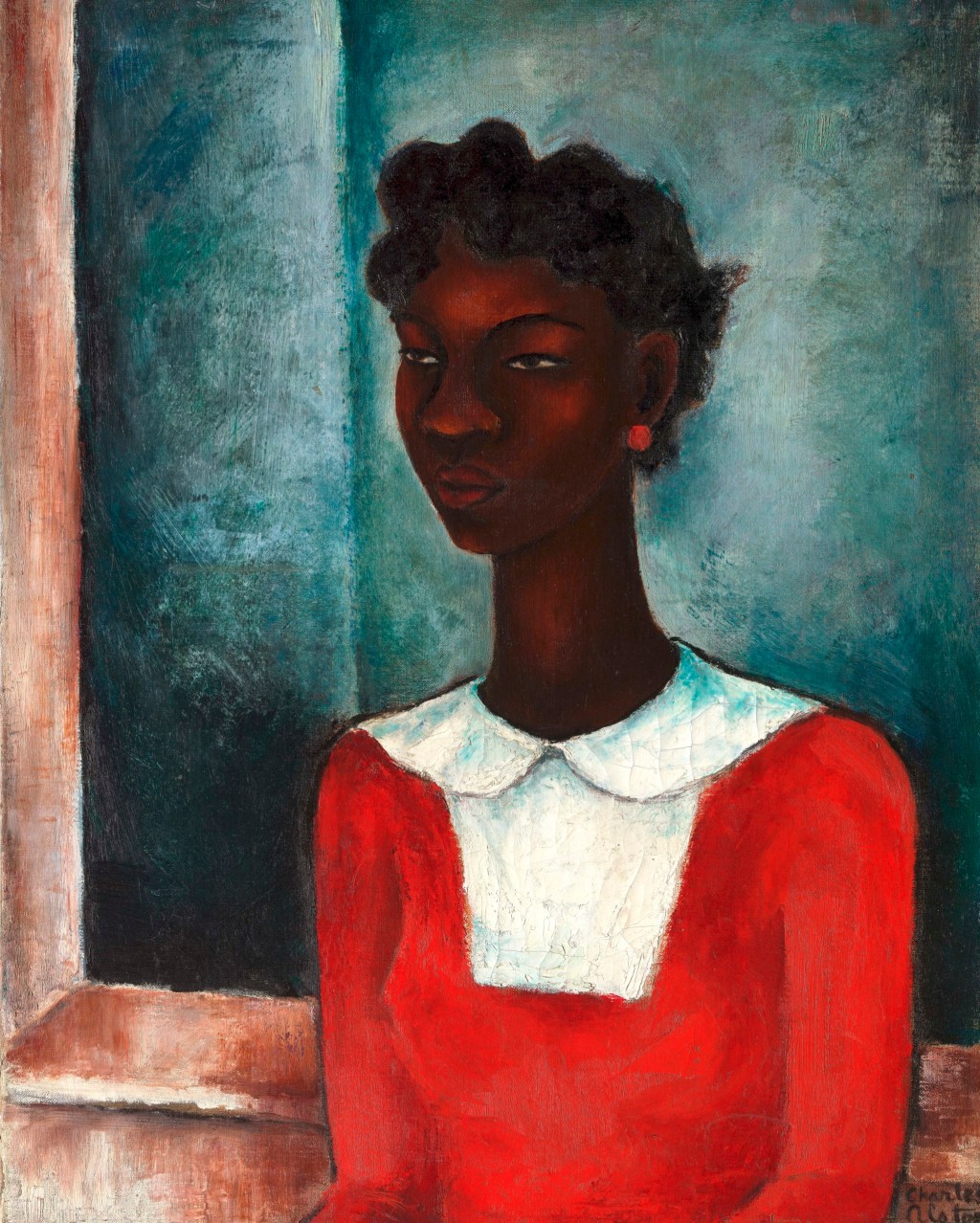
One of Alston’s greatest works during the Harlem Renaissance was Girl in a Red Dress, (1934). The painting depicts an elegant Black woman wearing a red dress with a white collar and red earrings. She sits proudly in the centre of the composition, with a simple blue background. This painting epitomises the purpose of the Harlem Renaissance, which was to celebrate the presence of African Americans. Charles Alston emulates the idea of the ‘New Negro’ in his portraits, as at this time, portraits were very popular in the movement as tools to empower Black families and counter racist depictions of African Americans, such as comic strips and postcards. Not only is the portrait of a marginalised racial group, but the subject is also a woman. By putting a Black woman as the main focal point, without any other pictorial distractions, Alston creates space for minorities who have been deprived of a spotlight. The painting also has European modernist undertones, as Alston experimented with bold colours and lines. The painting’s simple but powerful composition mirrors the European style of famous portraits, such as the Mona Lisa and the Girl with the Pearl Earring. In doing this, Alston is inserting African American identities into the Western art history canon. Alston is, therefore, redefining Black identity, placing African Americans in a position of power rather than subordination, and allowing his subject to take up space.
As well as appealing to European art styles, Alston also explores African art techniques, embracing this part of his identity. The notion of ‘African art’ is extremely broad and encompasses many different styles, cultures, and countries. However, there are a couple of prevailing tropes evident in African art that are paralleled in Alston’s work. Alston may have taken inspiration from the West African art, specifically Nigerian art. According to Michael Harris, West African art is known to be ‘striking, monumental and straightforward’, have ‘free symmetry, shine and high intensity colour with the deep rich brightness of African clothing, textiles and landscapes’. Alston’s painting emulates these qualities; the rich and deep colour of the red dress starkly contrasted with the turquoise background, mirroring the intense colours used in West African art. Furthermore, there is both shine and free symmetry in the composition. The image is two-dimensional but full of texture, especially on the dress, and the figural lines on the girl are bold and rhythmical. These West African qualities in Girl in a Red Dress show Alston’s attempt to celebrate an important part of his identity, and in doing so, create a presence for the Black community in America. Through combining a modernist European style with more formal qualities of African art reveals how Alston’s work defies categorisation, thus reinventing what it means to be an African American artist in the Harlem Renaissance.
To conclude, both Charles Alston and Aaron Douglas redefined what it meant to be African American in a context where this marginalised community was searching for equal rights and stability, evidenced by the Great Migration. The Harlem Renaissance acted as a collective reanalysis of African American identity, creating space for a group of people who felt out of place in history grappling with being both ‘African’ and ‘American.’ The art of Aaron Douglas rewrote history from the perspective of the marginalised, reclaiming a narrative that has long been dominated by white history writers. Using the technique of portraiture as opposed to history painting, Charles Alston explored what ‘African heritage’ meant to him as an individual, creating a striking style that epitomised Alston’s multifaceted identity. Alston also prioritised celebrating figures that have been excluded from paintings, giving the spotlight to everyday working African Americans. These artists readily contributed to an emerging movement that reclaimed African American history.
Bibliography
Davis, Donald F. ‘Aaron Douglas of Fisk: Molder of Black Artists.’ The Journal of Negro History 69, no. 2 (1984): 95–99.
Eyerman, Ron. Cultural Trauma: Slavery and the Formation of African American Identity. Cambridge: Cambridge University Press, 2001, Chapter 1 1-22, Chapter 3 58-88, Chapter 4 89-129.
Goeser, Caroline. Picturing the New Negro : Harlem Renaissance Print Culture and Modern Black Identity. Lawrence, Kansas: University Press of Kansas, 2022, 17-56.
Gordan, Glenn. ‘RE-MEMBERING THE AFRICAN-AMERICAN PAST: Langston Hughes, Aaron Douglas and Black Art of the Harlem Renaissance.’ Cultural Studies 25, (2011), 848–91.
Murrell, Denise. The Harlem Renaissance and Transatlantic Modernism. Metropolitan Museum of Art, New York City, February – July 2024.
Smalls, James. ‘Reading Aaron Douglas as Collage and Pastiche’ Revue Française d’études Américaines, (2018): 13-32.
 Retrospect Journal