
Written by Lauren Hood
06/04/25
“Never again, for one moment, would Rowlandson, Gillray or Cruikshank question their destiny: these three would be the leaders of the Golden Age of British Satire.”

Very Slippy Weather, James Gillray, 1808
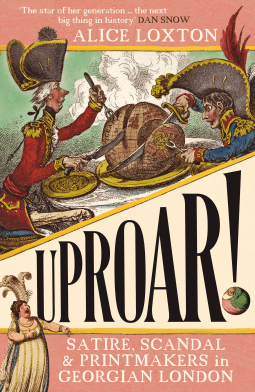
Uproar! Satire, Scandal and Printmakers in Georgian London by Alice Loxton (2023) follows the development of British satire in the eighteenth century, exploring the political and social events and scandals which satirists covered through their art. Set in London, 1772, Uproar! begins by following aspiring artist Thomas Rowlandson as he studies art at the Royal Academy Schools. Rowlandson’s career develops by opting for the controversial art form of satire which shocks some at this institution. Through his adoption of satire, Rowlandson – alongside James Gillray and Issac (later George) Cruikshank – became infamous throughout London, leading the satirical coverage of politics and society which became a core symbol of London’s Piccadilly area.
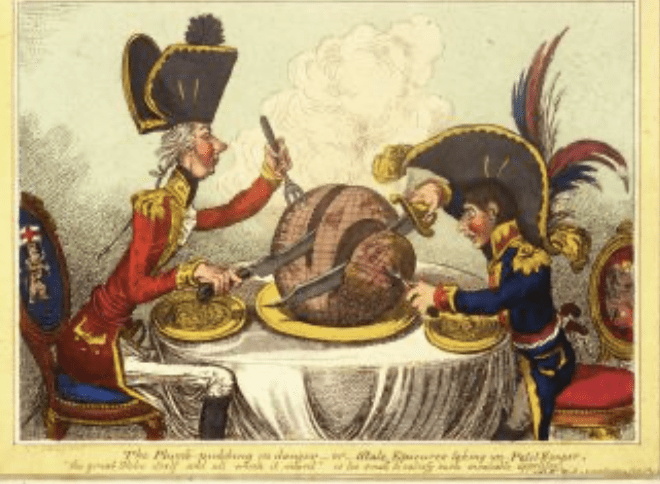
The Plumb Pudding in Danger, James Gillray, 1805: Depicts British Prime Minister William Pitt and French leader Napoleon Bonaparte
Loxton makes it clear to readers how influential satire was throughout London society, with this influence spreading across the country and even further to Europe. The satirist trio of Piccadilly covered the most pressing issues of the eighteenth and nineteenth centuries, from the French Revolution to the Napoleonic Wars, shaping attitudes towards politics throughout Britain and beyond. A particularly interesting section of the book was the coverage of the role which satire played in forming popular opinion towards Napoleon Bonaparte, with depictions of Bonaparte within satire art solidifying the reputation of his shortness. Politics played a prominent role within satire, with Loxton detailing the political motivations of the artwork, leading to changes in the way which the public perceived and interacted with politicians.
“The barrage of satire that had powered the Regency Crisis was a powerful new force that now commanded the streets of Piccadilly … Never before had graphic satire played such a formidable role in the nation’s politics.”
Alice Loxton’s writing is terrific. Loxton has the excellent ability to simplify complex historical issues and events, adding relevant historical context that allows readers to appreciate how influential the work of Rowlandson, Gillray, and Cruikshank truly was. The descriptions of characters in this book allow readers to get a sense of who they were, with anecdotal evidence used extremely well by Loxton. The most memorable example of this is, arguably, the discussion of the aftermath of the death of George Cruikshank:
“Not long after his death, George Crucikshank’s stainless reputation was dirtied when his wife, Eliza, discovered the contents of her husband’s will. His money was not destined to support her in her dotage. Instead, every remaining pound and shilling went to another woman: Adelaide Attree, a maid who had once worked for the Cruikshanks years before. Scandalously, it emerged that George had set up Adeliade in a flat around the corner from his own home and supported her financially until his death. What’s more, while George Cruikshank never fathered any children with his wife, Eliza, with Adeliade he had eleven.”

Touch for Touch or a Female Physician in Full Practice, Thomas Rowlandson, 1811
Overall, Alice Loxton’s writing is great, effectively and engagingly explaining complex cultural developments spanning two centuries. I thoroughly enjoyed Uproar! and look forward to reading more of Loxton’s work: especially her other published book Eighteen. Eighteen explores British history by focusing on different figures at the age of eighteen, and I am sure that this will be another greatly entertaining book, thanks to Loxton’s writing.

Music Hath Charms, Or A Dull Husband, Thomas Rowlandson, Date Unknown
Bibliography
Alice Loxton, Uproar! Scandal, Satire and Printmakers in Georgian London, London: Icon Books, 2024
Images
James Gillray, The Plumb Pudding in Danger, 1805.
James Gillray, Very Slippy Weather, 1808.
Thomas Rowlandson, Music Hath Charms, Or A Dull Husband, Date Unknown.
Thomas Rowlandson, Touch for Touch or a Female Physician in Full Practice, 1811.
 Retrospect Journal