
Written by Arianna North Castell
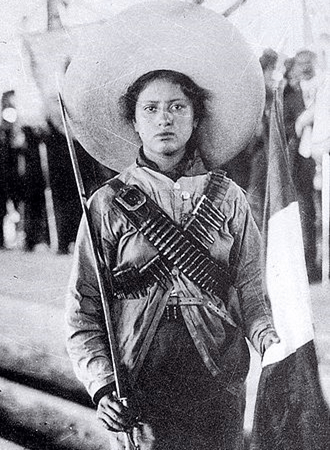
Adela Velarde Pérez
Steeped in black-and-white tones, the women of the Mexican revolution look straight into the camera lens and into the eyes of the modern viewer. Their gaze is strong, assured and piercing enough to bring forth questions to our lips to ask aloud, as if they were standing in front of us.
Slung with bullet cartridges and brandishing their weapons without a hint of boastfulness, it seems bizarre that the image of these women does not come to mind when we think of the Mexican Revolution. It is true that they were a minority in the revolutionary forces, and many did not engage in active battle, however, it is a fundamental mistake to think of women as passive in this conflict, holding perspectives that are unreachable in the modern day.
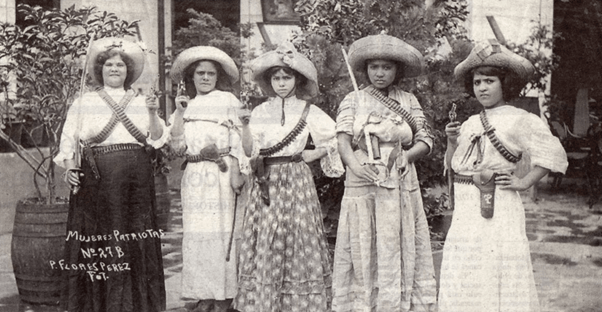
‘Mujeres Patriotas’- Patriotic Women
Nellie Campobello was a child at the time of the Revolution, living in the North of Mexico. In 1931 she published Cartucho, a novel of fifty-six fragmented snapshots from her childhood during the Revolution. The narrative voice is her younger self, which is notably one of the only female perspectives of the revolution, and the only of a child. It does not read as a novel. The vignettes are in no particular order, jumping through time, shaded with nostalgia and childlike naivety.
If we could, by some magic, step into Nellie Campobello’s mind, unlock a box of her childhood memories, and watch them as simple, unfiltered flashes of her reality —what would we see? Cartucho makes such magic unnecessary. These images are poured onto the page with the same vivid immediacy as when they first unfolded before her eyes. Each short chapter is ephemeral yet unyielding, capturing her memories with a painful honesty:
‘They were killed quickly, just like unpleasant things that shouldn’t be known.
The Portillo brothers, young revolutionaries, why were they killed?
The gravedigger said: “Luis Herrera’s eyes were so red, so red, he looked like he was crying blood.”
Juanito Amparan hasn’t forgotten them. “He looked like he was crying blood.”
Portillo took the boys to the Luis Herrera cemetery on a quiet afternoon, erased from the history of the revolution; it was five o’clock.’
The novel is replete with intimate flashes of daily life. It is a domestic, female version of the Revolution, narrated within private spaces and the village streets of Parral, spaces dominated by women. The female characters are complex, driven, and active agents during this historic time. The figure of Campobello’s mother stands out as a pivotal figure. As a child during the war, Campobello experiences the Revolution through her mother, who acts as a bridge between their private world and the violent upheaval outside. She speaks with soldiers, engages in political conversations, and, in doing so, brings the war into their home, shaping her daughter’s understanding of it.
Mamá dried her tears, she was suffering greatly– (My eyes were open, my spirit was flying to find images of the dead, of those shot; I liked to hear those stories of tragedy, it was like I saw and heard everything. I needed to have in my child’s soul those images full of terror, the only thing I felt was that they made Mama’s eyes cry as she told them. She suffered greatly witnessing these horrors. Her loved ones were falling, she saw them and cried for them.)
Avenging the memory of the revolutionary movement is said to have been Campobello’s main motivation for writing Cartucho. Born in northern Mexico, her family was staunchly loyal to Pancho Villa, and she recounts the bitter fighting between Villistas and Carrancistas with a deep sense of personal investment. Yet she does not mythologise the revolutionaries—she presents them as they appeared to her child’s eyes: an army of familiar faces, ordinary men who belonged to her village. She captures them in strikingly simple yet evocative terms: What did they look like? What did they wear? To her, the revolutionaries were ordinary men, soldiers that played with her and her sister, sang to them, Pancho Villa as a man that wept and grieved. To her, they were more than ordinary- they were human.
‘Catarino Acosta dressed in black with his jeans pulled back; every afternoon he would pass by the house, wave to Mamá, tilting his hat with his left hand, and always sporting a small smile that, beneath his black mustache, seemed shy. He had been a colonel under Tomás Urbina back in Las Nieves. Today he was retired and had seven children; his wife was Josefita Rubio de Villa Ocampo’
Death in Cartucho is omnipresent, lying beneath each word she writes and haunting each simple act she describes. How does a child view death when they confront it every day? How does a young, naïve mind conceptualise these horrors? Campobello gives us the answer – a heart wrenching simplicity to an incomprehensible occurrence:
‘Then Uribe said he didn’t want to waste a single bullet to kill him. They took off his shoes and put him in the middle of the road, with orders for the soldiers to ride (their horses) on either side of him and leave him until he fell dead. No one was allowed to approach him or use a bullet in his favour; orders had been issued to shoot anyone who attempted this show of sympathy.
Catarino Acosta lay dead for eight days. He was already eaten by crows by the time they managed to retrieve his remains. By the time Villa arrived, Uribe and the other generals
had fled Parral.
He was executed without bullets.’
Here, the reader is forced to confront the reality that war consumes all facets of society and imprints itself on young children. Young Campobello describes death as if it were the colour shoes she wore or the flowers that grew on the sidewalk – an ordinary sight. Her juvenile innocence is clear. Her frank assessment of the dead demonstrates how, at her young age, she did not understand the significance of a life ending. Death was immediate, material and visceral. There was no time to ask what death meant; it simply was. She describes fallen revolutionaries not with horror, but with a child’s blunt acceptance: they had been there, and now they were gone. This alone is deeply upsetting – not only is the violence deeply graphic, but the natural way that Campobello, as a child, absorbed it. War and death were just another rhythm of daily life.
It has been just over a century since the end of the Mexican Revolution, and we are left with the romantic notion of charismatic soldiers, riding bravely on horseback with wide-brimmed sombreros. This image paints a rose-glaze over the reality of this incredibly bloody conflict, where over one million Mexicans were killed. The Mexican Revolution was not a distant war between professional armies – it was a battle fought in the streets, homes, and villages of ordinary people struggling for their rights. It was a revolution of daily life, where survival and resistance blurred together. And the women of this conflict- named Las Adelitas for Adela Velarde- were never just spectators. They lived the revolution, mourned it, fought in it, and died for it. Captured in flashes of photographs and the fleeting memories of Cartucho, these women did not stand on the sidelines of history, they wrote it.
Bibliography
Campobello, Nellie. Cartucho, vers. 2018, Edited by Óscar de Pablo.
Ortiz, Gabriela, “Generalas, Periodistas, Enfermeras: Las Mujeres en la Revolución Mexicana.” Vida Universitaria, Universidad Autónoma de Nuevo León, 2020.
Rosas, Paula, “Las Mujeres de la Revolución Mexicana: No Solo Adelitas.” BBC Mundo, 2020.
Image credit:
Adela Velarde Perez, Wikipedia Commons https://es.wikipedia.org/wiki/Archivo:Adela_Velarde_Perez.jpg
‘Mujeres Patriotas’, https://www.sopitas.com/mientras-tanto/lo-que-no-sabias-de-las-adelitas-mexico-historia-revolucion-feminismo/
 Retrospect Journal