
Written by Peiqi An
(Please note that this article includes spoilers)
“They say there’s no such place as Paradise. Even if you search to the ends of the earth, there’s nothing there. No matter how far you walk, it’s always the same road. It just goes on and on. But despite that, why am I so driven to find it?”
Wolf’s Rain is an original Japanese animation series produced by Studio Bones and released in 2003. It was written by Keiko Nobumoto, directed by Tensai Okamura, and featured a score by Yoko Kanno. In contrast to light-hearted, entertainment-driven anime with bright images and comic storylines, Wolf’s Rain weaves a tapestry of sorrow, threading a sombre tone with a tragic theme: the effortless pursuit of a dream. The anime’s narrative structure, aesthetics, and motifs are imbued with some classic elegiac tropes: nostalgia, grief, and unfulfilled desire.
The anime focuses on a pack of four (later five) wolves searching for “Paradise”, a sanctuary for wolves alone. The story is set within a post-apocalyptic world where wars have ravaged human civilisation, and the wastelands lay cold and barren. The remaining population languish in dystopian cities reigned over by hedonistic Nobles. Wolves, ancient creatures thought to have been extinct for centuries, are said to hold a place in old legends. It is written that when the world approaches its end, they will follow the scent of lunar flowers, embarking on a journey to Paradise. Few know that wolves have survived extinction and disguised themselves as urban human residents through illusions. The series begins with Kiba, a wolf devoted to finding Paradise, entering a city, following the fragrance of lunar flowers from Cheza. Cheza is an alchemical homunculus made from a lunar flower who acts as the wolves’ guide to Paradise. In the city, Kiba meets fellow wolves who soon join his pack. After a Noble kidnaps Cheza, the pack embarks on a journey to rescue her. During this pursuit, they encounter human beings, interacting with them until ultimately being killed by them.
Wolf’s Rain frames its elegiac narrative upon the existential incompatibility between wolves and the human species. In the series, the urban spaces inhabited by human refugees appear to be the decaying remnants of industrialisation. Airships float above monumental buildings—their grey and iron facades mirroring the highly oppressive rule of the nobles. Outside the cities lie endless snowy wastelands covering the relics of the once-advanced civilisation, creating a vast, frozen graveyard. In sharp contrast to this desolation, Paradise is envisioned by the wolves as a pristine garden unspoiled by technology. The anime paints the illusion of Paradise by using bright colours and flowers, evoking visions of a lively, natural world long lost to time. Throughout the series, Paradise serves as a nostalgic tether for the wolves, a place of their own where they can find shelter and escape. In the human world, the wolves are hunted, slaughtered, enslaved and subjected to experiments. Yet, in the presence of Cheza, the symbol of Paradise, they find solace and a sense of comfort. The guide to Paradise loves the pack and soothes their pains with healing magic. Thus, the wolves’ longing for Paradise is driven by a poignant blend of desperation and idealism. As the story progresses in a wistful tone, the pack continues their journey across the decadent cities and desolate landscapes, chasing an ever-elusive dream.
Through a more rhetorical lens, the allegory of wolves chasing Paradise in a post-industrialised world intimately invokes Japan’s own cultural and historical legacies surrounding the creature. Their presence in highly-modernised cities stirs a sense of nostalgia in the audience for what has been lost—wolves, now extinct in Japan. The escalating intensity of hunting, coupled with the forces of modernisation, has led to the eradication of these majestic beasts from the Japanese archipelago. Additionally, the anime draws upon the religious symbolism of wolves in ancient Japanese beliefs. Revered as divine beings and regarded as the ancestors of humans, the act of their worship is mirrored in the wolves’ own stories. By embodying these historical and cultural connotations, the anime invites audiences to experience the intersection of nature, culture, and history—not only within its fictional world but also in reality. The reoccurring scenes of suffering and death among the lupine characters evoke a communal elegy for a troubled past. Meanwhile, the beautifully depicted Paradise serves as a reminder of a world rich in nature and traditional ways of life, now erased by the rise of industrialisation.
The unfulfilled pursuit of Paradise greatly contributes to the anime’s elegiac power. Paradise is non-existent, and the wolves fail to reach their destination. They all die before arriving at the gate of their imagined Paradise. Cheza withers and dies after having killed the Noble with her poisoned plant fluids. Her seeds scatter on the frozen land as the world ends, with the silently falling snow burying every corpse, sin and dream. The view then shifts to Kiba who in his last moments lies in the snow as his soliloquy echoes in the background, accompanied by melancholic music: “There’s no such a place as Paradise……But why am I so driven to find it?” The cycle of reincarnation commences with the desolation fading, leading to an Eden of natural harmony and tranquillity. This new world has a visage akin to Paradise with Cheza’s seeds blooming into lunar flowers. However, the anime posits that this world too will be lost to time. As the wolves endlessly drift in their unfruitful dreams of Paradise, so too does the audience sink into a haunting flow of disappointment and emptiness.
Overall, Wolf’s Rain is an elegy for a desire towards a pristine world. Nostalgia for “Paradise” permeates the story’s narrative, resonating deeply with Japan’s cultural and historical imagination. Through the interplay of plots, artistry, and symbolic connotations, the anime successfully evokes a collective lament for the lost past, solidifying its place as a classic elegiac work. Although imperfect, Wolf’s Rain remains a quintessential piece that deserves more attention from audiences and critics alike.
Bibliography
Napier, Susan. Anime from Akira to Howl’s Moving Castle: Experiencing Contemporary Japanese Animation. New York: Palgrave Macmillan, 2005.
Walker, Brett L. The Lost Wolves of Japan. The University of Washington Press, 2005.
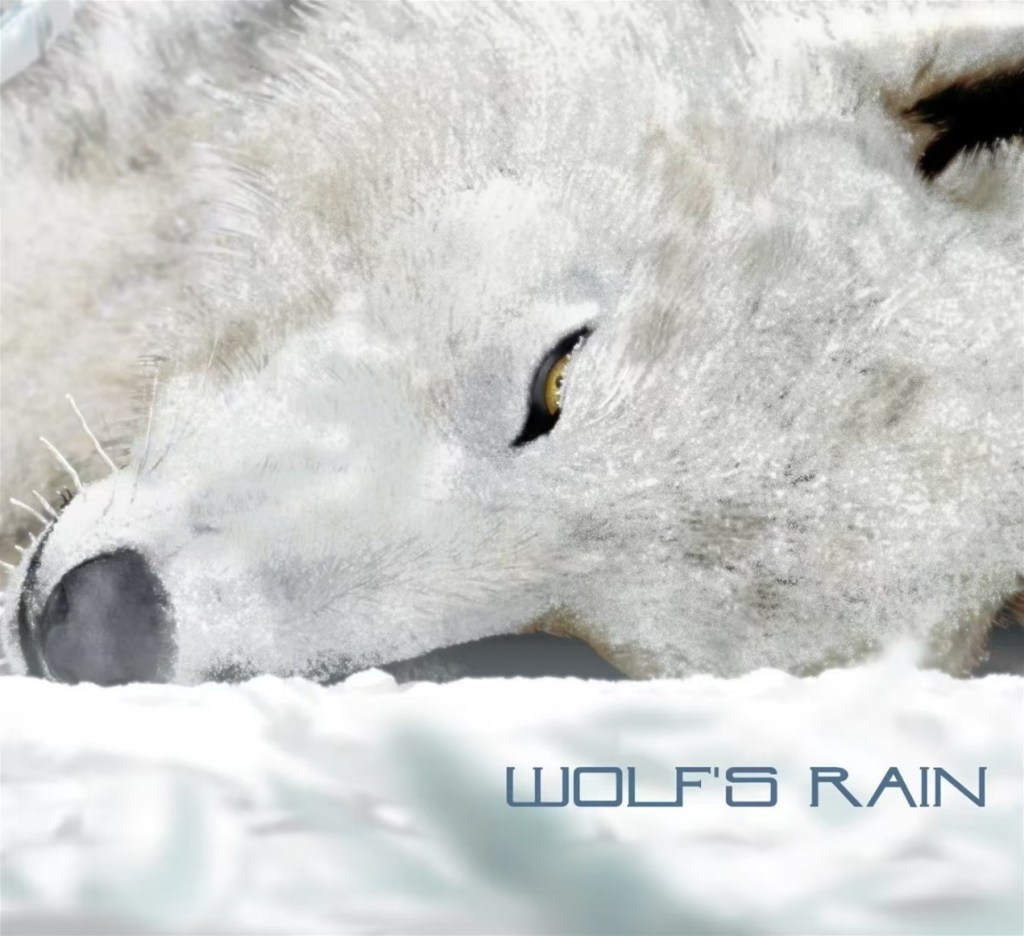
Image Credit: “Wolf’s Rain OST – Front” by DuchessDream is licensed under CC BY-NC-ND 3.0.
Acknowledgments:Arin Mukhopadhyay and Aidan Sibley for proofreading.
 Retrospect Journal