
Written by Logan McKinnon
“I travel not to go anywhere, but to go.”
Robert Louis Stevenson, Travels with a Donkey in the Cevennes
Knowing a landscape is a process of feeling – the feeling of the grit of a gravel path beneath the feet, the feeling of being entirely overcome by the beauty of the natural world around you, or even the feeling of being absolutely battered by the ever-unpredictable Scottish weather and asking that fabled question – “why am I here?”
To feel is to be immersed in nature and this brings a certain tranquillity in the dual relationship brought about by the raw physical power of nature where we do not only know nature, but nature knows us. Being amongst nature in this sense involves taking a slower approach to life, limited to the rhythm of our own feet in time with the beat of nature while the riptide of modern life speeds past and slowly chips away at the nature which through being within we recognise as a crucial life organ. Not only are we in time with nature but we have to be aware of our bodies and how they fit into the wider puzzle of nature in a process that involves recognising our relationship with the world around us. It is for this reason that we hike, to feel, and it is too for this reason that hiking can be categorised as a radical action.

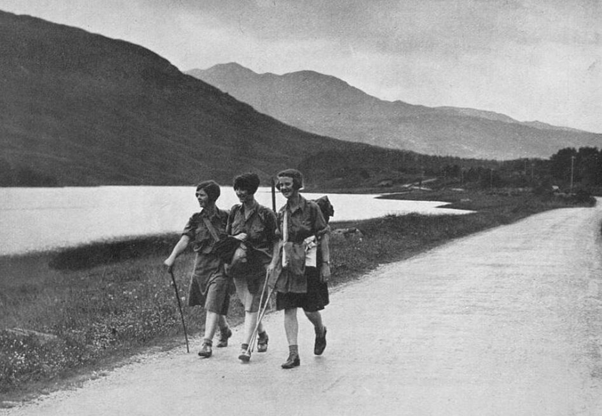
Figure 1: Hiking in the Highlands, The Sphere, July 11, 1931.
Hiking exists as a radical action precisely because of the radical social processes that characterised the ‘invention’ of hiking. The radical character of hiking is most telling in the idea that so often is associated with hiking and the motivation for many to hike, to return to nature. Humans have always walked – and human history is indeed time and time again the story of some our greatest walk – but in previous centuries we have been deprived of nature, and so for reasons that may outwardly seem pointless, we walk. Hiking is a relatively recent invention, roughly coinciding with the rise of our modern industrialised world in the late-nineteenth and early-twentieth century, and in its invention it takes on the character of escapism and is rather more necessity than invention in representing one of the deepest desires within humanity – our desire for freedom.
The escape to the countryside was motivated by the dire squalid conditions of the cities in this area which more represented urban encampments with people with little room to breathe or hardly any clean air to breathe with cities dripping with sludge and coated in smudge – Gomorrah’s of the twentieth century. Charles Dickens described the cities of the period as being entirely gobbled up by a ‘plague of smoke’ which ‘obscured the light, made foul the melancholy air.’ Those who suffered the most were of course the working-class who were stripped of at least the one fundamental right they were guaranteed in preindustrial society – the right to access the land – but people were no longer humans but rather productive goblins in the vein of homo economicus. Sunshine, clean air, wide open spaces – the colour green! – were seen by the wealthy elite as luxuries of which the working classes were not deserving.
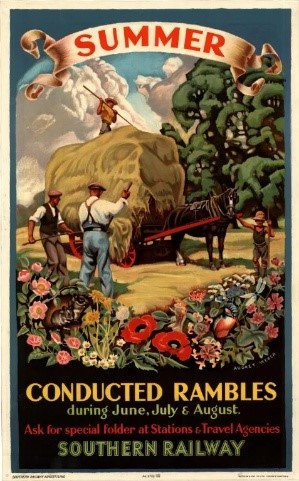
Figure 2: Conducted Rambles, Audrey Weber, 1936.
Train tickets were cheap though and were the gateways to a paradise beyond the city, so each Sunday nearly fifteen thousand Mancunians would pile out of their cities aboard trains taking them out of the hellscape of urban life, into the tranquillity of rural life where they could escape the pressures of modern life. Fundamentally, the earth and nature were for all, and for the working-class they were an environment in which they could temporarily slacken their chains. The calamity, joy, and crucially freedom of hiking is captured perfectly in a June 1932 edition of The Sphere:
“A clamour of voices and laughter, a clatter of heavy shoes, a burst of song waking the usual somnolent quiet of small country stations and ruffling the traditional hush of an English Sunday into a shocked and startled astonishment. Hikers! Boys in shorts or plus fours or grey flannels; girls in bright-coloured jumpers, in breeches or brief skirts. A laughing, noisy crowd, surging into the train like an invading army – eight, ten, fifteen, twenty in a carriage. Flushed, tired, blown about by the wind and rain, burnt by the sun, and yet supremely, gorgeously, radiantly happy.”
What made the natural environment so peaceful, so freeing, was its capacity to equalise – as John Muir described in nature, we all simply become ‘people’ regardless of origin or even species as we are all caught by nature’s web and where the space of nature becomes a shared web of mutual knowledge and understanding for even the smallest bug. It defies the social structures imposed by society by returning to the environment in itself where natural structure cannot oppress – hiking was a particularly freeing environment for women, for instance, who could establish female solidarity and defy traditional social constructions of female behaviour. In short, in nature we are but one.
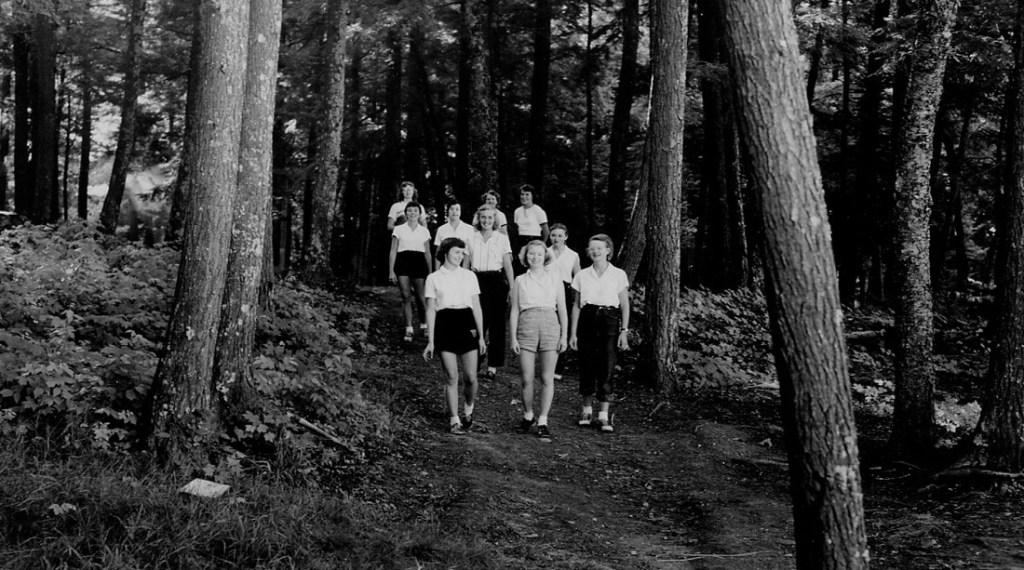
Figure 3: Green Bay Girl Scouts and Counsellors on Woodland Trail at Lost Lake Organisation Camp, Chequamegon-Nicolet National Forest, Wisconsin, August 1952.
Hiking as an activity would do away with society and was revolutionary in its capacity to at its basis alter the way we saw the social, political, and artistic paradigms of the time, and in this sense, hiking becomes an artform in its radical, green-fingered reinterpretation of the world. The wealthy landed elite treated “them queer walking folk” and their renowned tendency “to ignore totally laws and restrictions,” their “want of attention paid to private property,” and “their slightly socialistic tendency as regards the unassailable prerogative of youth,” as was reported in the Sphere in June 1932 with complete disdain, and they came down hard on trespassers – attempting to capture nature in a net of their own for their favourite pastime of grouse shooting while the working class had mud chucked in their face by the appalling quality of the paths they were forced to walk on.
The workers thus rebelled in defence of their right to the land – with hundreds of young working-class men and women coming to the pastures of Kinder Scout to battle with those wealthy landowners who had treated them like the scum of the earth in chasing them away with dogs. This was an eclectic bunch capturing the social freedom that lay behind hiking dressed in ‘picturesque rambling gear’ of ‘flannels and breeches, even overalls, vivid colours, and drab khaki… multicoloured sweaters and pullovers, army packs, and rucksacks of every size and shape,’ who would come out victorious, and (in-time) secure the right of working-folk to roam the land, to ramble. It had been firmly established in the consciousness of the British people that the land was for the people and that every individual should by right have access to the land – for who is to say that nature in which we are all equal is for one man or can be declared the property of one man?
This radicalism surrounding hiking often manifested in romanticism around the land – this is characteristic of the poems of the Lake’s poets and comes out through a fundamental question of the source of power which itself can take on quite a conservative form – and in Victorian Britian it often did. It is disillusionment and that crucial idea of the ‘return to nature’ as a form of escapism – the Highlands of Scotland in the writings of Sir Walter Scott for instance were transformed from a frontier of barbarism to a frontier of romantic tradition by playing on a romantic vision of what but the land itself. Such romanticism around the land is radical in its questioning of established power, the structures of society that were too later challenged by the workers who also came to nature in response.
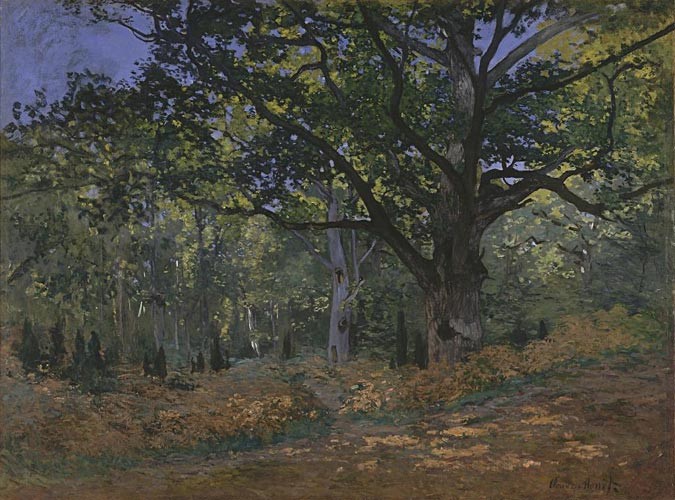
Figure 4: The Bodemer Oak, Fontainebleau Forest, Claude Monet, 1865.
Where this becomes dangerous is amongst the incorporation of a national romanticism into our hiking practices such as in the case of the German Wandervogel movement which incorporated the authority of German heritage into its vision as a form of protest against modernity where the vision is shifted from a ‘return to nature’ to a ‘return to heritage’. Indeed, this folkloristic and national-romantic conception of nature is often how we conceive of nature dating back to the beautiful, crafted forests of Fontainebleau which presented a myth of how to exist in nature that was interlinked strongly with mythology featuring oaks named for Charlamagne and Marie Antoninette for instance, or where guests could enjoy cyclops passage. This transforms how we engage with even the most beautiful nature to take on a more sinister element, where the goal goes beyond nature and where the idea of nature is exploited through the radical character of hiking and of nature. While immersing oneself in nature is one of the best ‘cures’ for the stresses of modern life, it is pure escapism, and the question thus becomes in the radical sense ‘what kind of world do we want to build’ and ‘how does that world tie in with nature?’
I’m a rambler, I’m a rambler from Manchester way
I get all my pleasure the hard moorland way
I may be a wage slave on Monday
But I am a free man on Sunday
The Manchester Rambler, Ewan MacColl
Bibliography
Book Chapters
Chamberlin, Silas. “The Origins of American Nature Walking.” In On the Trail: A History of American Hiking, edited by Silas Chamberlin, 1-29. Yale University Press, 2016.
Chamberlin, Silas. “The Rise of American Hiking Culture.” In On the Trial: A History of American Hiking, edited by Silas Chamberlin, 66-112. Yale University Press, 2016.
Articles
Houtryve, van Thomas and Elaine Sciolino. “The Invention of Hiking.” Smithsonian Magazine, May 2020. https://www.smithsonianmag.com/travel/invention-hiking-1-180974592/
Staveley-Wadham, Rose. “Hiking in the 1930s – Exploring the ‘Phenomenon of Post-War Youth.’ The BNA, June 01, 2021. https://blog.britishnewspaperarchive.co.uk/2021/06/01/hiking-in-the-1930s/
Buck, Stephanie. “The Nazis Outlawed Hiking, Then They Turned it into a Hitler Youth Travesty.” Medium, June 23, 2017. https://medium.com/timeline/hitler-youth-nazi-germany-hiking-29a3ac1c7b3d
Barnett, Marcus. “Remembering the Kinder Scout Mass Trespass.” Tribune Magazine, April 24, 2023. https://tribunemag.co.uk/2023/04/remembering-the-kinder-scout-mass-trespass
Wuyts, Jolan. “Trekking through Europe: A History of Hiking.” Europeana, July 30, 2020. https://www.europeana.eu/en/stories/trekking-through-europe-a-history-of-hiking
Forest History Society. “Hiking in America.” Forest History Society. https://foresthistory.org/research-explore/us-forest-service-history/policy-and-law/recreation-u-s-forest-service/hiking-in-america/
Journal Articles
Worster, Donald. “John Muir and the Modern Passion for Nature.” Environmental History 10, no. 1 (January 2005): 8-19. http://www.jstor.org/stable/3985830.
Teresa Lucio de Sales, Jose Castro, Maria Garca Saravia, and Teresa Pinto-Correia. “Hiking in the Landscape – the History of European’s Linkage to the Landscape by Hiking.” Landscape Architecture and Art: Scientific Journal of the Latvia University of Life Sciences and Technologies 12, no. 12 (December 2018): 86-94. https://llufb.llu.lv/Raksti/Landscape_Architecture_Art/2018/LLU_Landscape_Architect_Art_Vol_12_2018-86-94.pdf
 Retrospect Journal