
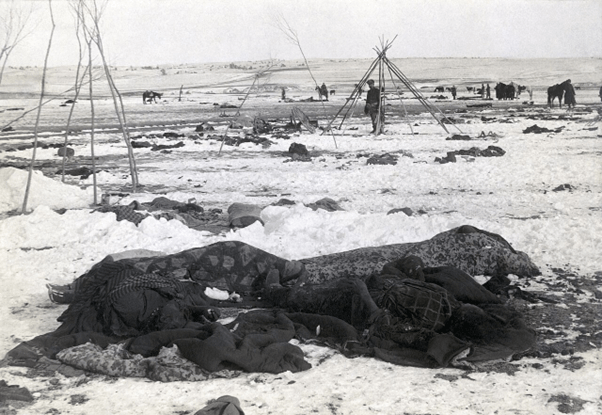
Written by Sam Mackenzie
Content warning: Distressing images, discussion of mass murder and the murder of children.
The wind whips at your face as you feel the wagon jostle beneath you. Blood is sticky on your face, but you dare not wipe it, afraid that the skin on the rest of your cheek shall peel away.
The wagon is silent, despite it being full. Women and wounded men stare in all directions, some at the hay-covered floor, some at their hands and others stare into the sky with their eyes closed. All have blood or tears frozen on their cheeks, most have both.
The babe you hold against your body begins to cry. It is a softer sound than it should be. The child doesn’t have the strength left to wail. None of you do.
The babe is not your own. Your own boy, just a fragile little thing who had only seen one winter, had been torn through by a Bluecoat’s bullet. His bundles had been soaked through with blood before you had realised.
Then the soldier had knocked you down. He kicked your babe away from you as he raised his rifle. His bullet had torn through your shoulder as you struggled to get away. A bullet struck him down before he could fire again. You searched frantically for your bleeding boy, in his sodden red bundle, but the other soldiers were coming quick, and you were dragged away, leaving your babe in the snow.
You rock the little baby who isn’t yours back and forth as it settles.
The night is dark, but nowhere near as black as the day has been. The wagon rumbles to a stop, and some soldiers move about them, shouting words you can’t understand.
Finally, the babe goes back off to sleep, and you brush some fresh snow off its face, just as you had done when you picked it out of the arms of its mother. Her body had been shredded by the mountain gun’s fire, and there was nothing more you could do for her.
The men were dead too, in their shirts meant to keep them safe. The prophet had said they would all be safe. They had lied, like the White men. But the White men are alive, and yours are dead.
Tears warm your face again, and everyone begins to climb down from the wagon.
You are a Squaw woman, and you have just arrived at the Pine Ridge reservation from the massacre of Big Foot’s camp at Wounded Knee.
A Century of Concession
The 19th century had been one of continued humiliation, defeat and concession for the Native Americans on the Western Frontier. These ‘Plains Indians’ were seen as the untameable, unredeemable and godless savages of the more wild and primitive parts of America.
These tribes had all been encroached upon by the White men for years, and naturally they fought back. These conflicts had been known as the ‘Indian Wars for the American West’ or simply the ‘Indian Wars’. These wars had great ups and downs for both sides, and there had been a whole litany of treaties intended to keep the White settlers off the land of the Plains tribes.
But the White men were too many, and their appetite for land was too voracious. In the words of War Chief Red Cloud: “They made us many promises, more than I can remember, but they never kept but one; they promised to take our land, and they took it.”
The Trans-pacific railroad was bringing in more Whites than ever before to the Indian country. This put unbearable strain on the Plains Nations’ way of life. The Buffalo that the plains nations relied on were being overhunted for sport and for their pelts. White men would hang out of the windows of train carriages and shoot Buffalo on the plains and just leave them there to rot. By the end of the 19th century, the Buffalo herds fell from a mighty population of somewhere between thirty and sixty million, to no more than a few thousand.
More Indians lived on reservations than were free, and the conditions out on the plains worsened with every passing year. Not that the reservations were much better. Children were shipped off to schools meant to ‘civilise’ them in the ways of the White men, and Congress fought every year to restrict the amount of food going to the reservations.
The Dance For Hope
The situation for the tribes was bleak, and religion became the crutch leaned on by many. Medicine men, Indian Religious leaders, became extremely prominent in this time.
One such man was Wovoka, a Paiute Medicine man residing in the Waller Lake Reservation in Nevada.
During a Solar Eclipse Wovoka fell into a deep sleep, where he spoke with the Great Spirit and was told that his people, and all the Indian peoples must dance. Dances were a key part of Native religious tradition, and this one was thought to be no different.
In January of 1889, Wovoka held three days of dancing and attracted warriors from all over to watch and take part in his ritual. After the three-day dance was done, Wovoka spoke of a vision. The Indians must all dance the Ghost dance together and then all would be well. The White men would vanish and be gone from the plains. The Buffalo would return in great herds like water off the mountains in spring. All the dead Indian nations would return to them, rising again in health and happiness as they had once been.
This dance spread around the Reservations like wildfire, with the Sioux adopting it with particular fervour. They began wearing white ‘Ghost Shirts’ painted with symbols on them along with the dancing, and these shirts were believed to be impervious to the White man’s bullets.
The Sioux began to sing along with the dances, singing ‘Ghost songs’ such as-
“The whole world is coming,
A nation is coming,
The Eagle has brought the message to the tribe,
The father says so, the father says so.
Over the whole earth they are coming,
The Buffalo are coming, the Buffalo are coming.”
The surge in the popularity of the Ghost Dances rekindled the fire in the hearts of a few old heroes. One such hero was Sitting Bull, the famous chief who had beaten Custer. He became a leader among the Ghost Dances, and this frightened the army so much they ordered him arrested.
During the attempt to arrest the old Chief, a fight broke out and Sitting Bull was tragically murdered by some of the Standing Rock Reservation’s Indian Police on 15 December 1890.
Blood in the Snow
The news “SITTING BULL IS DEAD!” spread around the plains, the United States and the World. It was another death knell for the roaming bands of Plains Indians. The man who, to many, had embodied their fight for freedom, was dead.
Some bands gave up and moved toward the Standing Rock reservation to surrender to the U.S army. Others, such as the band under Chief Big Foot, also called Spotted Elk, decided to head further West.
Big Foot was an old man, a chief of the Miniconjou Lakota, he was in his mid-sixties at the time and was in remarkably poor health. Most days he was too weak to even prop himself up in his stretcher in order to sit and speak.
After the death of Sitting Bull, Big Foot’s band had received some Hunkpapa Lakota, followers of Sitting Bull, and Big Foot was sheltering them in his tribe. As a result, his band was being followed by the forces of Colonel Sumner and was declared “both defiant and hostile” by Sumner’s commanding officer.
Though Colonel Sumner later wrote on the matter “if Big Foot had been hostile or defiant in attitude, I was not aware of it until receiving the orders making him so.”
As Big Foot fled West, his band was met by Major Samuel Whitside, where they met warmly. Each addressed the other “How, Cola” (Hello, friend), and an agreement was made for Big Foot to move his band down to near the creek at Wounded Knee, so they could be peacefully disarmed and brought to the reservation.
The issue of disarmament is the central conflict which caused the Wounded Knee massacre. The Indians in Big Foot’s band numbered one hundred and twenty men and some two hundred and thirty women and children. Many of the men would have had a firearm, and it was almost certainly the most expensive thing he owned. For this reason, and the reason that every event of the last hundred years had taught them not to trust White men, many of the Indian men were reluctant to give up their weapons.
The Indian camp was set up with men of the 7th Cavalry all around it, and a battery of four Hotchkiss guns (early, higher powered machine guns) facing down onto the camp.
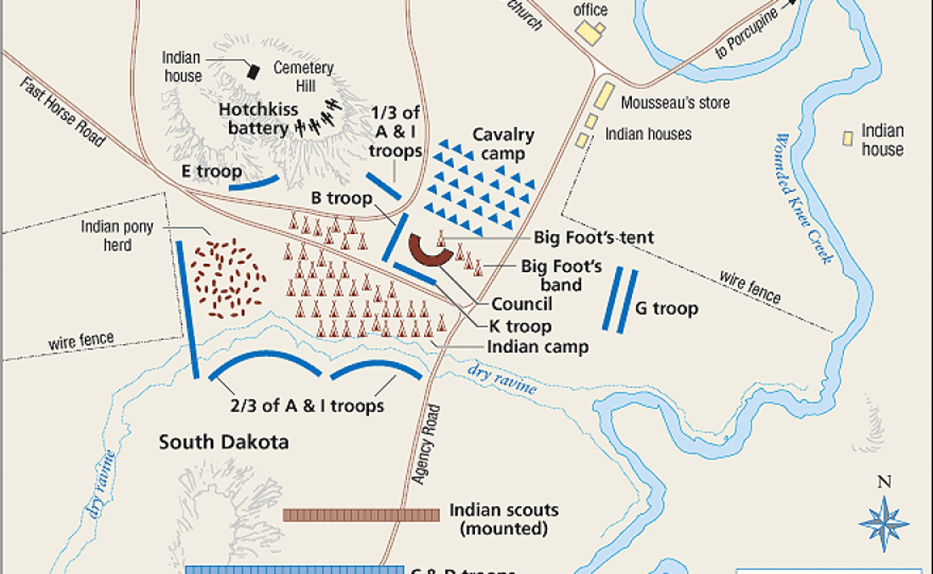
The night of 28 December, all was well. Food, coffee and cigarettes were given out to the Indians in good faith. But there was the sense of uneasiness hanging over the whole affair. The troops of the 7th Cavalry were mostly green recruits, raised through the ranks on the stories of the Indians ‘butchering’ their forebears at the Little Big Horn. And green troops with anger in their bellies can so often lead to disaster.
On the morning of 29 December 1890, the disarmament began. After a round of uncooperative talks, and a measly collection of forty mostly old and broken rifles, there was a search of the camp ordered for all weapons. Soldiers began to rake through tipis, shoving women and children off their bundles and blankets searching for hidden guns.
The bloody affair began when a Lakota man, Black Coyote, was asked to give up his rifle. He began shouting, demanding that the gun was expensive and that he would need to be paid for it. Misinterpreting his shouts as hostile, soldiers began shouting back at the man to calm down and hand over his weapon.
Unfortunately, the soldiers could not understand the cries coming from some of the other warriors.
Black Coyote was deaf.
Two soldiers grabbed Black Coyote from behind in an attempt to disarm him, and, predictably, the gun went off in the air during the struggle.
At this, soldiers and warriors alike were sent into a frenzy. Yellow bird, a medicine man, threw up a handful of dirt, and cried a war cry. Warriors brought rifles out from under their shirts and blankets to fire on the soldiers, and the formation lines of soldiers began pouring fire into the warriors.
The other lines of soldiers began firing into the Indian camp, knowing that some warriors had declined to come out of their tents that morning. The Hotchkiss guns on the ridge began pouring rapid-fire down into the camp.
Men, women and little children, were torn to pieces.
Many fled, frightened women and children ran to the ravines in an attempt to escape, but it was all in vain. After the Hotchkiss guns had blasted the camp for a full thirty minutes, they turned their guns on the fleeing Indians in the ravines.
Additionally, mounted cavalry chased down those who fled, with one soldier recounting that he and his troop had shot five little girls who were running down the ravine to escape the Hotchkiss’ burning fire.
A group of about thirty women and less than a dozen men sought shelter in a wooded gulch. One of the Hotchkiss guns was rolled to the very edge of the gulch and spewed fire directly into the group. Dewey Beard, stated that when the Hotchkiss opened fire, “then there went up from [my] dying people, a medley of death songs that would make the hardest heart weep.”
The clearing of the Gulch lasted twenty minutes. Dewey Beard managed to crawl away and was rescued by some Oglala warriors from a nearby Reservation who had come to inspect what was happening.
Finally, all was silent.
Then the mop up operation began, and the bodies were searched for signs of life. Both Big Foot and Yellow Bird were dead, killed at the very start of the ordeal. One private recalled coming across two babies alive on the ground, clinging to their mothers’ corpses. He scooped the two babes up in his arms and carried them back to the camp. As he walked, a sergeant ordered him to smash the two babies against a nearby tree, saying that otherwise “someday they’ll be fighting us”. The Private refused, saying “I told him I would rather smash him than those little innocent children.” He returned the children to some of the surviving Indian women, who were so overjoyed “they almost kissed me”.
All the wounded and the survivors were loaded into wagons and began rumbling toward the Pine Ridge reservation. The Lakota dead were left where they lay, to freeze in the snow. Their bodies would later be looted, before being dumped in a mass grave.
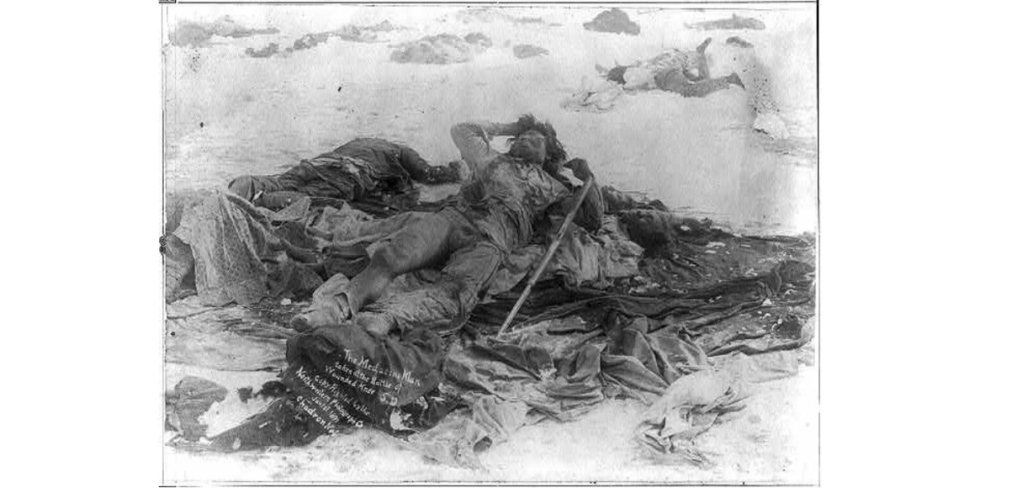
All in all, Wounded Knee yielded only fifty-one survivors of the three hundred and fifty Indians camped there on the morning of 29 December. Seven more Indians would die of their wounds at Pine Ridge Reservation. The vast majority of those killed, were women and children.
The U.S army suffered twenty-five killed. Many of these are believed to be as a result of friendly fire from the Hotchkiss guns. The United States government officially classed Wounded Knee as a battle until 1990, where it was finally designated as a massacre.
The night of 29 December 1890, the feeble remnants of Big Foot’s band were placed inside the Chapel of the Reservation. The only sound that pierced the grim silence was a droning cry of “Min-nie, min-nie, min-nie, [water]” from a little girl. A newspaper man rushed to give her a cupful, but it did her no good. She had only just swallowed the cool, clear liquid when it came gushing back out in a bloody stream from a hole in her neck.
Hanging about these wounded and broken people were Christmas decorations. Green holiday garlands were fixed to the walls, and the lights of the church were turned up to mimic warmth. A large banner hung above the scene, with its Christmas message in huge letters:
“Peace on earth, good will to men”
“I did not know then how much was ended. When I look back now from this high hill of my old age, I can still see the butchered women and children lying heaped and scattered all along the crooked gulch as plain as when I saw them with eyes still young. And I can see that something else died there in the bloody mud and was buried in the blizzard. A people’s dream died there. It was a beautiful dream… The nation’s hoop is broken and scattered. There is no centre any longer, and the sacred tree is dead.”
-Black Elk.
Bibliography
Image Credits:
Camp and remains – http://loc.gov/pictures/resource/ppmsca.15849/
Map of Camps – https://www.sdpb.org/images-of-the-past/2014-12-16/author-rex-allen-smiths-account-of-the-1891-wounded-knee-massacre
Body of Yellow Bird – https://www.loc.gov/pictures/item/2004665232/
Sources:
Andrist, Ralph K. 1964. The Long Death. New York : Macmillan.
Brown, Dee. (1970) 2014. Bury My Heart at Wounded Knee : An Indian History of the American West. New York: Fall River Press.
Cozzens, Peter. 2018. EARTH IS WEEPING : The Epic Story of the Indian Wars for the American West.
Jacoby, Karl. 2003. “Of Memory and Massacre: A Soldier’s Firsthand Account of the ‘Affair on Wounded Knee.’” The Princeton University Library Chronicle 64 (2) https://doi.org/10.25290/prinunivlibrchro.64.2.0333
Mattes, M.J. (1960). The Enigma Of Wounded Knee. Plains Anthropologist, 5(9), pp.1–11. https://doi.org/10.1080/2052546.1960.11908206
 Retrospect Journal