

Written by Helene Chaligne
A new exhibition has recently opened in Rome, at the Palazzo Barberini, which explores Caravaggio’s body of work in chronological order. Some works have been reunited after centuries of being apart. The exhibition’s chronological order speaks to how the artist’s life has fascinated and often added a layer to how people view the Western world’s master of light and shadow.
From a more personal angle, my favourite episode from Caravaggio’s life remains his Roman brawl over the way he wanted his artichokes. He asked for four cooked in butter and four in oil and, upon them arriving at his table, asked how he should know which was which. According to one account, the waiter told the artist to smell them in order to differentiate them, an answer that would prompt Caravaggio to throw the plate of artichokes in the waiter’s face at, what the witness described as, “mustache level.” The artist then reached for his friend’s sword and the waiter promptly fled the scene. Another account describes a more audacious waiter, as he was reported to have picked the artichokes up himself and smelt them after declaring he didn’t know which was which. Caravaggio’s violent response is only one in a life full of erratic and brazen behaviours which led to more than one encounter with the law.
Not only is this account quite dramatic and intriguing on its own, but another layer is added to it as Jesse Locker observes it “provides a fascinating glimpse into the social life of Rome around 1600, and the unlikely intersection of art, honor, and artichokes.”
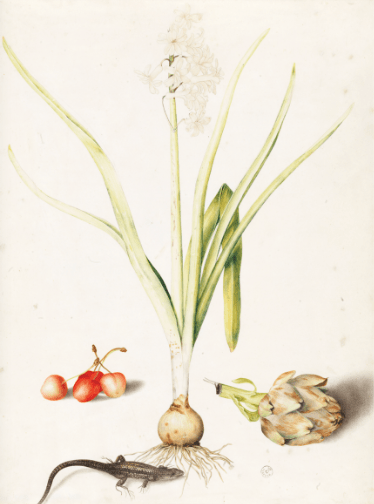
The first account of artichokes in Italy dates to 1466, when a banker brought them back from Naples to Florence. In the fifteenth century, they were primarily found in the gardens of the Arab quarters of Palermo and Venice, mostly unknown to the Christian population. They would develop from being a luxury to a more widespread dish in the sixteenth century. The first depiction of artichokes in Italian art is the passive canvas at the Galleria Borghese in Rome. Another interesting work is Giovanna Garzoni’s Hyacinth with Four Cherries, a Lizard, and an Artichoke (Figure 1), which depicts spring produce. Interestingly, the hyacinth was native to Mesopotamia and was being grown in Italy by 1590. This highlights an interesting way in which customs and symbols emerge and stick swiftly, with the hyacinth becoming a symbol of spring, alongside cherries and the artichoke being an iconic component of Roman cuisine.
The linguistic aspect of the feud ties into class relations at the time, as it is reported that Caravaggio accused the waiter of cuckoldry and of treating Caravaggio as a “barone”. Cuckoldry remains the foundation of most Italian insults today and barone originally meant “baron” but could also mean beggar, ruffian, rogue, or bum. This would indicate the artist was not only offended by the waiter’s behaviour but also believed he was insulting Caravaggio’s social standing.
Contemporary biographers of Caravaggio put down his behaviour to his humoral makeup. Humors were the popular theory that chemical systems regulate human behaviour, which fell out of favour with the discovery of microbes. The theory notes three humors: blood, yellow bile, phlegm, and black bile. An individual’s temper could thus be determined based on the dominance of one of these. For example, melancholic people had more black bile and excess phlegm. Funnily enough, Baldassare Pisanelli, a Bolognese physician, cautioned that artichokes inflamed blood vessels and increased libido and should therefore only be consumed by those with cold temperaments. Jesse Locker thus observes that, from a humoral point of view, Caravaggio should not have been consuming artichokes in the first place.
Caravaggio would be tried for this incident but, thanks to his powerful protector Del Monte, received no penalty. The painter’s violent habits were not uncommon in Clement’s Rome, but his paranoid responses and fragile sense of honour reflect his personal insecurities related to his status, even when he was the most celebrated artist in Rome.
Two years after the artichoke affair, Caravaggio killed Ranuccio Tomassoni in a deadly brawl on the tennis courts close to the Palazzo di Firenze. Some reports claim the two men clashed over a tennis match, and others seemed to argue that Tomassoni challenged Caravaggio to a duel. The victim’s wealthy family made it too hard for his patrons to protect him as they once had, and he was forced to go into exile. The artist was able to leverage his trade when taking cover in Malta after the incident. In exchange for two portraits and an altarpiece, Caravaggio was dubbed Knight of Obedience in July 1608. The altarpiece, The Beheading of Saint John the Baptist, is his largest work and the only one he has signed.
Caravaggio died sometime around 1610; the causes are debated, with most historians arguing he passed due to an illness. Bones found in Porto Ercole that are believed to have belonged to the artist showed high levels of lead, something that historians have linked to his erratic behaviour as well as a potential cause for his demise.
Caravaggio is one of John Berger’s favourite artists due to him being “the first painter of life as experienced by the popolaccio, the people of the back streets, les sans-culottes, the lumpenproletariat, the lower orders, those of the lower depths, the underworld.” Reflecting on Caravaggio’s life and even simply on his culinary habits, one can uncover so much about his contemporary society starting merely from what he and his companions were eating, which then leads to insight on social mores, the flow of culinary goods, class and status, and even medical history. While the artist obviously maintains his fame from his influence on Baroque and his dramatic use of chiaroscuro (strong contrasts between light and dark), his life continues to fascinate and prove a fruitful source for exploring a variety of aspects of seventeenth century Italian society.
Bibliography
Berger, John. “Caravaggio: A Contemporary View.” Studio International 196, no. 998 (1983).
Eva Sarah Molcard. “21 Facts about Caravaggio.” Sothebys.com. Sotheby’s, July 25, 2019. https://www.sothebys.com/en/articles/21-facts-about-caravaggio.
Langdon, Helen, and Merisi Da. Caravaggio : A Life. Boulder, Colo. Westview Press, 2000.
Riley, Gillian. “Caravaggio: Fury, Food and Fine Art | Art UK.” artuk.org, September 29, 2017. https://artuk.org/discover/stories/caravaggio-fury-food-and-fine-art.
Warwick, Genevieve. Caravaggio : Realism, Rebellion, Reception. Newark, Del University Of Delaware Press, 2006.
Figure 1: Giovanna Garzoni, Hyacinth with Four Cherries, a Lizard, and an Artichoke, Tempera and traces of black pencil on vellum, photo by Roberto Palermo, Galleria degli Uffizi, Florence.
Featured image credit: The Beheading of Saint John the Baptist , 1608. Oil on canvas, St. John’s Co-Cathedral, Valletta, Malta.
 Retrospect Journal