
Written by Eva Beere
30/03/25
James Marion Sims, regarded today as the “Father of American Gynecology”, was one of the most revered American physicians in the country in the nineteenth century. He rose to prominence when he carried out the first successful operation to repair a vesicovaginal fistula, a severe complication which arises from childbirth. From there, he became a hero of medicine, boasting a successful career that saw him elected as the President of the American Medical Association in 1876. However, behind his success was his unethical experimentation on enslaved Black women.
Born in Lancaster County, South Carolina in 1812, Sims received medical training during a time when textbook-based studies were preferred over hands-on medical training. After attending only a three-month internship at Charleston Medical College, and a year-long study at Jefferson Medical College, Sims returned to Lancaster to practice and teach medicine. After the death of two of his patients ruined his reputation, Sims left South Carolina and headed southwards, establishing the first women’s hospital in the United States, in Mount Meigs, Alabama. Here, between 1844 and 1849, Lucy, Betsy and Anarcha, along with nine other unidentified enslaved women, lived and worked in Sims’ slave hospital, under the dual status of patient and worker. Over these years, Sims would subject these women to a series of operations in his attempt to find a treatment for vesicovaginal fistulae, a treatment which would later make him one of the most revered figures in the history of American medicine.
Unlike the white women he treated in his hospital in New York, the women Sims experimented on were forced to undergo invasive surgeries without anaesthesia. For example, Anaracha had thirty surgeries and experiments conducted on her, all of which were unsuccessful and agonising. Only after Anarcha’s thirtieth operation did Sims successfully repair her fistula, perfecting a technique he would later use on other patients. This clearly demonstrates how elite white physicians in the Antebellum South had regular access to enslaved women’s bodies, using them to boost their own reputation in the medical field regardless of their patients’ desires.
Along with being continuously operated on, these enslaved women were also expected to help Sims run his hospital. Sims created a rotational work cycle in order to help his hospital run efficiently: whilst some women recovered from their surgery, often being bound to their beds for two weeks, others worked on his slave farm and within the hospital. When, after two years of working in Alabama, Sims had failed to cure any of his patients, he lost the loyalty of his white medical apprentices, forcing him to train his enslaved patients to work as surgical nurses. As Sims’ practice grew, they began to learn the fundamentals of gynecological treatment and surgency, and during Sims’ last two years leading the hospital, he taught these women how to assist him during surgery.
Due to the large amount of help he received from his enslaved patients in Alabama, Sims was able to recover his reputation in the medical field. Over the remaining course of his career, Sims managed to establish himself as one of the country’s most revered gynecological surgeons. In 1852, his article “On the Treatment of Vescio- Vaginal Fistula” was published in the American Journal of Medical Sciences; in 1855 moved to New York where he opened the Women’s Hospital of the State of New York; and, just before his death in 1877 he was elected president of the American Medical Association.
Despite his legacy, his medical malpractice has been heavily criticized in the twenty and twenty-first centuries. In 1894, a bronze statue of Marion Sims was erected in Bryant Park, New York to celebrate his status as ‘one of the great surgeons of the nineteenth century.’ In 1934, this statute was moved to Central Park, where it remained until 2018, when a group of activists criticized venerating a racist surgeon who used the subordination of Black enslaved women in antebellum America to further his career and status within the medical field.
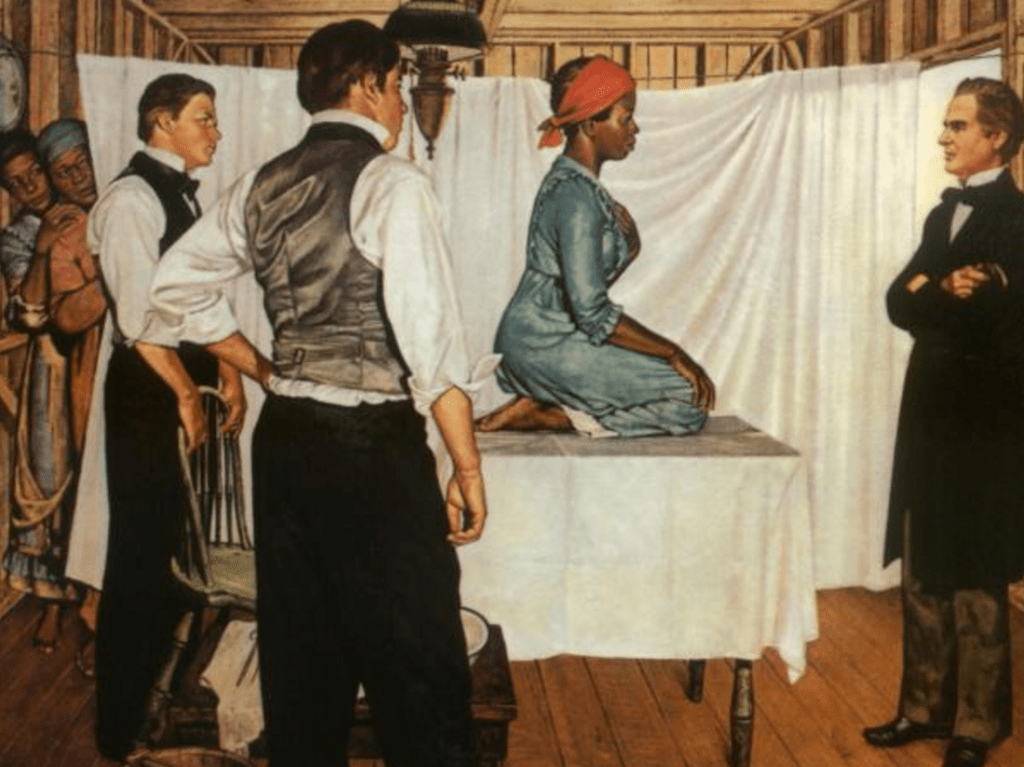
Furthermore, American artist Robert Thom rewrote the common narrative of Sims as a heroic and triumphant figure and instead portrayed him as a menacing and cruel physician who subjected his patients to fear and terror. His painting from 1952 depicts the only known representation of Anarcha, Betsy, and Lucy, whom Sims operated on and studied. The painting shows an encounter between Lucy and Sims in a hospital, as Sims clasps a speculum in his right hand, suggesting he is about to examine her. As Anarcha and Betsy hide behind a white curtain, two other men gather around the table, demonstrating the intrusion and lack of privacy the enslaved women were subject to while being examined. Thom’s painting serves as a juxtaposition to contemporary accounts of Sim’s success. For example, on May 12th, 1869, Mineral Point Tribune issue which discussed his Women’s Hospital in New York, claimed ‘No lady is degraded by entering the Women’s Hospital.’ By critiquing Sims’ experimentation methods, modern day accounts shatter the illusion of Sims as a revered physician and instead portray him as an elite white doctor who mistreated and used enslaved women for medical experimentation, to establish a successful hospital and surgery for white women in need of healthcare.
These later criticisms of Sims’ work highlight the intersection between race, gender, and medicine in nineteenth-century America, whereby elite white men exploited the racial and sexual hierarchies in antebellum society in order to boost their own success and maintain these racial boundaries. Whilst framing themselves as medical heroes and protectors of women, physicians experimented on black enslaved women in order to allow them to continue to reproduce to expand the slave labor force.
Whilst Sims was highly venerated by the newspapers and described as someone ‘American can well be proud of,’ the women who formed the backbone of his medical work were overshadowed. James Marion Sims’ work existed as part of a wider discussion of racialised medicine when Black people were regarded as biologically inferior to white people, often leading to biased treatments and diagnoses of diseases which neglected their needs. Thus, the experimentation he conducted on Anarcha, Betsy, and Lucy, along with nine other enslaved women whose identities are unknown, highlights how race played a key role in the history of American medicine and gynaecology.
Bibliography:
Léveillé, J.B. Dr. James Marion Sims and Nurse Repairing a Vesico-vaginal Fistula Patient. In
Henry Savage, The Surgery, Surgical Pathology, and Surgical Anatomy of the Female Pelvic Organs, in a Series of Coloured Plates Taken from Nature with Commentaries, Notes, and Cases. 2nd ed. London: J. & A. Churchill, 1870.
Mineral Point Tribune (Mineral Point, Wis.), May 12, 1869. Chronicling America: Historic
American Newspapers. Library of Congress.
OWENS, DEIRDRE COOPER. Medical Bondage: Race, Gender, and the Origins of American Gynecology. University of Georgia Press, 2017. https://doi.org/10.2307/j.ctt1pwt69x.
Public ledger (Memphis, Tenn.), 15 November 1883. Chronicling America: Historic American Newspapers. Library of Congress.
The Newberry Herald (Newberry, S.C.), 09 March 1881. Chronicling America: Historic
American Newspapers. Library of Congress.
Thom, Robert. J. Marion Sims: Gynecologic Surgeon. 1952. Oil on Canvas, 4 ft. 8 13/16 in. x 46
in. The Collection of Michigan Medicine, University of Michigan, UMHS.30.
Wall, L. L. “The Medical Ethics of Dr. J. Marion Sims: A Fresh Look at the Historical Record.”
Journal of Medical Ethics 32, no. 6 (June 2006): 346–50.
Featured Image Credit: https://www.npr.org/2016/02/16/466942135/remembering-anarcha-lucy-and-betsey-the-mothers-of-modern-gynecology.
 Retrospect Journal