

Written by Fleur O’Reilly
There is a strong preconception of travel as a modern concept, ignoring that the urge to explore is not a new one. To believe that people in the Middle Ages did not leave their hometowns or travel further than their neighbouring villages, or even worse, had no knowledge of others, would be an insult to them and would be part of this mistaken perception we have of people before the Renaissance. Of course, travel was not nearly as quick or accessible as it is now: transport was limited to horses, carts, walking, and boats before the advent of trains in the nineteenth century. It would also be a further misconception to pretend that travel was common or undertaken by everyone. However, this article would like to dispute the many claims that travel was non-existent and look specifically at England and the broad reasons for travel; England’s history has always been one of travel and blends of culture.
Travel was essentially a road trip for people of all classes with a range of reasons to be travelling. Those with money would travel by horse or in a carriage; those with less would travel in a cart or by foot. Travel by sea was precarious and weather dependent. Trade from the early Middle Ages reveals links between Europe and China, the Middle East, and the Baltic. Spices, silks, gold, and perfumes were all transported from different regions. Towns would hold market fairs once a week, but they would only sell locally produced items due to the expense of transporting internationally; the cost of tolls, transport, and the dangers of losing wares on route to robbers or nature meant only expensive items were worth it. Although, once a year, certain towns would hold trade fairs where people would travel from all over the region to attend. The most famous examples are from the Champagne region in France, which was famed for its entertainment and dances. Five of these trade (or charter) fairs took place in England. These fairs would sell wool and cloth imported from Europe, alongside spices and wax, with entertainment on the side. By 1516, England had 2,767 fairs, the largest of which took place in Stamford, St. Ives, Boston, Winchester, and Northampton, lasting around four weeks and drawing in merchants from all over Europe. The Norman Conquest marked a turning point in English trade; whereas before, English trade had been primarily concerned with Scandinavia, 1066 opened it up, and saw their relationship with France and the Lowlands improve, trading with mainland Europe for cloth and wine. There is evidence of long-distance throughways linking English regions throughout the Anglo-Saxon era. In 934, King Aelstan and his court travelled from Winchester to Nottingham in 8 days; another example is the transportation of St. Aethelwold’s body from his place of death in Beddington, near Croydon, to Winchester, sixty miles away, in two days. These distances suggest maintained roads for frequent travel. As seen in Figure I below, roads linked London to as far as York.
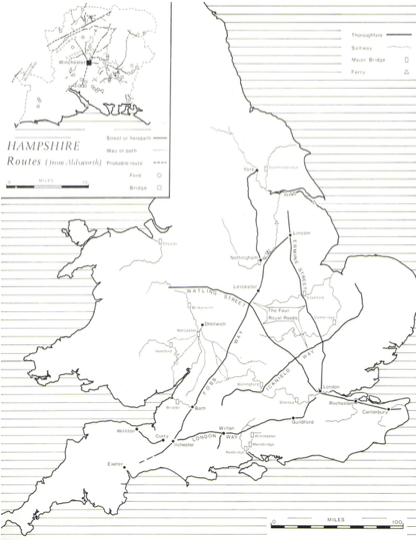
Figure I – major roads in Anglo-Saxon times (from Aldsworth). P 116 D. Hill, An Atlas of Anglo-Saxon England (Oxford: Blackwell, 1981)
Another common reason for travel was pilgrimages. These were undertaken by all members of society and could extend from a journey to somewhere in their own country, all the way to Jerusalem. Pilgrims would often undertake these journeys on foot or horseback as a sign of spiritual devotion, although they would often occur in the summer months, acting as a holiday, some scholars propose. The main locations for the English to take their pilgrimages to were Canterbury, Jerusalem, and Santiago de Compostela. Within England, Canterbury was a centre of pilgrimage to give thanks, attracting thousands of visitors each year. Visitors came from all over and may have even come from as far as India. Pope Innocent VIII writes in a letter dating to 1489 ‘[Three pilgrims] came from India to Jerusalem, and stayed there for several years, and have come to Rome in order to visit the basilicas of the Apostles Peter and Paul and other basilicas, and intend to visit the church of St. James in Compostela and the churches of St. Mary, Finistére, Mont Saint-Michel in Normandy, and St. Thomas of Canterbury in England, and then to return to Jerusalem, and thence to India.’
Tour Guides such as the twelfth century Liber Sancti Iacobi, were published as proxy travel guides for the pilgrims, with useful phrases and information on the towns and customs along the pilgrims to Santiago de Compostela, demonstrating large movements of ‘proto’ tourists. Uprisings also demonstrate some internal movement. The 1381 peasant’s revolt saw around 6,000 people travel from all over the southeast to London to protest for their rights.
Alongside this, warfare was another cause for travel. While often only to neighbouring lands, some wars saw soldiers travel from England to Jerusalem, travelling through all of Europe to get there. The Hundred-Year War often saw armies travel from England to France; each battle would contain around 5,000-7,000 soldiers on each side. The English had divisions from all over the kingdom, from Cornwall to Wales to Yorkshire. This point proves the hardest to gain evidence for as records of soldiers in battles prove limited. However, we do know that armies would travel to different countries to participate in wars, such as the Crusades, as well as travel around their own country, such as during the War of the Roses. The armies would contain ordinary people, especially under the feudal system, which was a form of conscription that brought these men to new lands outside of their hometowns.
Medieval courts were also not stationary; in fact, they were the opposite, travelling from town to town and sometimes across countries for visits, politics or marriage. These courts were known as travelling kingdoms and had a political as well as economic function. Importantly, capital cities had yet to emerge. Although under Norman rule in England, the court was a lot more stable and centralised in London. Travelling also allowed the monarch’s image to disseminate and spread their power in an age before newspapers and photography. Another reason for this travel was food and resources; maintaining a court of the size they did was hard to feed and ensure the space was habitable; travelling was one way to work around this issue. Figure II highlights the different cities Athelstan held court between 924 and 939, showing a wide range of regions. Diplomats would travel from court to court, as would much of the aristocracy. Marriage reveals these relationships between kingdoms acting as an exchange of courts and good relations. Marriages outside of kingdoms for diplomacy always existed; as early as 926AD there were records of betrothals outside of England, with the betrothal of Eadhild (daughter of Edward the Elder, King of the Anglo-Saxons) to Duke Hugh of Francia (son of King Robert I of France) at Abingdon.
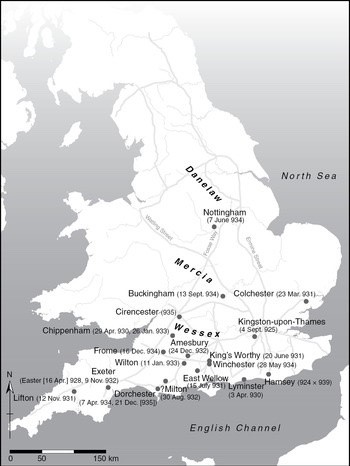
Figure II- Dispositive’ assemblies, 924–39. Roach, Levi. “Meeting Places and Times of Assemblies.” Chapter. In Kingship and Consent in Anglo-Saxon England, 871–978: Assemblies and the State in the Early Middle Ages, 45–76.
A final category of travel would be those intrepid explorers who travelled to explore and record it or simply for a new life. Of course, the boundaries of kingdoms, empires and duchies were less defined than they are now. The most famous example of a medieval explorer was Marco Polo in the mid-thirteenth century, who served in the court of the Mongolian Empire. It would be ignorant not to believe that immigration was still a phenomenon, internally and to other countries and regions. By the fifteenth century, one in ten people in England were foreign-born; in London, the rate was even higher, every one in six. Similar to nowadays, there were those who fled their countries from war, persecution, or natural disasters, both the wealthy and the poor. They worked as servants, labourers or even bankers. As always, reception towards immigrants was mixed. Between 1440 and 1487, the records show that over 55,000 resident foreigners paid a special taxation, suggesting that between one per cent and two per cent of England’s population were foreign. Figure III shows just one insight into the number of documented immigrants entering and living in England, illustrating just French immigration between 1440-49. However, this taxation is not wholly representative: it did not include the names of women who had married an English or Welsh man, those who could not afford the taxation, some religious orders, or those who had purchased their letters of denisation. Furthermore, there was little incentive for the tax to be collected or to single out immigrants in communities.

Figure III- Map showing results by residence: France 1440-49. Image source: England’s immigrants 1330-1550. Accessed via : https://www.englandsimmigrants.com/search/chart/england?origin=france&chartFacet=residenceCounty.untouched&documentStartDateDecade_untouched_facet=1440+-+1449&page=1
All in all, it would be a bold misconception to assume that medieval Europeans remained entirely isolated from knowledge of other places or experiences of foreign cultures. While often imperfect or riddled with inaccuracies, maps and travel books were produced and circulated. One notable example is The Book of John Mandeville, which survives in 300 manuscripts and was translated into ten languages, reflecting a widespread curiosity about the broader world. Medieval Europe harboured a palpable desire to understand distant lands, even if much of this understanding was filtered through limited or imaginative sources. Although we lack extensive written records from ordinary people regarding their experiences of travel, evidence suggests that movement and cultural exchange were not uncommon. For some, travel was an intrinsic part of life, challenging the stereotype of the medieval person as wholly ignorant of the wider world.
Bibliography
https://thebecketstory.org.uk/canterbury/journeying
D. Hill, An Atlas of Anglo-Saxon England (Oxford: Blackwell, 1981)
Roach, Levi. “Meeting Places and Times of Assemblies.” Chapter. In Kingship and Consent in Anglo-Saxon England, 871–978: Assemblies and the State in the Early Middle Ages, 45–76. Cambridge Studies in Medieval Life and Thought: Fourth Series. Cambridge: Cambridge University Press, 2013.
Lutkin, Jessica, and Mark W. Ormrod. “Alien Subsidies in Medieval England.” Our Migration Story. https://doi.org/https://www.ourmigrationstory.org.uk/oms/by-era/AD43%E2%80%931500.
 Retrospect Journal