
Written By: Michaela Hamman
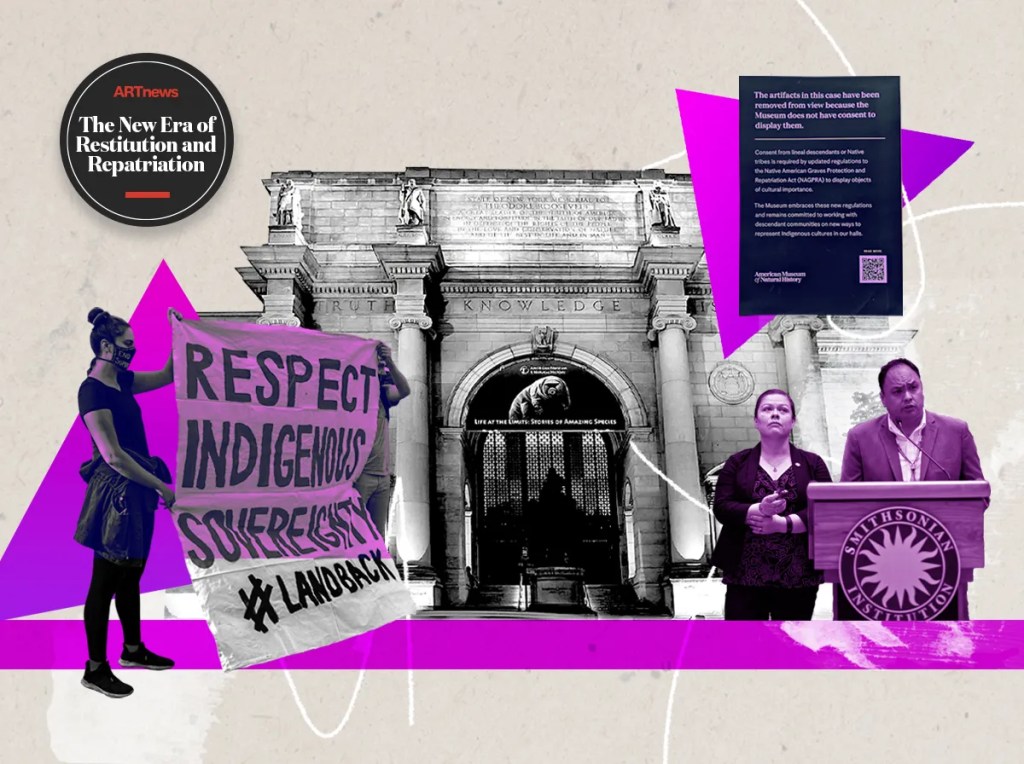
In 1990, the United States acknowledged the centuries of racist and colonial practices that built the country’s museum and university archaeological and anatomical collections. Recognizing the rights of Native American tribes, Native Hawaiian organizations and Native Alaskan villages, the United States passed repatriation legislation. This article will use Natalie Grumhaus’s definitions of repatriation and cultural heritage. Repatriation can be understood as “the permanent return of objects of cultural heritage to the nation or culture from which they were removed.” Cultural heritage or property covers objects of archaeological, historic, artistic, scientific, or other interest that “tells an important story about a nation’s heritage, people, history, and ideals.” The 1989 National Museum of the American Indian Act (NMAIA) and the 1990 Native American Graves Protection and Repatriation Act (NAGPRA) were the first national laws mandating repatriation of Native American human remains in the United States. While the past thirty-five years has led to thousands of human remains and objects being repatriated, the process has not been without difficulties.
While NMAIA only addresses the collection of the Smithsonian Institution, NAGPRA applies to all federal museums or agencies and museums that receive federal funding. Under NAGPRA, repatriation of Native American human remains, associated funerary objects, unassociated funerary objects, and sacred objects is required. A 1996 update to NMAIA expanded its application from only culturally affiliated human remains and funerary objects to align with NAGPRA.
Both legislations lay out a required process for repatriation. Collections need to be inventoried, associations researched, notifications sent to affiliated tribes, and, once a formal request for repatriation is received, the cultural property be returned expeditiously. If an object is unassociated or human remains argued to be too old for association to a modern-day tribe, a federal agency can transfer them to a group that is not a potential claimant. If a museum or Federal agency is unable to determine the cultural affiliation of ancestral remains, then the tribe or Native Hawaiian organization is required to provide “reasonable” evidence. Museums and federal buildings are required to complete inventories of human remains and associated funerary objects within no more than five years. Museums are allowed to request extensions, but only after an earnest effort and consultation with descendants, tribes, and organizations.
Despite this legal progress, there are still problems within NAGPRA. Importantly, the legislation does not protect Native American ancestors on private land. Parts of the human body that could be given or shed, such as hair or teeth, are also not protected. Furthermore, there are scientific exceptions to NAGPRA if the study’s outcome is of major benefit to the country. Scientific study is limited through regulation and requires tribal consent but occurs despite being against Tribal interests. Lineal descendants, American Indian tribes, and Native Hawaiian organizations can receive relevant records, catalogues, and other data, but the data is not categorized as objects of cultural patrimony. Archival collections, which can be a physical or digital document, image, recording, artefact, or other object that preserves memory or knowledge, can contain culturally sensitive materials. Despite their exclusion from NAGPRA, documents and other archival artefacts can be a part of institutional policy. Providing digital access and restricting research and access to materials of community importance to best align with tribal wishes can help restore heritage, especially if there are geographical complications to access.
NAGPRA, and NMAIA, has resulted in large numbers of repatriation, yet institutional stalling and large collections mean there is still much to do. Between 1990 and 2019, the Smithsonian repatriated, or informed tribes of, over six thousand human remains, two hundred and fifty thousand funerary objects, and one thousand four hundred cultural objects. As of September 2024, NAGPRA has resulted in 126,299 human remains, out of 216,804 reported, being repatriated. The same report stated that, out of around 4.3 million reported associated funerary objects, just under 3.66 million are repatriated. Spickard and Lovely wrote of the 2023 project by ProPublica and NBC News investigating repatriation which revealed that there were ancestors “whose remains have not been made available for return to their descendants,” despite legal requirements. Specifically, there are 104,539 Native American ancestors held by 617 institutions, including universities and government departments, and another thirty thousand held by the Smithsonian Institute. Not included are reported ancestors, in theory available for repatriation upon request, that have not been returned.
One of the institutions reported by ProPublica for not complying with NAGPRA was Phoebe A. Hearst Museum of Anthropology, part of the University of California, Berkley. The museum collection comprises of approximately 3.8 million objects, owned by the University of California’s Board of Regents. Other than transfers within the university, the Hearst Museum last acquired human remains in the 1980s. Despite being subject to NAGPRA, reports state that the University of California, Berkley only began to comply with NAGPRA in 2018. They developed an online collections portal, making accessible approved meta-data, paper documentation, and imagery, allowing descendant communities to access key information despite geographical distance. The Phoebe A. Hearst Museum also began identifying human remains not originating from the United States in the collection, proposing but not requiring repatriation to source communities. However, this is after the state of California passed Cal-NAGPRA in 2001, specifying enforcement methods and broadening who could receive repatriations, and the University of California adopted UC-NAGPRA in 2022, which instructed all campuses to expedite return of human remains and cultural objects. In 2023, the University of California, Berkley still had over nine thousand human remains in their collection.
NAGPRA legislation does little for the objects of other minoritized communities in American collections. The process remains slow and difficult with geographical, financial, and other roadblocks Native communities need to hurdle in the repatriation process, with little governmental support. However, NAGPRA acknowledges Native rights and allows the process of repatriation to become normalized, keeps inventories of collections correct and updated, and fosters collaboration between communities.
Bibliography
Grumhaus, N. (2023) “Spoiled Spoils of War: When Are Official Spoils of War Legitimate Acquisitions at the British Museum?”, Michigan State International Law Review, 31(1), pp. 37-70.
Jacobs, J. and Porter, B. (2022) “Repatriation in University Museum Collections: Case studies from the Phoebe A. Hearst Museum of Anthropology”, International Journal of Cultural Property, 28(4), pp. 531-550.
Krupa and Grimm (2021) “Digital Repatriation as a Decolonizing Practice in the Archaeological Archive”, Across the Disciplines, 18(1-2), pp. 47-58.
National Park Service (2024) Fiscal Year 2024 Report: National NAGPRA Program. Available at: https://irma.nps.gov/DataStore/DownloadFile/711020 (Accessed: 11 November 2024).
Native American Graves Protection and Repatriation Act Systematic Processes for Disposition or Repatriation of Native American Human Remains, Funerary Objects, Sacred Objects, and Objects of Cultural Patrimony (2023) United States Department of the Interior: Office of the Secretary. 43 CFR Part 10. Available at: https://www.federalregister.gov/documents/2023/12/13/2023-27040/native-american-graves-protection-and-repatriation-act-systematic-processes-for-disposition-or (Accessed: 11 November 2024).
Native American Graves Protection and Repatriation Act, c. 32. Available at: https://uscode.house.gov/view.xhtml?path=/prelim@title25/chapter32&edition=prelim (Accessed: 11 November 2024).
Sinn, D. (2024) “‘Finders Keepers, Losers Weepers!’: Why the United Kingdom Should Respond to Repatriation Claims and the Lesson the United States Can Teach”, Penn State Law Review, 128(2), pp. 603-34.
Spickard, P. and Lovely, K. (2023) “Respecting the Ancestors: On Repatriating American Indian Remains”, California History, 100(4), pp. 3-17.
Watkins, J. (2023) “Repatriation Acts: The Politics of Repatriation in North America”, in Smith, C. (ed.) Encyclopedia of Global Archaeology. Springer, pp. 9164-9169.
 Retrospect Journal