
Written by Abbie Teal
30/03/25
“To dance and hop, women and men…
Until at last the sickness left them.”
On the streets of Strasbourg in the summer of 1518, a unique contagion spread vigorously amongst civilians. Unlike its bubonic counterpart, this plague infected the lives of the citizens in a most perturbing way; equal in deadliness to the Black Death yet rather more perplexing to behold.
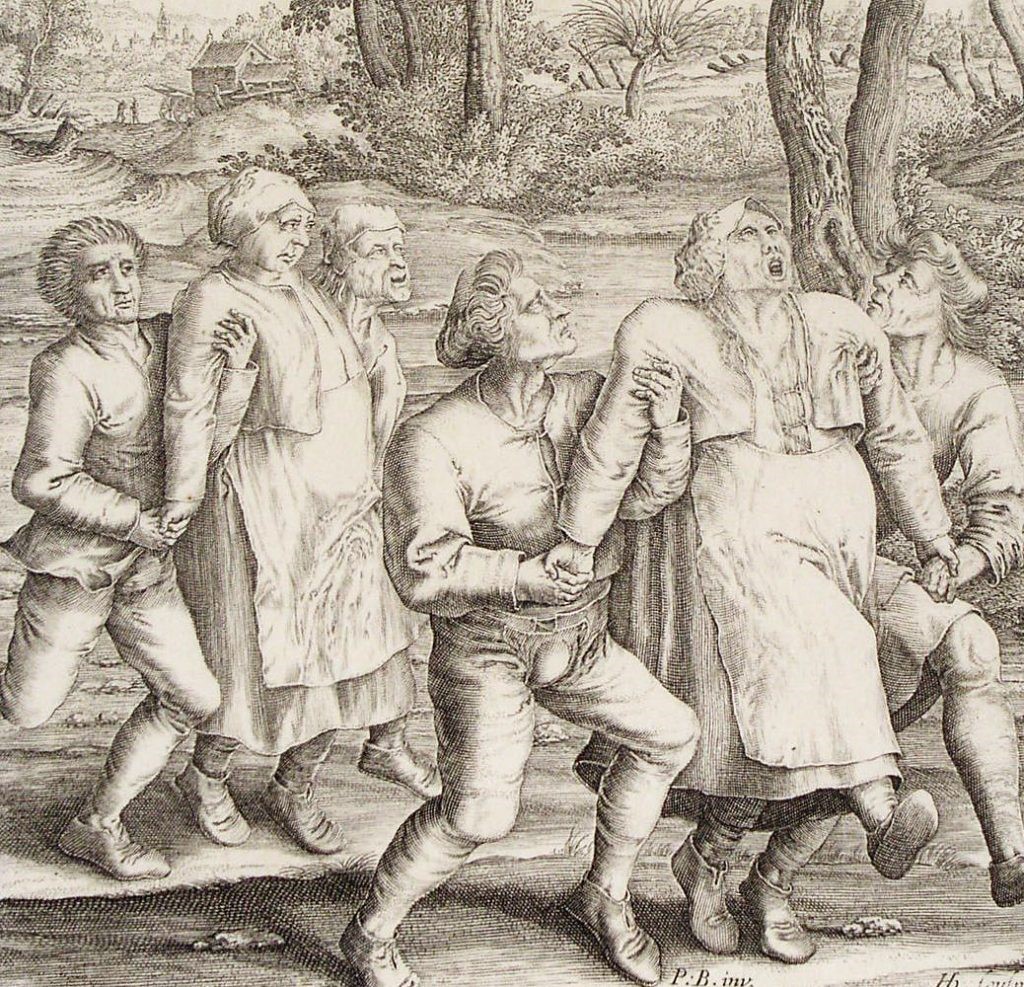
Beginning in what sources describe as an exceptionally warm month of July, Mrs Troffea stepped onto the streets of Strasbourg and began to display symptoms of a contagion which would come to be known as the Dancing Plague. Carrying out frenzied, uncontrollable, compulsive dancing, devoid of respite, it was no wonder she eventually collapsed with exhaustion.
Not long after this initial peculiar display, the contagion began to spread, with more than thirty individuals finding themselves afflicted with similar symptoms before the end of the week. The disease inhibited rest, and after collapsing with exhaustion, the frenzied dancing merely continued, with as many as fifteen people dropping dead per day.
Unsure of how to react, authorities naturally assumed that the cure for uncontrollable dancing was, of course, more dancing!
Therefore, in an unsurprising turn of events, the setting up of dancing halls and hiring of musicians were to ‘no avail’, according to medieval chronicler Specklin, and many infected dancers in fact ‘danced themselves to death’ regardless. Despite the remedial attempts of authorities, the number of dancing deaths eventually reached around four hundred people.
Whilst dancing plagues had broken out across Europe in earlier decades, the 1518 spread marked the first case where medical reasoning was considered when finding an explanation. However, as is often the case with medieval medical reasoning, each suggestion remained as confusing as the next.
Perhaps with consideration of the uncharacteristically warm July, medieval physician Paracelsus attributed the dancing to the heating of blood within the ‘laughing veins’, proposing the forcible cooling of the body and application of medicine to particularly ticklish areas. A more religious explanation considered the dancing to be a form of divine punishment, with the affliction adopting the name of the ‘St. Vitus dance’, after the patron saint of epileptics and dancers.
It therefore followed that to heal such an affliction required the non-conformist to visit the church of St. Vitus, where they would henceforth be cured through clerical pronouncement and consequent intervention of the Saint. Upon the unfortunate failure of this remedy, the remaining afflicted, who had not yet died or been cured, were loaded into wagons, and promptly removed from the city henceforth!
So, what, from a modern perspective, is assumed to have caused such a bizarre plague to emerge? Even amongst modern historians there appears to be a lacking consensus regarding the decisive origin.
One opinion adopts a sociological approach, with Bartholomew suggesting that the dancers were adherents of a heretical sect, dancing to attract divine esteem.
Whilst this explanation is certainly intriguing, the most widely accepted theory remains the belief that the Dancing Plague was a phenomenon explained by science, with religious suggestions once more succumbing to scientific explanations in the form of a fungal disease. Modern day investigators suggest that the rye flour bread consumed by the population contained the disease ergot, which was known to produce drastic convulsions.
Therefore, no matter how much we might have hoped otherwise, the curious events of 1518 could be attributed, as with all plagues, to germs.
Similarly, whilst its historical fame has failed to transcend that of its Bubonic equivalent, it is justified to conclude that the Dancing Plague is rather more memorable in its peculiarity.
Bibliography
Bauer, P. “dancing plague of 1518.” Encyclopedia Britannica, February 27, 2025. https://www.britannica.com/event/dancing-plague-of-1518.
MILLER, LYNNETH J. “Divine Punishment or Disease? Medieval and Early Modern Approaches to the 1518 Strasbourg Dancing Plague.” Dance Research: The Journal of the Society for Dance Research 35, no. 2 (2017): 149–64. https://www.jstor.org/stable/90020124.
Featured Image Credit: https://publicdomainreview.org/essay/the-dancing-plague-of-1518/.
 Retrospect Journal