
Written by Lauren Hood
Historians have traditionally classified 1960s Britain as an ‘affluent society’. Amid significant cultural change in the 1960s, most importantly the emergence of a distinctive youth culture, historians in the decade after the period such as G. Murdock and R. McCron have argued that the 1960s represented “the imminent arrival of a capitalist society without classes”. The connection between affluence and increased spending power amongst young people was argued during the period, with T.R. Fyvel claiming in 1961 that an increased spending power amongst teenagers was a distinctively working-class phenomenon, and therefore so too was the youth culture and goods which this inspired. In pushing this narrative of affluence which benefited the working-class, historians fail to adequately explore experiences of poverty and slum housing which many of Britain’s poorest remained living in.
The photography of Nick Hedges highlights the everyday experiences of poverty and squalor, the reality of many Britons during the ‘affluent society’ of the 1960s. Commissioned by housing and homelessness charity Shelter amid the ‘rediscovery of poverty’ within British social sciences, Hedges captured the poor living conditions often believed to have been eradicated by post-war welfare policies, such as the creation of the NHS. This article will use the work of Nick Hedges to explore the social issues which existed throughout working-class communities during the ‘affluent society’.
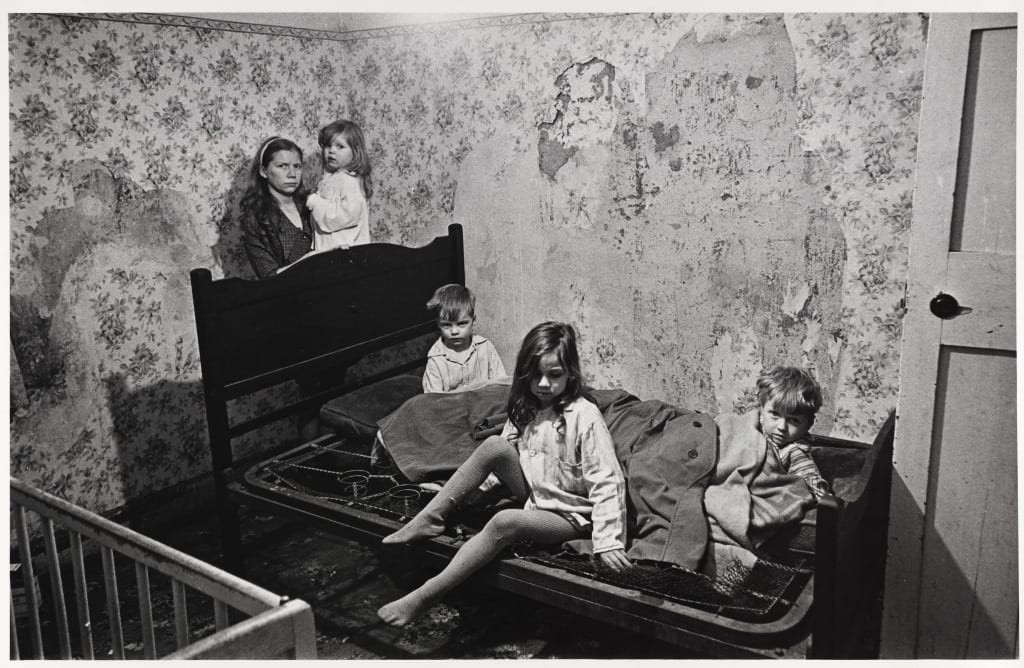
Inside of a council-owned house, Birmingham, 1969.
This image shows a mother and her four young children living in a house with peeling wallpaper, dirty (and potentially mouldy) floors and furniture, and “old ‘macs’” as a mattress. This photograph highlights the poverty and substandard living conditions which remained in Britain, emphasizing how not everyone felt the benefits of increased consumerism and household spending, as this family does not have adequate furniture or safe living conditions.
The description offered alongside this photograph stresses the dangerous conditions of the house and surrounding area, with the home providing inadequate warmth for the family and broken glass presenting a danger to their health. This description implies that the family’s living environment creates challenges for their everyday life and safety while showing that the surrounding local area is in a similar poor condition.
That this image portrays a council house suggests governmental acceptance of these conditions, and that the family likely has no alternative option than the home they are living in. Furthermore, the council letting a family live in such squalor suggests this is a widespread problem, meaning that these living conditions were common amongst the poor. The nature of this property being council-owned is further reinforced by the lack of personal belongings or decorations due to the insecurity which the family are living in.

Inside of a tenement flat in Maryhill, Glasgow, 1970
The demure, almost ashamed, expression of this young girl when Hedges is capturing her living conditions contradicts contemporary narratives of unprecedented spending power for young people and families, challenging both media and scholarly claims. The existence of this image and the aim of showing the poverty which people faced, highlights contemporary fears from Shelter over increased wealth disparities fuelled by consumerism and an acknowledgment that not everyone was benefiting from it.
This fear over increasing wealth disparities and how long increased consumerism would last, was evident in a Harold MacMillian speech of 1957. The most famous phrase of this speech is MacMillian’s declaration that “most of our people have never had it so good”, with this often used as proof of British affluence during the 1960s. However, this speech also highlights contemporary fears over the new presence of consumerism in Britain, with it often forgotten that MacMillian went on to warn of the dangers of consumerism and affluence, acknowledging that not everyone would benefit from this.
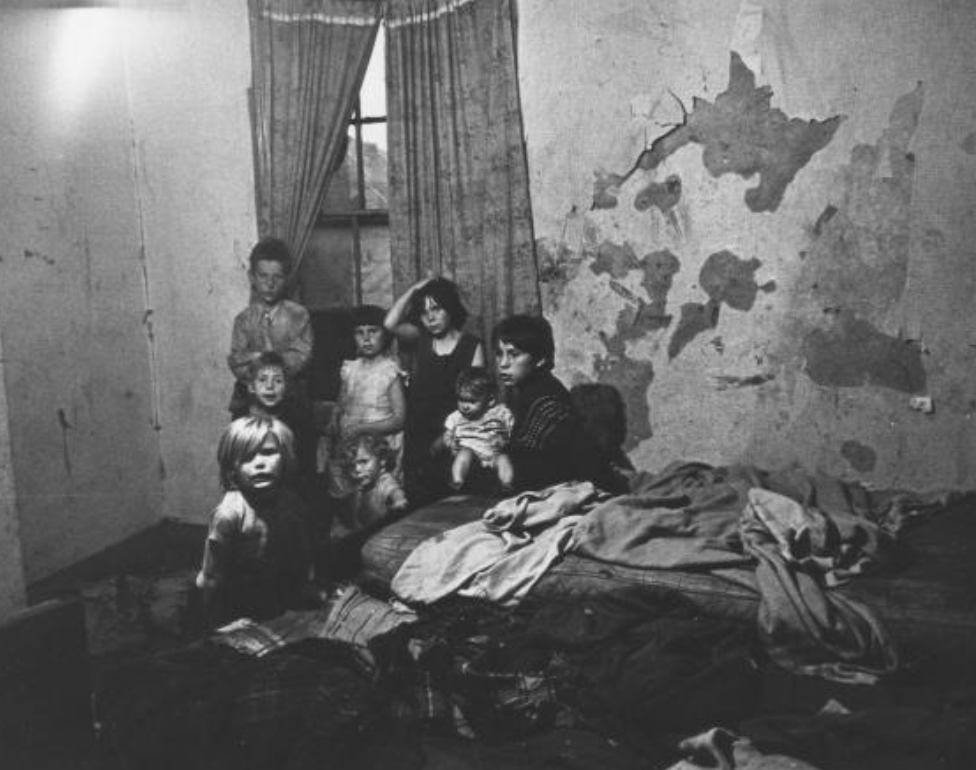
Eight children in a slum bedroom in Moss Side, Manchester, 1969.
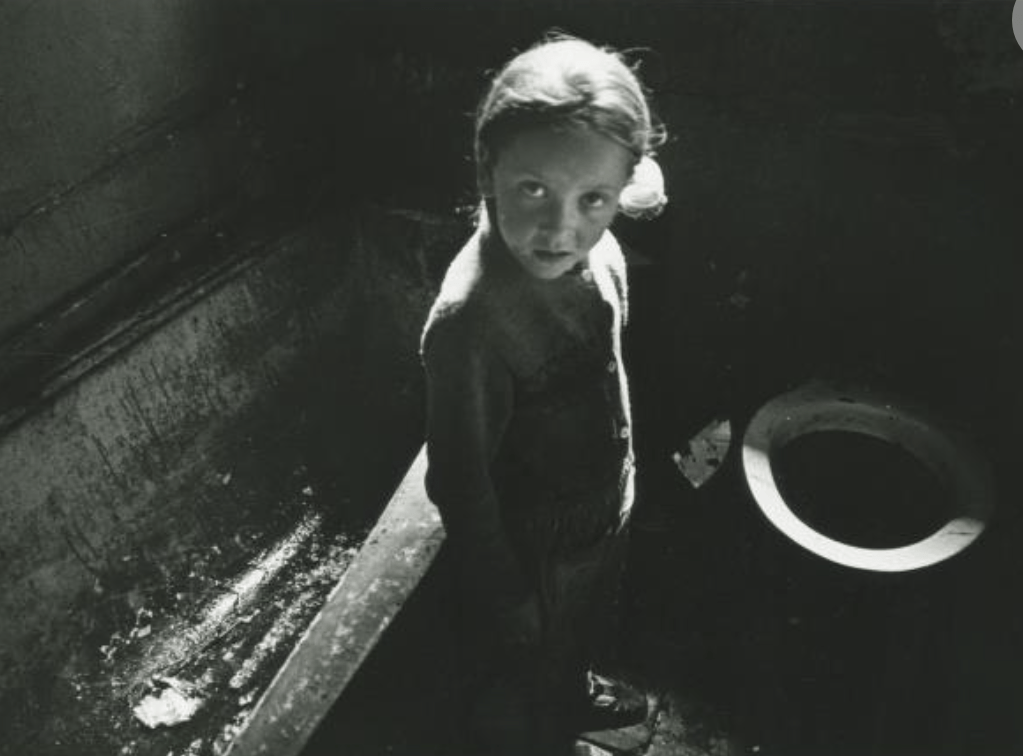
Young girl in a slum bathroom in Moss Side, Manchester, 1969.

Girl in slum interior, Liverpool, 1971.

Mother and her baby boy in a Gorbals tenement yard, Glasgow, 1970.
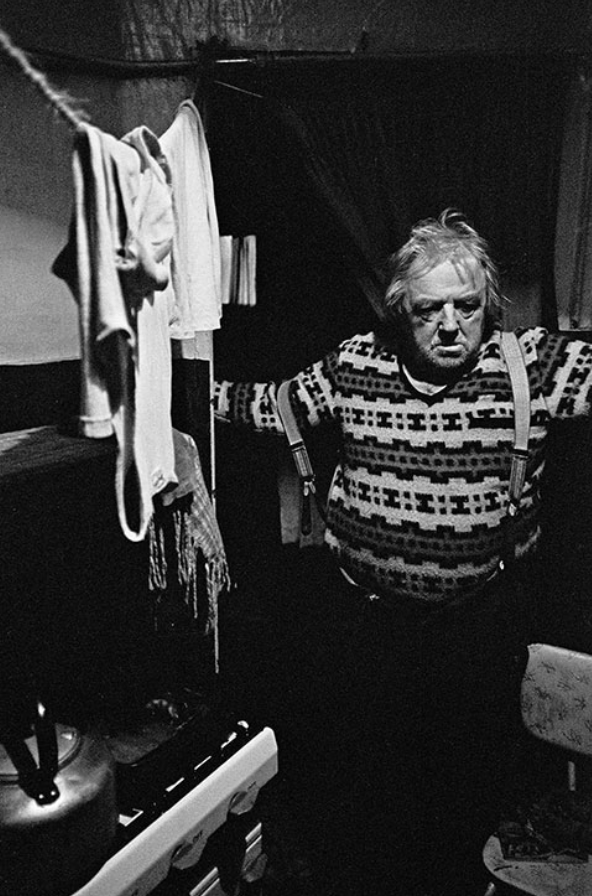
Senior citizen living in a damp basement tenement flat in South London, 1971.

Child and baby, Birmingham, 1971.

Child on the staircase of his tenement home, Glasgow, 1971.

A toddler climbing over a demolished house in Ladywood, Birmingham, 1968.

The only house left occupied in Falkner St., Liverpool, 1969.
These photographs highlight widespread issues of poverty and slum living conditions across Britain in the 1960s and early 1970s. The work of Hedges highlights the importance of capturing lived experiences of working-class people, reprioritizing the personal within discussions of contradicting societal issues such as affluence and poverty. Illuminating the widening wealth inequalities which spread throughout Britain in the 1960s allows for a more nuanced discussion about the period. The experiences of poverty and slum living conditions were fundamental to large proportions of the British population during the 1960s, and in classifying the period as an ‘affluent society’ these experiences are largely forgotten.
Bibliography
Black, Lawrence and Hugh Pemberton. An Affluent Society? Britain’s Post-War ‘Golden-Age’ Revisited. Routledge, 2004.
Fyvel, T.R. The Insecure Offenders: Rebellious Youth in the Welfare State. Chatto and Windus, 1961.
MacMillan, Harold. Speech at Bedford Town, 20 July 1957. The Times (22 July 1959).
Majima, Shinobu and Mike Savage. “Contesting Affluence: An Introduction.” Contemporary British History 4 (2008).
Murdock, G. and R. McCron. “Youth and Class: The Career of a Confusion”. Resistance Through Rituals. Edited by Hall and Jefferson, 1976.
Todd, Selina. “Affluence, Class and Crown Street: Reinvestigating the Post-War Working-Class”. Contemporary British History 4 (2008).
Image credits:
Nick Hedges Photography. “Slum Housing and Poverty”. Accessed 13 March 2025.
http://www.nickhedgesphotography.co.uk/photo-gallery/slum-housing-and-poverty
Science Museum Group. “Birmingham, January 1969. Mr. and Mrs. M. and Their Four Children.” Accessed 8 February 2025. https://collection.sciencemuseumgroup.org.uk/objects/co8423839/birmingham-january-1969-mr-and-mrs-m-and-their-four-children
Connecting Histories. “The Shelter Archive: Photographs by Nick Hedges”. Accessed 13 March 2025.
 Retrospect Journal