

Written by Ailsa Fraser
Part V of V of Natural Contracts: Historical Partnerships Between Humans and Other Animals
The articles in this series have looked at a range of nonhuman animals, all admired or loved, even if merely through familiarity. But there are animals humans have historically partnered with that are not widely loved today, though they are intensely familiar. Consider: the humble pigeon.
They adorn every city pavement. You’ve probably cursed them at least once as you walked down the road; they were in your way. There’s a good chance that even if you haven’t, you never gave them much thought. These staples of our urban ecology are just nuisances. Winged rats, I’ve heard them called. Pigeon spikes adorn buildings everywhere to stop birds from roosting (and pooping). In bigger cities, the injuries pigeons get frequently are obvious on their bodies: missing toes and bent wings. They’re wild birds that lived too close to humans and got burned.
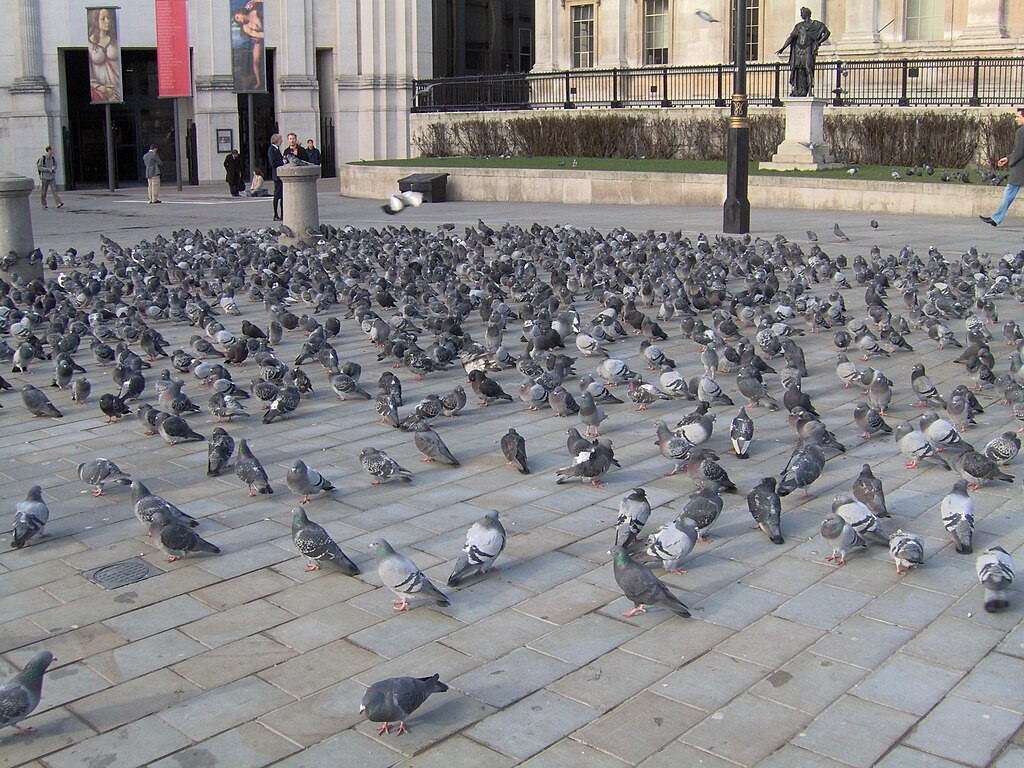
Figure 1: A flock of feral pigeons in London.
But the pigeons that live in our towns and cities aren’t wild birds. They’re feral. Once—like dogs, like cows—we domesticated them.
I’m referring here specifically to feral pigeons, which can come in a range of colourings, though the most common is in the photo above. There are other pigeons within the same species, like woodpigeons and stock doves, but they are of different descent and different habitats. Woodpigeons, as the name suggests, live in wooded areas and are very attracted to gardens (there are certainly plenty in mine). Stock doves, meanwhile, you’re more likely to see foraging in farmland. Other doves, like collared doves and turtle doves, are in a different genus altogether. But feral pigeons and those that are still domesticated today are descended from rock pigeons—a bird found on rocky cliffs and mountain faces all around the globe. These birds became the carrier pigeons of the past and the racing pigeons still bred today, and when they escaped or were released, now obsolete, they went feral.

Figure 2: A common woodpigeon.
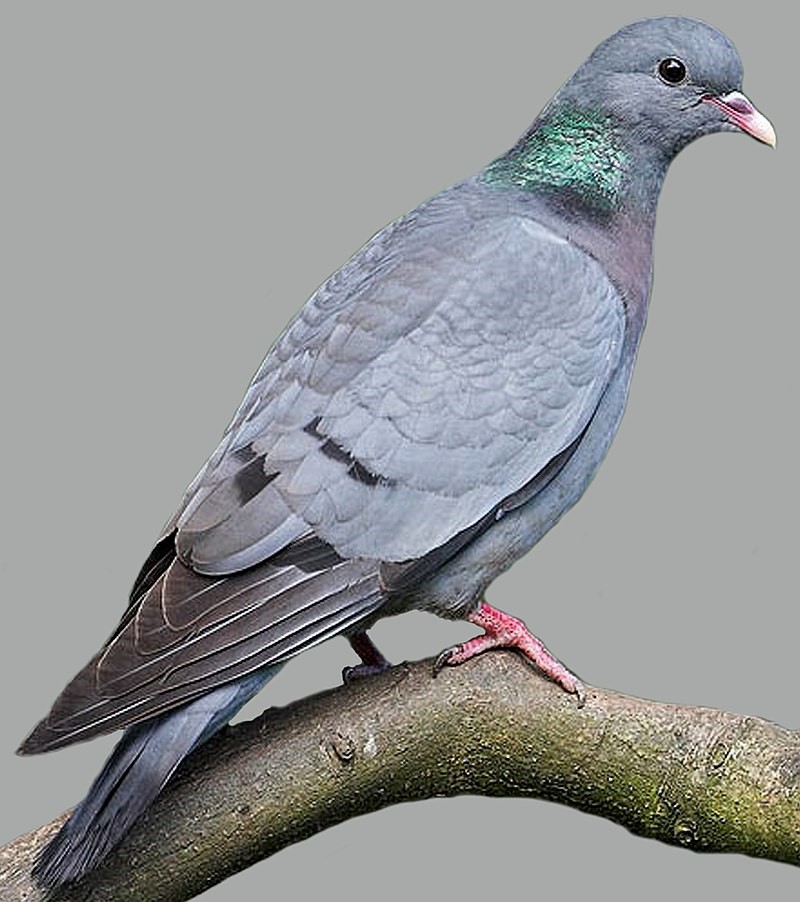
Figure 3: A stock dove.
Rock pigeons are intelligent birds. Their extraordinary endurance in flight is what made them attractive for domestication, not to mention their homing abilities, which scientists today still struggle to explain. They have a unique ability to find their way home, no matter where they’re released. More than anything, they are social creatures and have always been far more comfortable living alongside humans than other doves. Some go so far as to argue that they domesticated themselves with how closely they lived with us. They likely moved from living in caves to living in purpose-built houses at the same time in the distant past that we did; today, the roofs of buildings take the place of rocky cliffs. But they were known for their fickleness and flightiness, and dovecots were made especially tempting for them to prevent them leaving.
Artefacts depicting doves have been unearthed from Ancient Egypt, but it’s Rome from which we get the earliest written record of dovecots being kept, where several Roman writers mention them. Most dovecots in medieval Europe were modelled off of Roman dovecots, though today there’s an enormous range of designs. They had many uses, including as food and as bait for falconry (see my previous article in this series for more on falconry), but their role as messengers is perhaps most historically notable. The earliest records of pigeon messengers come from fifth century CE Chinese texts that describe tying letters to a pigeon’s leg, but by the twelfth century, there was a system of ‘pigeon post’ established in Baghdad, which carried messages as far as Syria and Egypt. The concept was first introduced to England in the seventeenth century, but it didn’t become popular until the nineteenth century. At that time, pigeons became used as messengers in wartime across Europe, most notably during the 1870–71 Siege of Paris during the Franco-Prussian War, where they allowed besieged Parisians to keep in contact with the outside world.

Figure 4: The Bogward Doocot (Dovecot), a sixteenth-century dovecot in St Andrews, Scotland. It’s designed to look like a bee-skep, or beehive (see my article on bees).
During the First World War, they served a similar role, being deposited in enemy-controlled territory so spies could attach information to their legs and release them to fly home with the intelligence. By the Second World War, though, their use had declined. Despite this, the Dickin Medal, which was given to British animals for wartime service and was the equivalent of the humans’ Victoria Cross, was awarded to several pigeons in the Second World War, including Winkie, as pigeon who saved the crew of a crashed plane by delivering their request for help. Even when their use in war faded, their relationship with humans continued in other ways. Pigeon racing and fancying had been a popular pastime in nineteenth century Britain. It was so widespread, and the visual effects of selective breeding on pigeons’ appearances so evident, that Charles Darwin used pigeons as an example of ‘artificial selection’ to contrast his theory of natural selection and argue that species could change over time. These pursuits continued, and pigeon sports are still conducted today—including aerobatics, where pigeons are trained to do acrobatics in midair for entertainment.
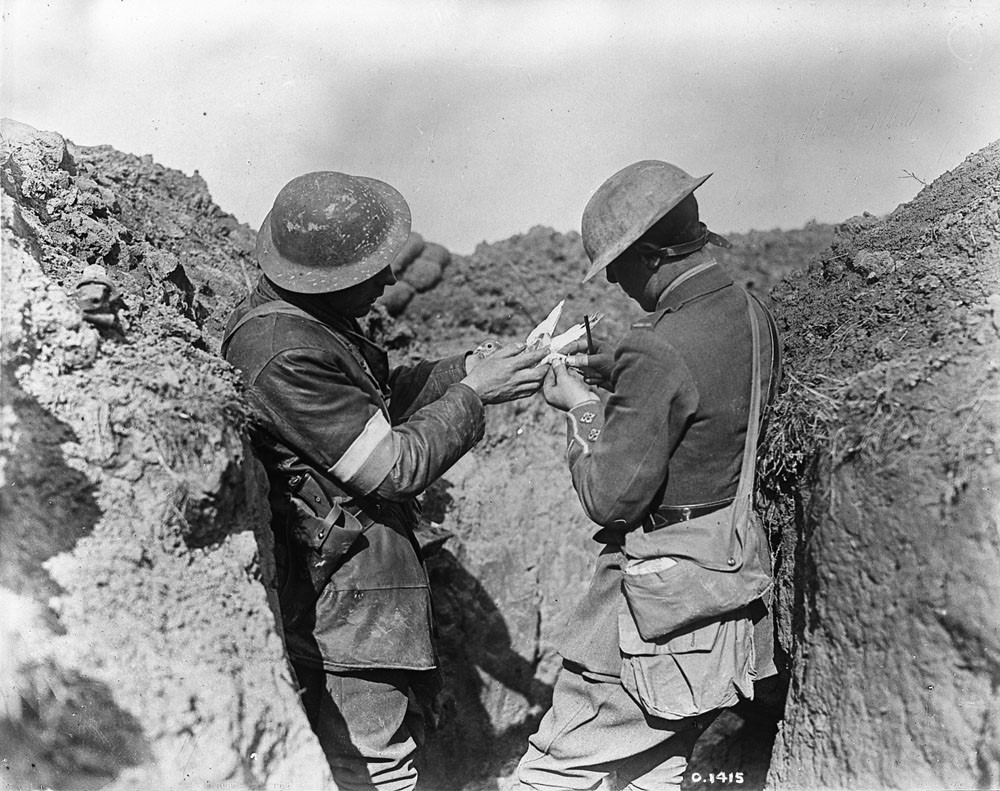
Figure 5: First World War soldiers attaching a message to the leg of a carrier pigeon.
Pigeons have had a varied reception over the millennia they’ve associated with us. Even today, we tend to consider ‘doves’ as beautiful while ‘pigeons’ are mundane; similarly, studying their history is difficult as they would be called doves in religious contexts, associated with peace and beauty, and pigeons in everyday life. They become a poignant symbol for human-nonhuman relations. Over the years, they’ve experienced us as wild animals, as domesticated partners, and as ex coworkers. Their presence in cities is partly what has moved the peregrines I discussed in the previous article to cities, as pigeons remain a major part of their diet. They demonstrate the role of animals themselves in being domesticated, just like dogs, as their social behaviour likely bolstered the process, as well as historical cruelties humans have enacted toward our partner animals: they’re only feral because we abandoned them. But still, they remain. Thousands of years of species co-existence lurks behind the brief, irritating spat you had with that overly bold pigeon on the street.
Perhaps that complicated relationship can pave the way for a brighter future. We see pigeons every day. They’re the ideal point to start appreciating a bit more the nonhuman world we disdain—however dirty, smelly, and downright rude it might be. There’s been increased interest in recent years in urban ecology, the multitudes of life that exist even in the cities we live in. Pigeons are only the tip of the iceberg, but they’re a good place to start. How do they live? How do they treat us? How can we co-exist with them?
Because it is possible to live alongside them, both happily and productively. Every animal featured in this series, including humans ourselves, has learnt over thousands of years to live in environments with a surprisingly high density of humans. Our future looks the same as our past: deeply social and deeply grounded. We have never been alone.
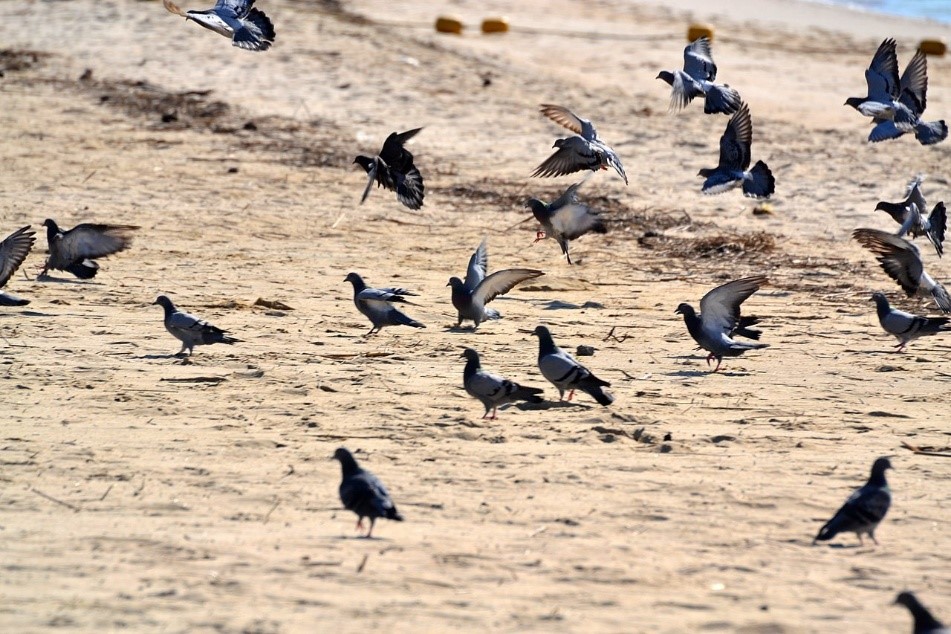
Figure 6: Pigeons in flight.
Bibliography
Bowman, Reed. “Superdove? How Humans Facilitated the Success of the Rock Pigeon.” Ecology (Durham). Ecological Society of America, 2009.
Bridle, James. Ways of Being: Animals, Plants, Machines: The Search for a Planetary Intelligence. London: Penguin Books, 2023.
Greenoak, Francesca. British Birds: Their Folklore, Names, and Literature. London: Christopher Helm, 1997.
Hansell, Jean. The Pigeon in History, or The Dove’s Tale. Bath: Millstream Books, 1998.
Svensson, Lars, Killian Mullarney, and Dan Zetterström. Collins Bird Guide: The Most Complete Guide to the Birds of Britain and Europe. Third edition. London: Harper Collins, 2022.
Theunissen, Bert. “Darwin and His Pigeons. The Analogy Between Artificial and Natural Selection Revisited.” Journal of the History of Biology 45, no. 2 (2012): 179–212. https://doi.org/10.1007/s10739-011-9310-8.
Image credits:
Figure 1: By ProhibitOnions at the English-language Wikipedia, CC BY-SA 3.0, https://commons.wikimedia.org/w/index.php?curid=7079316.
Figure 2: By Jakub Hałun – Own work, CC BY-SA 4.0, https://commons.wikimedia.org/w/index.php?curid=90703712.
Figure 3: By jim.gifford – Flickr, CC BY-SA 2.0, https://commons.wikimedia.org/w/index.php?curid=72718108.
Figure 4: Photograph by author.
Figure 5: By Castle, W.I. (William Ivor), official Canadian war photographer – Library and Archives Canada does not allow free use of its copyrighted works. See Category:Images from Library and Archives Canada., Public Domain, https://commons.wikimedia.org/w/index.php?curid=33443434.
Figure 6: By Tony Alter from Newport News, USA – Pigeons on the Move. Uploaded by theveravee, CC BY 2.0, https://commons.wikimedia.org/w/index.php?curid=26892341.
Featured image: Photo by Hugo Martu00ednez on Pexels.com
 Retrospect Journal