
Written By: Alexander Stroem
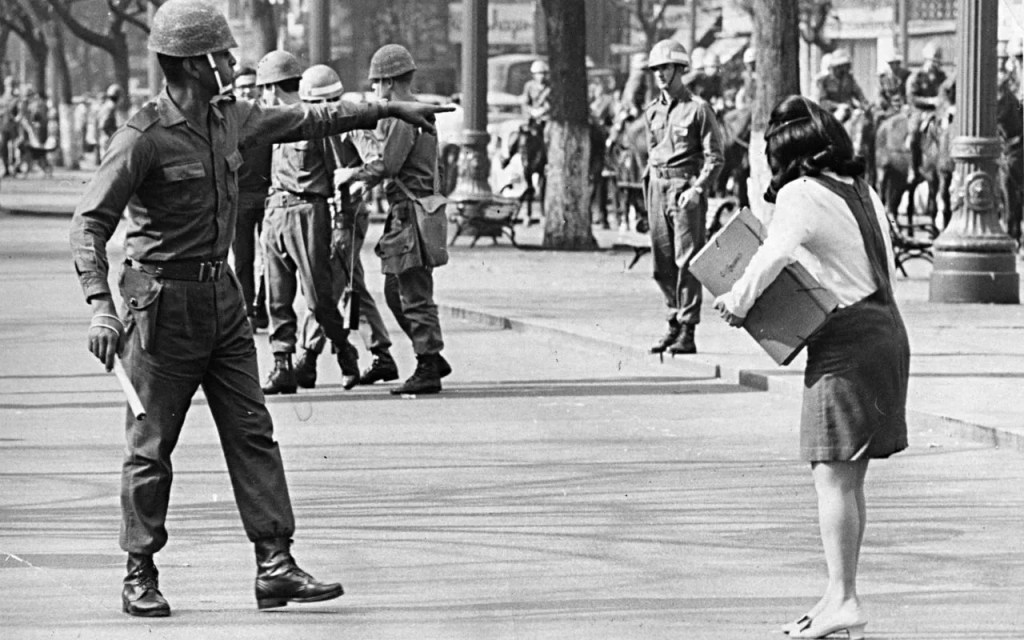
On March 15, seemingly an ordinary day for many, Brazil reaches the fortieth anniversary of the restoration of democracy following two decades of military dictatorial rule from 1964 to 1985 (although a liberalizing transition towards “redemocratization” [redemocratização] had begun in 1979). The period, characterized by its indirect-democratic authoritarianism (mostly with fraud and by a 686-member electoral college established in 1967) under the Aliança Renovadora Nacional (ARENA) and Partido Democrático Social (PDS, until 1979), censorship, persecution (by exile, torture and assassination) and Indigenous persecution, remains inherently fastened to Brazilian public historical memory and is often used even today in political discourse. Particularly notable in this case is former president Jair Bolsonaro (2018/2019-2022), himself an ambitious officer during the period, who has spoken favorably of the period, even denying it to be a dictatorship at all. However, the image remains generally much more negative, being characterized as a period that “sullied Brazilian life with blood, torture and death for twenty-one years”, as noted by former president Dilma Roussef. Yet this unpopularity is not limited to the widespread repression evident throughout the period, but also its economic failures and lack of changes. Indeed, despite its earlier economic success in the late 1960s to 1970s, the later 1970s and 1980s saw a deep recession (1981-1983), widespread through Latin America and the “Third World”, which very soon resulted in the rising popularity of several prominent opposition parties and widespread protests, particularly among students and workers, ushering in the return of the civilian government by the election of 1985.
Brazil’s economic situation before and during the early-middle military period is characterized by contrasts and subsequent growth beginning in 1964 with the overthrow of President João Goulart and the Fourth Republic (1946-1964). In the years prior to the coup of 1964, the Brazilian economy saw a notable decline in various spheres following increased public spending (notably in public infrastructure and transport, as well as electrical energy, and industry) while lacking the required capital and fiscal system, resulting in an increased rate of issuing currency and subsequently an inflation rate of 54.8 per cent by 1962. By the time of the coup of March 1964, inflation stood at around 91.8 per cent with a substantial deficit. Indeed, according to the preamble to the first of the Institutional Acts (Atos Institucionais) passed by the military regime, which essentially sought to justify the deposition of Goulart and fortify executive powers (presidential and by extension military), the “victorious revolution” aimed to “complete the mission of restoring economic and financial order in Brazil”.
With the ensuing reforms to Brazilian capitalism spearheaded by the Government Program of Economic Action (PAEG) under the technocratic Minister of Planning Roberto Campos and Minister of Finance Octavio Gouveia de Bulhões, the dictatorship, led by General Humberto de Alencar Castelo Branco since April 1964, managed to reduce much of the inflation within years of the coup. Initial reforms included the reduction of public spending, restricting private credit and reducing salaries (often at the expense of the working class). This was further supplemented by the exploitation of Brazil’s vast natural resources and agricultural market for exporting goods abroad and monetary reform for the “correction for inflation” (Correção monetária) through various monetary institutions, as well as further support towards Brazil’s foreign debt through the IMF and a subsequent American loan of 50-million USD credit through the Alliance for Progress. By 1968, inflation had decreased to 25.4 per cent, while the GDP had increased to 11.5 per cent. Economic growth was once more possible.
By 1974, the economy further had improved under Presidents Arthur da Costa e Silva and Emílio Garrastazu Médici with Antônio Delfim Netto as Minister of Finance under what is considered the “Brazilian miracle” (Milagre Brasileiro) and “Economic Miracle” (Milagre Econômico). Through the expansion of credit and price controls as well as surges in foreign investment, Brazil saw a median annual growth of 11.2 per cent in the GDP, peaking in 1973 at 13 per cent, while inflation generally remained steady at circa 18 per cent. Overall, industry grew by some 30 per cent in 1970-1973 (indeed, from 1964 to 1974, motor vehicle output grew from 183,707 to 730,912, and passenger cars from 94,768 to 459,234 among many others), widening consumer credit and increasing manufacturing at unprecedented levels by “revised norms of production” according to Fausto (1996), with Baer (1976) noting that manufacturers’ (notably in the automotive industry, including Ford, General Motors, and Chrysler) export value rose from 7.2 per cent in 1965 to 27.7 per cent in 1974. Correspondingly, foreign exports grew substantially at a yearly rate of 14.7 per cent, particularly with sugar and soybeans, the latter being particularly favoured in the international market. Yet this was often countered by low wages for the working class and a base of repression against any worker movement through the National Security Law and various anti-strike decrees, while benefiting the industrial middle-class of developed cities. Not for nothing has it been deemed “savage capitalism” (Capitalismo selvagem) in its ecological and social impact, notably in the Amazonas region in the Northwest. Opposition began to grow.
A decline ensued after 1974 and the Second National Development Plan (PND II) under the following regime of Orlando Geisel in 1973. Intending to increase Brazil’s basic input and capital industry, focusing on oil, metallurgy (steel, aluminum, bauxite, copper, iron and zinc) as well as energy, Geisel further accelerated economic growth, particularly investments by Eletrobrás, Petrobrá, Embratel and other public companies. The GDP grew and inflation generally remained around 37.9 per cent, while industry even grew by some 35 per cent. Yet this was a “forced march” (marcha forçada) and came with a catch: a substantial debt due to the lack of domestic capital and subsequent required loans, which by 1978 amounted to a national debt of $43.5 billion USD. Brazil had become dependent on foreign loans for its balance of payments through its “large negative trade balance and high level of debt service” according to the CIA, one which was highly susceptible to foreign pressure. The result became further salary reductions at the expense of the working class, who became increasingly unionized in groups such as the National Confederation of Farm Workers (CONTAG), which by 1978-1979 had some 5.1 million members (43 per cent of all workers). These unions (counting 2,144 in 1980) were often supported by the increasingly militant and oppositional church and its Pastoral Land Commission. A struggle for workers’ rights, land and economic progress began to grow. To make matters worse for the regime, in August 1977, it admitted to manipulating the inflation rates of 1973 and 1974, inevitably affecting the rates of salary increases. Through this, purchasing power declined by some 31.4 per cent during the period of the Milagre. The result was widespread discontent and strikes, particularly among metalworkers in São Bernardo in São Paulo (Brazil foremost industrial region), yet also in industries, as seen by the cane workers’ strike in Pernambuco in 1979. In the former, demanding an increase of 34.1 per cent in wages, Luiz Inácio Lula da Silva, then president of one the regional unions (currently the President of Brazil since 2023, previously so between 2003-2010), would remark that despite the above economic changes (benefiting the middle class mostly), little had changed for workers. He remarked in May:
“They say that inflation has been caused by the wages of working people. Over the past fifteen years they have held down our wages, and yet inflation has continued at the same high rate as it was before 1964. The transnational corporations did away with the sacred rights workers once cherished. They ended what was once held so dear, job stability, and instead implemented a severance fund, which only makes it easier for bosses to fire their employees. And let us remember all the riches we have given to Brazil only to be kicked in the pants… Thank God for the political awakening of the Brazilian worker, the political awakening of all who earn wages, and for their opposition to the state of misery that the government has created for all of those who depend on wages to get by”.
In total, 1979 saw some 3.2 million workers striking, (958,000 metalworkers (twenty-seven strikes) and 766,000 teachers (around twenty strikes), and demanding wage increases, work guarantees, recognition of workers factory committees, and perhaps most importantly, democratic freedoms.
With the succession of General João Batista Figueiredo in 1978 to the presidency and Mário Henrique Simonsen as Finance Minister, things began to change, although simply not enough and not all for the better. Formerly head of the National Intelligence Bureau (SNI), Figueiredo began a process of political liberalization (abertura, lit. opening) of gradually allowing opposition under the Movimento Democrático Brasileiro (MDB, later PDMD), albeit under a merely symbolic candidate (most notably Ulysses Guimarães) that would culminate in 1985. Yet this was also accompanied by a growing economic crisis linked to the petroleum crisis of the 1970s (with the cost of barrels increasing from $15 USD to $35 USD, devasting to the Brazilian import economy), the collapse of the international coffee and iron ore markets, agricultural problems and Brazil’s subsequent problem in balancing its payments with higher interest rates and its inability to obtain loans. With Neto’s reluctant enforcement of tight money policies such as printing less money and cutting investment, economic growth was slowed down substantially. Brazil’s miracle had ended, and things were headed for the worse, particularly with greater social disturbances. As the CIA remarked, “widespread economic privation underscores the importance of a political safety valve for rising social frustrations… Growing unemployment and reduced economic opportunities could trigger political demands for counterproductive economic policies”. The agency further predicted “chronic inflation and demands for increased urban infrastructure and social services are likely throughout the 1980s”, even considering stagflation and a possible foreign exchange crisis resulting in the defaulting of its foreign debt and nationalizing of foreign firms.
The CIA was not wrong. With the 1981-1983 recession and debt crisis, the GDP fell at an annual rate of 1.6 per cent and later 2.5 per cent, particularly hitting sectors producing consumer goods and capital goods. The flow of external financing and investment ceased in 1982. Substantial urban inflation followed, reaching 110.2 per cent in 1980 and 99.75 per cent in 1982 (rising to 178 per cent in 1983, 209.1/223 per cent in 1984 and 239.1 per cent by 1985 and the fall of the regime, even 1157.6 per cent by the end of the decade). Any attempt at reducing domestic expenditure or changes to the national and private debt had little effect. Indeed, Brazil’s debt reached around 100 million USD by 1984. Much like Mexico following its declaration of bankruptcy in August 1982, Brazil’s dollar reserves were exhausted, and it was forced to request an IMF loan by February 1983. Indeed, the CIA’s prediction of stagflation was on point: Real wages declined noticeably and unemployment oscillated unpredictably in the period, affecting large metropolitan areas such as Belo Horizonte (Minas Gerais), Recife (Pernambuco), Rio de Janeiro, São Paulo, Salvador (Bahia) and Porto Alegre (Rio Grande do Sul), indeed reaching around 18 per cent in São Paulo and 10 per cent in Belo Horizonte in mid-1981 (9 per cent in 1984), reducing thereafter, not too differently from Recife. Despite some betterment by 1984 owing to the stabilizing of the internal market, the severity was apparent.
Widespread discontent among workers, the middle class, the church and students resulted in marches that challenged the regimes’ legitimacy, which gradually eroded. By the 1982 elections for state governors, owing to earlier liberalization and the rise of opposition parties, the opposition had won most of the major Brazilian states, including Rio de Janeiro, São Paulo, Minas Gerais, and other states (the regime nonetheless won Rio Grande do Sul and Pernambuco, and generally 12 of 22 states), controlling some 75 per cent of her GDP and 60 per cent of her population. Following the amalgam of economic and political problems facing the regime, protests for direct election began to grow around the country calling for “Direct [elections] Now” (Diretas Já). Protests of some 30,000 people gathered in Curitiba (Paraná) in January 1984, followed by around one million in Rio on April 10, and over one million in São Paulo on April 16, occurring once more on January 25th with 200,000 people, supported by some members of the regime themselves in Congress (the Senate and Chamber of Deputies), including Vice-President Aureliano Chaves. Theodorico Ferraço, a federal deputy from Espírito Santo even remarked that the government was a group of “half a dozen irresponsible people who are leading the country”. Despite opposition in Brasília to direct elections in the vote of April 25, problems of presidential succession (eventually to Paulo Maluf, governor of São Paulo) and growing tensions among the regime’s hierarchy forced its hand, all while uniting opposition parties and various social movements: feminists, labor unions, Catholics, ecology groups and other liberal opposition (Frente Liberal and the PMDB) under the Aliança Democratica, led by Tancredo Neves (governor of Minas Gerais) and José Sarney. In the elections of January 1985, the electoral college was clear, the democratic civilian government was restored under Neves (who died later that April), and Brazil proclaimed its Sixth Republic/Nova República.
While repression, torture and violations have come to define Brazil’s military regime and its end, alike to Chile, Argentina, Bolivia and other Latin American states, it is important to note on its economic development, which itself bordered on repression on occasion. Indeed, its end is inherently linked to its economic failures, resulting in widespread strikes, protests and its 1985 electoral loss. Nonetheless, its legacy, whether economic or social, remains pertinent even today, being used by all sides of the political spectrum for its deep and scathing impact on Brazilian historical memory.
Bibliography
Central Intelligence Agency. “Document C06820732 – Nuclear Politics in Brazil: Likely Reaction to US Pressure” in International Issues: Regional and Political Analysis. (1977/03/16).
Central Intelligence Agency National Foreign Assessment Center. “CIA-RDP85T00287R000101510001 – Memorandum: Brazil in the 1980s”. (1980/07/08).
dos Santos Nacimiento, Francisco. “Institutional Act No. I” (trans. Emma Wohl; Victoria Langland) in The Brazil Reader: History Culture, Politics. Ed. James N. Green; Victoria Landgland; Lilia Moritz Schwartz. (Durham/London. Duke University Press. 2019). pp.435-438.
Lula da Silva, Luiz Inácio. “Lula’s May Day Speech to Brazilian Workers” (Trans. Natan Zeichner) in The Brazil Reader: History Culture, Politics. Ed. James N. Green; Victoria Landgland; Lilia Moritz Schwartz. (Durham/London. Duke University Press. 2019). pp.489-491.
Riding, Alan. “Direct Vote Backed in Big Brazil Rally” in The New York Times. (1984/04/11). p.10.
Altamura, Carlo Edoardo; Kedar, Claudia. “Friends or foes? Brazil, the IMF and the World Bank, 1961-1967”. (Financial History Review. Vol.28. No.2. 2021). pp.205-236.
Araujo, Maria Paula; da Silva, Izabel Pimentel; dos Reis Santos, Desirree. Ditadura Militar e Democracia no Brasil: História, Imagen e Testemunho. (Rio de Janeiro. Ponteio, 2013).
Baer, Werner. “The Brazilian Economic Miracle: The Issues and Literature”. (Bulletin of the Society for Latin American Studies. No.24. 1976). pp.3–22.
Barbosa, Catarina. “Relembre 7 vezes em que o governo Bolsonaro se espelhou no Brasil da ditadura militar” in Brasil de Fato. (2021/03/21). – https://www.brasildefato.com.br/2021/03/31/relembre-7-vezes-em-que-o-governo-bolsonaro-se-espelhou-no-brasil-da-ditadura-militar/.
Bellingieri, Julio Cesar. “A Economia No Período Militar (1964-1984): Crescimiento com Envididamento”. (Revista Hispeci & Lema: Faculdades Integradas FAFIBE. Vol.8. 2005). pp.12-17.
Cardoso, Eliana; Urani, Andre. “Inflation and Unemployment as Determinants of Inequality in Brazil: The 1980s” in Reform, Recovery, and Growth: Latin America and the Middle East. Eds. Rudiger Dornbusch; Sebastian Edwards. (Chicago. Chicago University Press. 1995). pp.151-176.
Carlucci, Manoela. “Dilma diz que manter a verdade histórica sobre o golpe militar é crucial “para que essa tragédia não se repita” in CNN Brasil. (2024/03/31). – https://www.cnnbrasil.com.br/politica/dilma-diz-que-manter-a-verdade-historica-sobre-o-golpe-militar-e-crucial-para-que-essa-tragedia-nao-se-repita/.
Dedecca, Claudio. « Les Perspectives de l’Emploi et du Revenu au Brésil ». (Lusotopie. No.1. 1994). pp.279-302.
De Paiva Abreu, Marcelo. “The Brazilian economy, 1945-1964”. (Texto para discussão, No. 414, Pontifícia Universidade Católica do Rio de Janeiro (PUC-Rio), Departamento de Economia, Rio de Janeiro. 2000). pp.1-43.
Fausto, Boris. História do Brasil. (São Paulo. Editora da Universidade de São Paulo. 1996).
Fausto, Boris; Fausto, Sergio. A Concise History of Brazil. (Cambridge. Cambridge. University Press. 2014).
Fernandes, Antonio Jorges; Arbugeri, Margarete; Formiga, Nilton. “The Brazilian Economy in the 1980s: The Lost Decade or wins? The consequences of the external debt crisis, inflation and the state crisis”. (International Journal for Innovation Education and Research. Vol. 9 No.6. 2021). pp.173-184.
Mainwaring, Scott. “The Transition to Democracy in Brazil”. (Journal of Interamerican Studies and World Affairs. Vol.28. No.1. 1986). pp. 149-179.
Skidmore, Thomas. The Politics of Military Rule in Brazil, 1964-85. (New York/Oxford. Oxford University Press. 1988).
 Retrospect Journal