
Written by Arianna North Castell
It’s a rite of passage for every young Ancient Greek child to look up at their parents and ask, ‘Where did everything come from?’ and ‘Who made the world?’. It’s every parent’s delight to sit their child down and launch into a not-so-PG story about incest, patricide and the invention of the word castration. So, I’d like you to take yourself back to that moment, wondering about the beginning of the world with a child-like curiosity. I’ll do my best to answer all your questions. Maybe you’ll find comfort in the story, knowing the world a little better. It’s likely you’ll come away even more confused — is this really how our world in all its marvels came to be? Who can say? After all, I wasn’t there.
How to Build a Universe (it’s no Ikea flatpack):
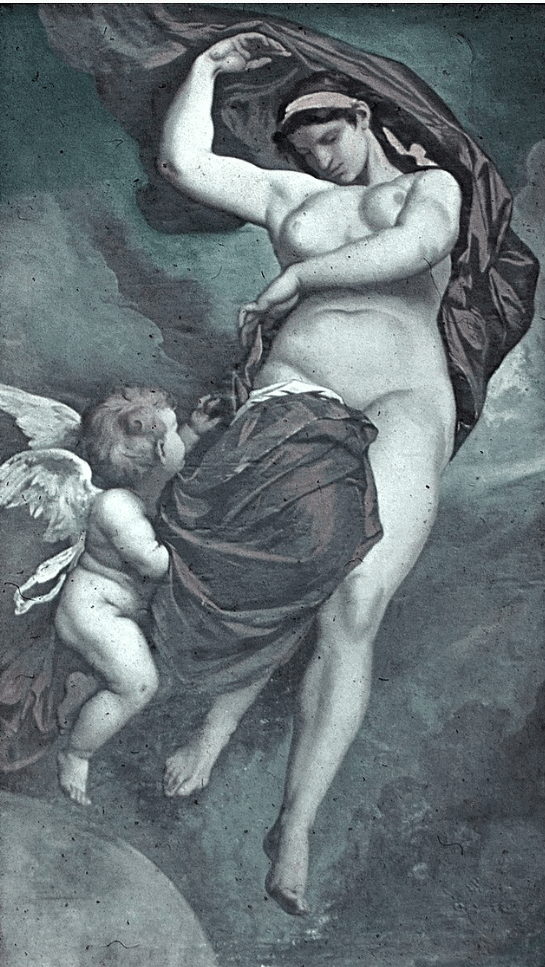
In the beginning, there was nothing. It’s something we’ve all heard before, but the idea can be a little difficult to conceptualise. The Greeks thought the same, but their ‘nothing’ had a name — Kaos, meaning chasm. An inky, black nothingness that floated around being all dark and impossible to fathom. But all this primordial soupiness got boring. So, as all divine blobs do when they get bored, Kaos created something. Thankfully this ‘something’ is a little easier to conceptualise than Kaos is. Think green grass, soft mud, and you’ll begin to get the picture. Her name was Gaia, or as we know her, the Earth. It doesn’t take long for other primordial beings to spawn. We get some emo gods — Tartarus, Erebus, Nyx. Inspired by all this spontaneous creation, Gaia decides to try her hand at it. She creates the sky, Ouranos, to cover her from all sides. Next, she creates Pontus, the seas, which runs over much of the Earth’s surface. Everything was going swimmingly, that’s until two of the gods got a little too familiar.
Match made in Heaven (unless you castrate him):
It didn’t take long for Gaia and Ouranos to get busy (and if you’re grossed out by godly incest, stop reading now — I won’t give you any spoilers, but it absolutely does get worse). To start, they took things slow and only had twelve children. These were the Titans — tall, beautiful, each with their own powers and domains like primeval Avengers. There were six girls and six boys, and it didn’t take long for the brothers and sisters to start coupling up too. Hyperion and Theia (Mr and Mrs. Shiny), Oceanus and Tethys (Mr and Mrs. H2O) were just some of the hot new couples on the block.
After the success of their first batch, Ouranos and Gaia went for round two. Except this time the results weren’t so winning. They had triplets- tall and strong gods with a single eye in the middle of their heads called the Elder Cyclopes. Gaia didn’t mind that her sons were lacking in the ocular department, she loved them. She was maternal — Mother Earth was no joke to her. Ouranos was far less enamoured with his visually unappealing sons. He was more of an out of sight, out of mind kind of guy. So, he bound his sons in chains and chucked them into Tartarus. Don’t get me wrong, it did the trick, but Gaia was less than pleased. She screamed and raged, but Ouranos wouldn’t release their children. In any case, they must have gone to the world’s first couple’s counsellor or done something to rekindle the love, because pretty soon after that Gaia gave birth to another set of triplets. They were called the Hecatoncheires, or the ‘Hundred-Handed Ones’. This wasn’t a wholesome nickname, but a precise moniker. They not only had one hundred arms, but fifty heads to match. Ouranos, considering this set of sons as another visual assault, gave them the same chained-and-chucked-away treatment. Dad of the Year. Cue more mental breakdowns from Gaia- she grieved so intensely it caused earthquakes, but Ouranos would not relent.
Gaia’s grief was so intense it had a physical manifestation — a weapon forged from the earth’s pain. It was a long, curved blade of adamantine — the first scythe. Gaia took this weapon and gathered her twelve Titan children and casually suggested that one of them steps up and murders their dad. Now, the Titans weren’t unaware of their parents’ shaky marriage, it had been a source of much gossip and sympathy. But, when it came down to it, none of them jumped at the chance to commit patricide. They avoided eye contact, made their excuses, sheepishly looked at the ground. Cue the crickets. Eventually, one voice did pipe up from the back. It was Kronos, the youngest Titan. Call it what you will-tyranny, filial protection for his mother, youngest-child syndrome — he was more than prepared to murder his father.
So, they concocted a plan. Gaia would pretend to take Ouranos back, and Kronos would hide until the time was right, jump out and kill him. He enlisted four of his brothers to hold down their father while Kronos did the actual slicing and dicing. Gaia invites Ouranos down for a hot date, and the brothers hide out in caps and sunglasses (which, if we know anything from superhero movies, makes you unrecognisable.) Ouranos was not suspicious of Gaia’s change of heart in the slightest. To be fair, this was the first time a wife had plotted the murder of her husband, so how was he to know? Gaia put the moves on him and it’s not long before Ouranos’ guard was down. Just when he thought he was about to get lucky, he got very unlucky. Kronos and his four brothers jump out (some say inventing the word ‘Sike!’ in that moment) and they grab their father. Kronos goes straight for the bull’s eye, slicing his father’s genitals clean off before tossing them over his shoulder. He then chops Ouranos up into iddy-biddy pieces. Wholesome stuff. To those of you that are wondering: what happened to the genitals? For the first time, that’s not a weird question to ask. They end up landing in the sea — we’ll come back to that later.
I know what you’re thinking. Hey, if Kronos killed the sky, how come when I look up, I still see sky? Excellent question. Well, the general consensus on this is that Kronos wiped out his physical form. Just like Gaia is both the Earth and a maternal, female figure, these primordial gods have a couple states- their domains and their anthropomorphic manifestations. Ouranos in the physical form was gone but in the actual sense, as the sky, was still kicking. There’s even a theory that’s why the sky is up and separate from the earth — before the divorce/ murder there was less of a separation, but who are we to know? Either way, one thing was for certain. Ouranos was no more, and Kronos was in charge.
Daddy Issues II — Revenge of the Boulder:
The Romans referred to the time of Kronos’ rule as a ‘Golden Age’. Now, I don’t know about you, but I’m not sure how many golden ages are marked by (even more) incest, baby-murdering and cannibalism. Well, I can imagine you’re wondering. Ouranos was a pretty bad dude. No-one can be a worse father than him. To that I’d say, hold your horses — for King of the Cosmos, Kronos was lacking some fundamental self-awareness. When Kronos became the new Top Dog of All the Universe and Everything, his mother Gaia decided to take a long-deserved nap. She had had way too many children and became the first widow and husband-murderer simultaneously. That takes a toll on a woman. Before she turned on the white-noise machine and settled into her slumber she decided to give her son Kronos one final piece of advice. She tells him to beware, that if he is overthrown, it will be by the hands of his own son.
Now, Kronos was not exactly a level-headed guy. He was the dude that relieved his own father of his genitals — something that made him want to hang on to his own dearly. He also had an issue. It’s not like Kronos could just not have kids, condoms hadn’t even been invented yet. Plus, his wife/sister Rhea was already pregnant. He pondered his options for a while, but when he was presented with his first daughter, Demeter, he panicked and did what any rational, father-murdering Titan king would do. He detached his jaw and swallowed the child whole. Now, to say that his wife Rhea was stunned and angry was an understatement. I can’t pretend to know how Kronos talked his way out of that one, but Rhea lets it slide. Not just once or twice, but she goes on to get pregnant five more times. Each kid gets the same ‘down the hatch’ treatment, but one.
What To Do When Your Husband Keeps Eating Your Children (A Practical Guide):
For some reason, it took five kids for Rhea to realise that maybe Kronos had some issues. When it came time for Rhea’s sixth child, she gave birth in Crete (far away from Mount Etna, the home of the Titans), and stashed him away with some nymphs who have a magic goat. When she goes to present the new baby to Kronos, she presents him with a rock — all swaddled in blankets and a pair of googly eyes to sell the lie. He swallows the rock with no hesitation. By this point, Kronos is tired. Five Olympian gods and a rock chilling in his stomach was not comfortable at all — he was bloated and whiny all the time. The baby that Rhea had stashed in Crete was the opposite. His name was Zeus, and he grew tall and strong, and eventually (either through the help of his first wife, Metis or a plan devised with his mother) was able to slip Kronos a special drink. This drink made Kronos throw up everything, not just his breakfast from that morning, but five very traumatised Olympian gods and a rock with just one remaining googly eye.
War and Peace (one of those is a lie):
The stage was set for the beginning of a new era, but it wouldn’t be without a fight. The Titanomachy saw the first Civil War. Many Titans flocked to Zeus’ side, resenting Kronos’ tyranny. Zeus enlisted the help of Gaia’s long-suffering children, the Elder Cyclopes and the Hundred handed ones. The Olympians, as we know, come out on top, with Zeus as new head honcho. I’d love to tell you that their reign is devoid of incest, murder, serial infidelity and love goddesses born from sea foam and primordial semen (I told you we’d come back to that). But unfortunately, that’s just not how the Olympian cookie crumbles.
Bibliography
Homer. The Odyssey. Translated by A. T. Murray, Perseus Digital Library, https://www.perseus.tufts.edu/hopper/text?doc=Perseus%3Atext%3A1999.01.0130%3Acard%3D492. Accessed 25/02/25.
Apollodorus. The Library. Translated by J. G. Frazer, Perseus Digital Library, https://www.perseus.tufts.edu/hopper/text?doc=Perseus%3Atext%3A1999.01.0022%3Atext%3DLibrary%3Abook%3D1%3Achapter%3D1%3Asection%3D4. Accessed 25/02/25.
 Retrospect Journal