
Written by Olivia Norbury
The Nahda, otherwise known as the Arab Renaissance, was a project of Arab modernity from the mid-nineteenth to early twentieth century. It revolved around linguistic, educational, and journalistic reforms, as well as the redefinition of traditional thought surrounding political justice, science, and religion. However, historians have widely disputed the causes of the Nahda. Traditional historiography attributes it to Europe, arguing Napoleon’s 1798 invasion of Egypt introduced Eurocentric notions of Enlightenment to a supposedly backward Arab world. More recently, scholars have suggested that Ottoman Tanzimat reform, a series of modernising socioeconomic and political reforms, produced conditions for modernity and that the Nahda represented continuity from the Arab past. These historians have sought to disrupt the narrative of the Nahda as homogenous and imported from European, instead positing that it was a complex process. Thus, this article will briefly explore various historiographical perspectives, examining how diverse influences converged to produce the Nahda.
In his seminal 1962 Arabic Thought in the Liberal Age, Albert Hourani emphasises the significance of Ottoman contact with French enlightened ideals, and Egyptian student missions to France. Muhammad Ali Pasha sent young men such as al-Tahtawi to Paris to gain information about Western European progress. He returned and established language schools, translation movements, and promoted secularism to the clergy. Hourani argues that these men were exposed to European civilisation and transferred the foundations of European modernity to an Arab context. Elizabeth Kassab identifies Hourani’s five main principles of the Nahda, based on European discourse, which reflects his acceptance of Arab inferiority. However, Hourani cements binaries such as modern versus traditional, revealing the Eurocentric lens through which the traditional perspective explains the Nahda. This perspective is rooted in orientalist discourse, which propagates negative stereotypes of Arab civilisations as inherently backward, requiring Western aid.
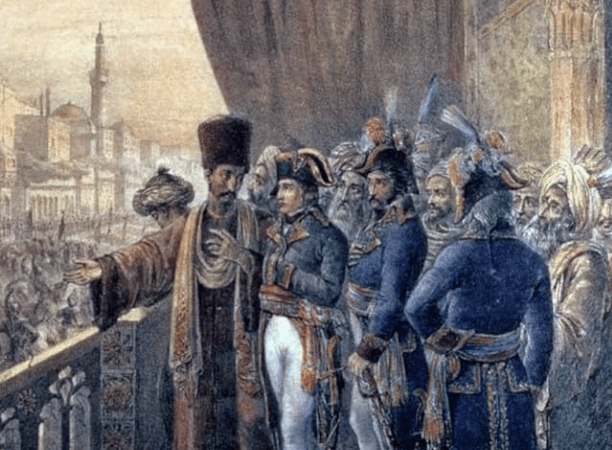
Similarly, in his 1963 Arab Rediscovery of Europe, Ibrahim Abu-Lughod claimed that Napoleon’s 1798 invasion of Egypt constituted the introduction of European ideas to the Arab world. He posits European knowledge as inherently superior, portraying the Mamluks’ defeat as inevitable given Arab weakness. Abu-Lughod sets French and Egyptian systems in opposition, reinforcing the image of a declining Egyptian civilisation necessitating European intervention. Abu-Lughod discredits contemporary Arab intellectuals, such as al-Jabarti, accusing him of ignorance of Napoleon’s Republic and motivations for invading Egypt. His perspective reveals the traditional explanation of European modernity causing the Nahda. However, Abu-Lughod’s argument perpetuated orientalist stereotypes and reinforced Eurocentric constructed binaries between East and West, therefore clouding his view.
On the other hand, the historiographical field since the 1990s has shifted to critiquing Hourani, revising traditional explanations of the Nahda. For example, Stephen Sheehi argues that the mass distribution of Arabic literary-scientific journals, whose modern ideas were promoted during the Tanzimat, produced conditions for modernity in Arab countries. He critiques orientalist scholars who contend that Arab countries inherently contradicted modernity, among a wider attempt to dismantle constructed European superiority. Sheehi further argues that journals were the vehicle by which Arab intellectuals forged modernity and created an Arab desire for enlightened knowledge. Thus, he contributes to the revisionist movement which disrupts Eurocentric narratives, foregrounding the role of Arab intellectuals in causing the Nahda. Similarly, Jen Hanssen and Max Weiss explain that the Nahda represented continuity with the Arab past, arguing that not all modern Arab ideas came from Europe. These historians directly revise Hourani’s work, employing a wealth of primary and secondary sources in the context of broader attempts to decentralise Europe within world history in the 2000s. They utilise Peter Gran’s argument that the Arab liberal age is rooted in the eighteenth century and Napoleon’s invasion nearly suppressed, not commenced, the Nahda. They support that notions of Arab modernity can be found before the European Renaissance, corroborated by their explorations of Arab intellectuals such as Muhammad Abid al-Jabiri and Abdallah Laroui. These historians apply a revisionist approach that problematises Hourani and orientalist ideologies, which erase Arab roles in modernity, thus demonstrating that the Nahda is not solely a European import but rather rooted in the Arab past.
Hussein Omar’s 2017 Arabic Thought in the Liberal Cage extends this argument, proposing that key Egyptian intellectuals critiqued Eurocentric modernity fifty years before postcolonial academics did. He identifies intellectuals such as Al-Sayyid who dispute that Egypt imitated Europe, arguing that political modernity was universally inevitable and colonial rule disrupted it. Al-Sayyid asserts that Lord Cromer only diagnosed Islam as backwards by misrepresenting European history. Omar utilises this notion that Al-Sayyid recognised the Eurocentric ideology imposed upon Arabs to suggest that Arab figures were involved in initiating the Nahda. Omar further proposes that Arab intellectuals were stuck in a cage of European liberalism whereby their arguments responded to Eurocentric discourses and thus were trapped within orientalist ideology. He explains the contradictions of intellectuals such as Amin and Kamil, who unintentionally recycle orientalist claims about Egyptian and Islamic inferiority. Therefore, Omar’s revisionist approach foregrounds Arab intellectuals, arguing how Eurocentric discourse erases them and thus obscures a key driver of the Nahda.
Historians have further applied a revisionist perspective to acknowledge various factors which explain the underlying causes of the Nahda. El-Ariss complicates the binary between East and West by highlighting influences from Russia and India, not just Europe and the Arab past He rejects a totalising narrative which places Europe at the centre of world history, instead explaining the Nahda through numerous geographic and historical routes. Hanssen and Weiss corroborate this, stressing that many Arab reformers settled in Cairo or Damascus had come from Delhi and the Mughal Empire. They suggest that intellectual movements from Europe may have originated elsewhere, disturbing the orientalist narrative which obscures the movement of ideas occurring in all directions, not solely from Europe to elsewhere. Therefore, in recent historiography, historians have rejected the narrative that credits Europe with bringing modernity to the Arab world, seeking to uncover explanations hidden by Eurocentric discourse.
Therefore, historians have explained the Nahda through two principal perspectives; the traditional approach attributes its underlying cause to Napoleon’s invasion of Egypt in 1798, whereby European ideas of liberty and freedom were introduced to the Arab world. It deems Egypt and Islam as inherently backward and inferior, thus necessitating superior European civilisation. The revisionist approach challenges this argument, instead crediting Arab intellectuals and the Ottoman Tanzimat with causing the Nahda, producing the necessary conditions for reform and modernity. Historians have further connected non-Eurocentric influences, such as from Russia and India, to define its causes. Therefore, it is impossible to explain the Nahda through a monolithic narrative; instead, it must be understood as a complex network of factors that include but are not limited to European cultural influences. This revisionist approach in the historiography reflects the broader need to decentralise Europe within global history and give greater attention to the ideas and movements of figures and groups historically regarded as inferior in comparison.
Bibliography
Abu-Lughod, Ibrahim. Arab Rediscovery of Europe: A Study in Cultural Encounters. Princeton: Princeton University Press, 1963.
El-Ariss, Tarek. ‘Introduction.’ In The Arab Renaissance: A Bilingual Anthology of the Nahda, edited by Tarek el-Ariss, xv-xxvii. New York: The Modern Language Association of America, 2018.
Hanssen, Jens and Weiss, Max. ‘Introduction: Language, Mind, Freedom and Time: The Arab Intellectual Tradition in Four Words.’ In Arabic Thought Beyond the Liberal Age: Towards an Intellectual History of the Nahda, edited by Jens Hanssen and Max Weiss, 1-37. New York: Cambridge University Press, 2016.
Hourani, Albert. Arabic Thought in the Liberal Age 1798-1939. Oxford: Oxford University Press, 1962.
Kassab, Elizabeth. Contemporary Arab Thought: Cultural Critique in Comparative Perspective. New York: Columbia University Press, 2010.
Omar, Hussein. ‘Arabic Thought in the Liberal Cage.’ In Islam after Liberalism, edited by Faisal Devji and Zaheer Kazmi, 17-46. Oxford: Oxford University Press, 2017.
Sheehi, Stephen. ‘Arabic Literary-Scientific Journals: Precedence for Globalization and the Creation of Modernity.’ Comparative Studies of South Asia, Africa, and the Middle East 25, no.2 (2005): 439-449.
 Retrospect Journal