
Written by Ishaabhya Tripathi
16/03/25
CONTENT WARNING: mentions of pregnancy loss
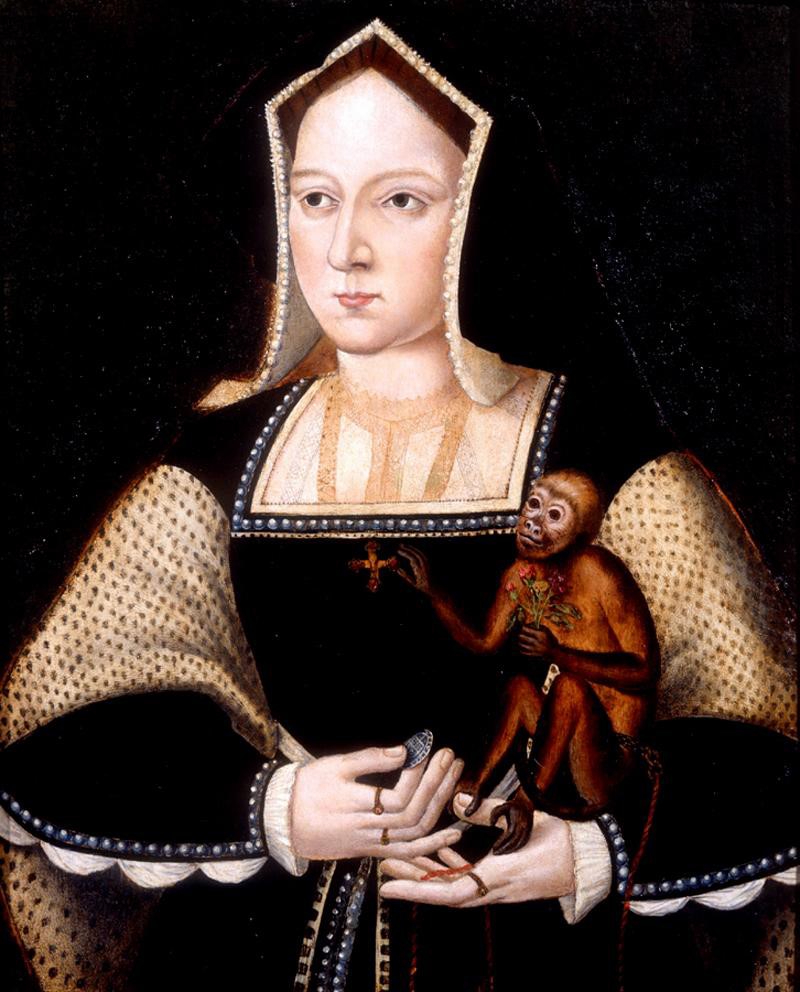
Catherine of Aragon is perhaps most widely known as the first wife of Henry VIII. Of the king’s six marriages, theirs was the longest, with their matrimony lasting eighteen years. As a daughter of King Ferdinand and Queen Isabella of Spain, she played a crucial role in securing alliances with Tudor England. Catherine’s role in the politics of Europe was decided effectively from infancy, with her first betrothal taking place when she was only three years old. Henry VIII’s dissolution of their marriage proved to be monumental to English history by triggering the English Reformation and shift to Protestantism. However, Catherine’s decision to stay in England after the divorce, as well as contemporary support for her as a queen, suggests that, instead of a passive pawn in a political game, she was resourceful and enterprising in a system that was geared against her.
After the Battle of Bosworth Field in 1485, Henry VII needed to reinforce his claims to the throne. To this effect, forming alliances with other European monarchies was crucial. Religion was also an important factor since Henry VII considered a matrimonial match with Spain—a historically Catholic nation—a formal recognition from another Christian sovereign. With these aims, his son Arthur, then Prince of Wales, was set to marry Catherine, the daughter of Ferdinand II of Aragon and Isabella I of Castile. The first formal agreement of their marriage took place in 1489, when Catherine and Arthur were only four years old. Another intention for their match was for Spain and England to form an alliance against France. In this way, several political pressures were imposed on Catherine’s life and destiny from the very beginning.
Catherine was widowed only a year after her wedding to Arthur in 1501. Not long afterwards, she was engaged to Henry VII’s younger son, the prince who would later become King Henry VIII. Although aristocratic marriage served to provide male heirs and placed women in a position subject to the whim of much more powerful men, the presentation of Catherine of Aragon in certain pieces of contemporary literature suggest that she was respected and appreciated despite the fact that she did not fulfil the duty that the marriage institution dictated. The lack of a male heir was one of the reasons for which Henry VIII became frustrated and wanted to end the marriage. This phenomenon is also seen in Henry’s subsequent marriage to Anne Boleyn, which has interesting implications for the way in which Catherine was perceived and treated. It is theorised that Henry VIII had a blood condition that caused the multiple stillbirths and miscarriages that his first two wives suffered. Historically, many communities have blamed women for pregnancy complications. However, the fact that Catherine had sympathisers and defenders even after her divorce suggests that such social conditioning, as well as widespread anti-Spanish and anti-Catholic propaganda, did not damage her image to an irreparable extent.
Although their marriage ended badly, there is evidence that Henry truly did love Catherine. A Tudor court tradition in the early sixteenth century involved the recreation of pageants with romantic plotlines. These were called ‘tournaments’, and they often featured knights fighting for women’s love and honour. A tournament in Westminster, London was held in Catherine’s honour in 1511, and featured Henry fighting under the pseudonym, ‘Sir Loyal Heart’. Dedicating this spectacle to Catherine proves that Henry did, in some part, maintain a level of infatuation for her. Henry also wrote to his father-in-law that, if he were not already married to Catherine, he would choose her over anyone else anyway. Catherine was admired and respected throughout Tudor England for the stability that she brought through her steadfast commitment to religion and her role in securing the matrimonial alliance between England and Spain.
Many contemporary studies of Catherine of Aragon portray her as a victim of Henry VIII’s erratic, volatile, and sometimes irrational behaviour. In fact, the first work about Catherine to be published after she died in 1536 was about her divorce. Specifically, this work was a biographical poem written by William Forrest. In this poem, the reader gets a sense of Catherine as a noble, steadfast, and deferential wife. Forrest’s poem remained unpublished until the nineteenth century, but this depiction of Catherine featured in other works from the period. Nicholas Harpsfield portrayed Catherine in a similar manner in his work, which was published in 1556. This document examined the royal divorce and the extent to which religion was relevant. During her lifetime, arguments in her defence were published, even at the time of her divorce, when she experienced a fall from grace of sorts. Juan Luis Vives describes in his text, Instruction of a Christen Woman, the ideal conduct for women in Tudor England. Vives maintains throughout the multiple reprints of this book that Catherine fits the criteria for a ‘good woman’, citing her resilience and loyalty as reasons for which she conforms the idea of a ‘good woman’ in the first place. The fact that she stayed in England and maintained her Catholic faith, even during her divorce and Henry VIII’s clashes with the Pope, until she died in 1536 supports the descriptions of her as steadfast and faithful.
Henry VIII’s reputation often precedes him, meaning that it can be easy to relegate Catherine of Aragon to one of his many wives. However, she was vital to the European politics of her time from a very young age and played a crucial part in securing an alliance between her native Spain and England before she even married Henry VIII. In her own right, she was a determined and loyal woman, respected and admired by many.
Bibliography
The Editors of Encyclopaedia Britannica. “Catherine of Aragon.” Encyclopedia Britannica, January 23, 2025. https://www.britannica.com/biography/Catherine-of-Aragon. Accessed Friday 7th March
Harris, Barbara J. “Power, Profit, and Passion: Mary Tudor, Charles Brandon, and the Arranged Marriage in Early Tudor England.” Feminist Studies 15, no. 1 (1989): 59–88. https://doi.org/10.2307/3177818.
WHITLEY, CATRINA BANKS, and KYRA KRAMER. “A NEW EXPLANATION FOR THE REPRODUCTIVE WOES AND MIDLIFE DECLINE OF HENRY VIII.” The Historical Journal 53, no. 4 (2010): 827–48. http://www.jstor.org/stable/40930359.
Travitsky, Betty S. “Reprinting Tudor History: The Case of Catherine of Aragon.” Renaissance Quarterly 50, no. 1 (1997): 164–74. https://doi.org/10.2307/3039332.
Carpio Mercedes, Salem. “Las entradas reales de las hijas de Castilla en las cortes nórdicas: Recepción de Catalina de Aragón en Londres y de Juana de Castilla en Bruselas”. XIV Jornadas Interescuelas/Departamentos de Historia. Departamento de Historia de la Facultad de Filosofía y Letras. Universidad Nacional de Cuyo, Mendoza, 2013. https://www.aacademica.org/000-010/110
Daum, Jennifer R., “Gendered expectations: An exploration of identity and power in the life of Katherine of
Aragon.” (1998). Graduate Theses, Dissertations, and Problem Reports. 10353.
Featured Image Credit: https://thehistorypress.co.uk/article/12-little-known-facts-about-catherine-of-aragon/
 Retrospect Journal