
Written by Lauren Hood
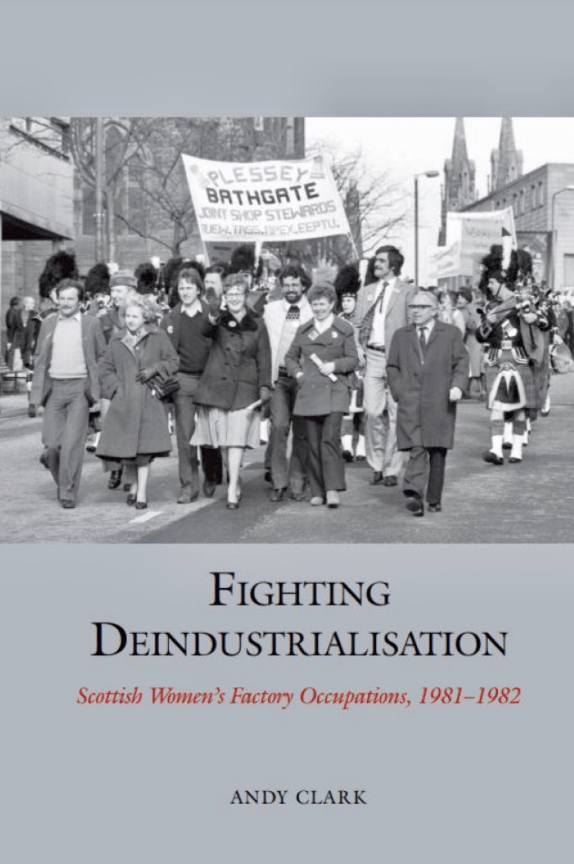
Andy Clark’s Fighting Deindustrialisation: Scottish Women’s Factory Occupations, 1981-1982 details the experiences of women workers who decided to act against the closure of their workplaces. Through detailing the events of worker occupations at three Scottish factories, Lee Jeans in Greenock, Lovable Bra in Cumbernauld and Plessey Capacitors in Bathgate, Clark explores the motivations behind the women remaining in their factories to prevent closure. This book is the first time that the three factories have been spoken about together – remarkable, considering the similarities of worker action. By focusing on these three occupations, Clark argues that deindustrialisation scholarship, and more importantly public memory of deindustrialisation, has been gendered by scholars focusing on male-dominated industries. Clark used oral history methods to interview the women involved in the occupations which allowed him to analyse the impact of a gendered remembering of deindustrialisation on their own retellings. Clark effectively discusses the women’s experiences of deindustrialisation, encouraging new avenues of scholarship which shift from previously male-centric studies.
All three of the occupations had similar elements, allowing Clark to efficiently explore the workers’ motivations for resistance. All of the factories had a predominantly female work staff where workers were represented by a trade union and occurred in areas where few other employment opportunities existed for women. After factory closure was announced, all three workforces decided to resist closure by occupying their workplace. Worker testimony emphaises how important their jobs were, particularly as their towns were already experiencing increased unemployment and industrial closures. Clark uses this context of scarce employment opportunities in the workers’ localities to explore Shirley Lee Linkon’s theory of the ‘half-life’ of deindustrialisation, an idea which illuminates the lingering impacts of deindustrialisation for working class communities decades after the initial industrial closures. Clark convincingly argues that worker testimony suggests workers were strongly motivated by declining alternative opportunities available to women, making their opposition to closure not solely about losing their current jobs, but an attempt to protect their identity and stability within their community.
Clark’s methodology depended strongly upon new testimony from workers. Clark acknowledged that sourcing workers to interview was difficult, with many feeling reluctant to share their experience or that they could not adequately contribute. Clark’s approach to collecting testimony largely followed Anna Green’s approach to oral history, focusing on the individual experience to explore a larger ‘collective memory’. This methodology allowed Clark to create a narrative about each occupation as different workers recalled different aspects of the events. The validity of Clark’s conclusions based on so few testimonies is questionable, particularly when some women interviewed had difficulty recalling certain aspects of the disputes. The reluctance from many of the female workers contrasted trends seen elsewhere in oral history, with Lynn Abrams highlighting that men are more willing to participate in the collecting of oral history. This stark contrast in gender approaches to oral history participation was not considered in Clark’s writing, despite extensively discussing the implications of gendered remembering of deindustrialisation. An analysis of implications of higher male participation in oral history for deindustrialisation scholarship would have strengthened the book’s argument, particularly as Clark questioned why male experiences of deindustrialisation became so central to Scotland’s memory of deindustrialisation.
Clark argues the occupations could not have happened had the groups of women not been so connected to each other through their workplace socialisation. E.P. Thompson’s theory of “consciousness of class” supports Clark’s argument of the importance of work as an avenue for working class female socialisation. The importance of this socialisation was evident in the testimony of the workers as the type of work is negatively discussed, but the connections created were remembered positively, shown by Cathy from Lee Jeans using “wee kinda family” to describe her colleagues. Through testimony, it is evident workers were motivated by their connections to each other, wanting to protect the community they created over years of workplace socialisation.
The male-dominated focus of previous scholarship is challenged as Clark argues the exclusion of female experiences of deindustrialisation discussions have shaped the way female workers remember their own experiences. Scholarship on Scottish deindustrialisation focuses heavily on the closure and subsequent impact of
predominantly male industries which, Clark posits, shapes the collective memory of deindustrialisation as a masculine process and experience. The interviews revealed that many of the interviewees could not recall connections between the three groups of workers and occupations, despite Clark providing them with photographic evidence. Clark believes the extent of deindustrialisation’s masculinisation and commemorations altered the women’s memories, leading them to downplay their own involvement. Clark highlights public discussions of male experiences of deindustrialisation, such as the extensive focus on male-dominated industrial job losses in the 2014 Scottish Independence Referendum. This example strongly supports Clark’s argument as national political campaigns were portraying deindustrialisation as a male event, showing that public views towards deindustrialisation are that of a male experience. Clark competently argued of the implications of a masculine public memory of deindustrialisation, emphasising the negative impact that these masculine portrayals had on women who were also affected.
Fighting Deindustrialisation: Scottish Women’s Factory Occupations, 1981-1982 was successful in entering the experiences of Scottish women into deindustrialisation narratives. The experiences of women have continually been ignored in deindustrialisation scholarship and often reduced to their relation to a man who experienced deindustrialisation instead of people who were also impacted by it. It is in this context that Clark focuses on the resistance of Scottish women workers to workplace closures, allowing their experiences to be documented and considered in deindustrialisation discussions. This book successfully showcases women as integral parts of working class and industrial communities who also suffered by declining industrial opportunities in Scotland. Through this work, Clark encourages other researchers to investigate how marginalised groups in deindustrialisation research were affected by redefining who was victimised by industrial job losses. As the first time the occupations of Lee Jeans, Lovable Bra and Plessey Capacitators have been discussed together, this book highlights the extent of experiences of deindustrialisation which have not been explored. Clark implores other scholars to stop moving away from studying smaller groups and local experiences of deindustrialisation, arguing that groups like women have not had their experiences sufficiently studied, making existing scholarship inaccurate and unrepresentative.
Bibliography
Abrams, Lynn. Oral History Theory. London: Routledge, 2010.
Clark, Andy. Fighting Deindustrialisation: Scottish Women’s Factory Occupations, 1981-1982. Liverpool: Liverpool University Press, 2023.
Green, Anna. ‘Individual Remembering and “Collective Memory”: Theoretical Presumptions and Contemporary Debates’ in Oral History 32, no. 2. 2004.
Linkon, Shirley Lee. The Half-Life of Deindustrialization: Working-Class Writing about Economic Restructuring. Ann Arbour: University of Michigan Press, 2018.
Thompson, E. P. The Making of the English Working Class. New York: Vintage, 2003.
 Retrospect Journal