
Written by Alexander Stroem
Religion, as a means of popular control and collective identity, has often been the subject of authoritarian control, regardless of political standpoints. While this paradigm is evident across various political, philosophical, and historical writings, notably Marx and Gramsci concerning hegemony and the superstructure, more recent work has been concerned with the rise of Latin American liberation theology and the paradox of clerical opposition to authoritarian regimes, particularly by the catholic church in Latin America, Spain, and Eastern Europe. Argentina, despite the general church cooperation with the Junta that ruled Argentina between 1976 and 1983 in what has been named a “Process of National Reorganization” (el Proceso de Reorganización Nacional) following the coup d’état of March 24th 1976 and arrest of Isabella Perón, certain limited clerical opposition was seen. Yet this opposition was evidently enough to raise fears and suspicion among the paranoid regimes. Indeed, in a speech given in celebration of 86th anniversary of the Estado Mayor Conjunto (effectively the military wing of the Ministry of the Defense), Vice Admiral Armando Lambruschini, a high-ranking member of the ruling Junta and Chief of the Navy General Staff, remarked that subversive opposition forces “have used and attempt to use all possible imageable methods: the press, songs of protest, comics, cinema, folklore, literature, universities, religion, and fundamental, they have attempted, without achieving it, to use panic”. Religious persecution undertaken during the Junta in reinforcement of state control and authority remains a fundamental topic in understanding the regime, one whose results were deplored by many, including Julio Cortázar, for its “open violation of the most fundamental of human rights” and its “physical and cultural genocide” that remains polemical to public memory even today.
A preliminary brief overview, not merely concerning the dictatorship itself and its ecclesiastical policy, but also Liberation Theology and Tercermundismo, is perhaps necessary, being a particular source of conflict and repression within Latin America. The Junta dictatorship, beyond its general anti-Peronist, anti-communist and conservatist ideological base (in line with the American CIA-supported Condor Plan against left-wing regimes), held a rather generalized ecclesiastical policy. The Catholic church, maintaining its cultural hegemony not only in Argentina but the region entirely, worked alongside the regime(s) in defense of its own authority and control, albeit nonetheless being highly regulated. The church actively supported the military hierarchy, even participating in torture, as seen by Christian von Wernich. Von Wernich served as Police chaplain during the dictatorship and was described during the 2007 trial as “present at torture sessions in clandestine detention centers”. Seemingly, he “extracted confessions to help the military root out perceived enemies, while at the same time offering comforting words and hope to family members searching for loved ones who had been kidnapped by the government”. In total, von Wernich was accused of involvement in seven murders, and 42 cases of kidnapping and torture. Yet von Wernich was no lone case, and seemingly, thirty or so priests could have been similarly charged. Even among high-ranking clerics, cooperation was common. Archbishop Adolfo Servando Tortolo of Paraná in Entre Ríos in Northern Argentina, and Monseñor Emilio Teodoro Grasselli, secretary to the archbishop of Buenos Aires, seemingly gave no support to relatives of the disappeared, even perhaps “acting as a source of information to the military”. Jorge Videla, one the leading members of the Junta as presidente de facto between 1979 and 1981, even admitted in a public confession of his “sins” in his life sentence, testified on open collaboration with the church during the “dirty war” and that “the church aided us with the situation of the disappeared”, notably in managing the situation, and who offered “its good duties, and before families who had the certainty that they would not make use politically of the information, told them not to look for their son because he was dead”.
Videla himself remarked that his relationship with the church was “excellent, very cordial, sincere, and open”. Argentine journalist Horacio Verbitsky has particularly charted Church relations to the military leadership, culminating in his work El Silencio, published for the first time in 2005 and which featured various testimonies involving clerical relations to the military ESMA (Escuela de Mecánica de la Armada), effectively a prison and torture center and even persecutions of the clergy themselves based on “dangerous thought” and possible “Izquierdista” and “Peronista” ideology. Other religious practices were even prohibited entirely, effectively only permitting Catholic tradition to be maintained. These included the Jehovah’s Witnesses, while also incarcerating the Pais Santos of Afro-Brazilian religions, and Pentecostal ministers. As noted by Matthew Marostica (1998), “With the notable exception of the Protestant denominations and the sectors of the Catholic Church that formed the MEDH (Ecumenical movement for Human Rights), the effect of this religious repression in Argentina was the privatization of religion and the elimination of religious innovation”. The “religious innovation” at hand included various new strands of Christianity that emerged in South America in the aftermath of Vatican II (1962-1965).
Liberation Theology, emerging in the 1960s and perhaps the most prominent and widespread manifestations of the “innovations”, based itself principally of a form of social Catholicism in “liberation” and solidarity the oppressed poorer classes, one based on an earlier sociological and philosophical traditions of dependence theory, Marxism, and the contemporary status quo of repression. To the Peruvian theologian Gustavo Gutiérrez, a Parish priest of Lima and , liberation through theology was to be achieved, alongside the fight against “oppressive structures and the construction of a more just society”, the “duty of solidarity with the poor, to which charity leads us”, notably by acting on their behalf and the denunciation of the “intolerable situation which the poor frequently endures”.
Opposition to such emerging philosophies of liberation deemed inherently Marxist and subversive to the neoliberal and democratic state, was ripe throughout Latin America and the United States. Elaborated during the initial years prior and during the Reagan Administrations between 1980 and 1988, the Santa Fe Documents provide details on American opposition to such new emerging “innovations”, one which Latin American US-backed military regimes, including the Argentina Junta, would follow zealously. Documents I present the plan spearheaded by US policy advisors during the Reagan campaign in 1980 concerning Liberation Theology and its subsequent treatment. Seemingly, as part of the Reagan Doctrine and its interaction with Latin American regimes:
“US foreign policy should begin to confront (and not just to react with posterity) liberation theology in the way that it is used in Latin America by the clergy of “liberation theology”. The role of the church in Latin America is vital for the concept of political liberty. Unfortunately, Marxist-Leninist forces have used the church as a political arm against private property and the capitalist system of production, infiltrating the religious community with ideas that are less Christian than Communist”. (Part 2, Proposition 3).
In line which such condemnation of the movement as subversive and insubordinate, many figures, known for the role in such liberationist theologies and their outspoken criticism of military and repressive governments in the region, were subsequently, arrested, tortured and martyred in the quest for liberation by military dictatorships throughout the latter half of the century.
Liberation theology nonetheless had its variants and practitioners in the Cono Sur. From the Platense region and Northern borders to Paraguay and Uruguay to the southern regions of Santa Cruz and Tierra del Fuego, priests and clerics at various hierarchical levels sought to the liberation and promotion of the poor. Priests for the Third World in Argentina (MSTM), known as Tercermundistas, worked alongside poor communities in hopes of improving the lives of marginalized groups throughout the region in the period leading up the coup of 1976. This was not without is stigmas and subsequent unpopularity among certain ideological sectors, leading to unprecedented violence, even against clerics, notably after October 1965 and the dialogue between Catholics and Marxists at a symposium hosted by the faculty of Faculty of Philosophy and Letters at the University of Buenos Aires, which included the Marxist Fernando Nadra, known for his support of Castro, and priests such as Carlos Mugica and Guillermo Tedeschi. As noted in the “open letter to the Argentine episcopate”, published in the journal Cristianismo y Revolución, by the former seminarian and Marxist Montonero-antecedent, Juan García Elorrio:
“We want a poor episcopate – authentic and truly poor – without official honours, without extraordinary privileges, without dangerous compromises with the wealthy classes, with entrepreneurs, with the military, with the sources/factors of power. An episcopate that serves and is not served. An episcopate which renounces the budget of the cult, and all the financial subsidies and prebends…. Because they are a testimony of the church of the poor”.
Such open collaboration with Marxist forces among the church was by no means taken lightly. Carlos Mugica, perhaps the representation figure of the movement in Reconquista (Sante Fe) and Buenos Aires with known Peronista and Montonero sympathies, was martyred in May 1974 by the Argentinian Anti-Communist Alliance (Alianza Anticomunista Argentina, AAA, Triple A), resulting in the eventual breakdown of the movement. Mugica was but one of 270 such priests aligned with Tercermundista belief, and many who survived the initial pre-dictatorial repression by parapoliciary right-wing groups would suffer repression under the Junta’s leadership. Nonetheless,
The statistics concerning the victims of the Junta remain largely polemical, and few agree on any precise numbering. Figures alleged by the dictatorship itself, the church, families of those persecuted, denouncers, and other groups with a given interest in the period have all suggested different figures, often differing by substantial margins. Regardless of figure, the statistics of the “desaparecidos” remain a matter of national debate and inherent to Argentine historical and public memory. The official figure from 1984, formalised by the Comisión Nacional sobre la Desaparición de Personas (CONADEP), created by President Raúl Alfonsín (1983-1987) following the restoration of democracy and far from accepted by all, allege a figure 8.960 based on a nine-month investigation and urban environments, with Tucumán, Mendoza, Jujuy, alongside many rural northeastern and northwestern parts being excluded from the eventual publication of the findings in Nunca Más (Never again). Since then, numerous figures have emerged from various sources, and even the above 1984 figure was amended with the 2005 court proceedings, although others have suggested lower figures ranging between 6.500 to around 7.018, or even greater to 30.000. The army themselves admitted to a far greater number following the declassification of Chilean and American intelligence material, reaching some 22.000 people disappeared merely for the period of 1975-1978. Regardless of precise overall number, many of those included within the list(s) of victims were clerics, although given the open stance of support by the church, clerical victims are not as high as students, academics, journalists, and other professions, whose victims number in the thousands.
Amnesty International, as an international human rights organization which heavily condemned the coup and subsequent violations of human rights, counted some eight clerics among the “disappeared” (namely under the category of “Desaparición Forzada”) between March 1976 and February 1979, including foreigners. Names included: Carlos Armando Bustos Carlos di Pietro, Alice Domon, Leonie Henriette Duquet, Pablo Gazzarri; Kleber Silva Iribarnegaray, Juan Marcelo Scler Guinard, Miguel Anges Urusa Nicolau, and Alfredo Daniel Verlarde, all suffered similar fates. Nonetheless, as the organization itself admits, “this list, as yet incomplete, has been compiled with a high regard to accuracy. Therefore, those cases considered to be inadequately documented have been omitted”. It is therefore presumed to be much higher. The aforementioned Nunca Más report, elaborated in the aftermath of the dictatorship, further gives a number of testimonies absent from the above Amnesty International report, mostly related to their fates after their disappearances and their deaths the French Leonie Henriette Duquet for instance, a known sympathiser of the Madres de Plaza de Mayo, was “executed” by the “Vuelos de la muerte” (Flights of Death, being drugged with a sedative and thrown off a plane) around the coastal zones of Buenos Aires Province. In August 2005, her body was found and exhumed, one of very few to be confirmed. A much more exhaustive list of church victims is provided by María Soledad Catoggio (2016).
The means of this opposition remain rather unknown as well. The problem (among countless others) with dictatorial regimes is that opposition comes in many forms, even often where there is no threat at all. Needless to say, mere left-wing ideas contrasting those of the regime were reason enough for suspicion and arrest, particularly in one such as the Argentine regime. In the case of Argentina clerics, mere preaching or continued affiliation with tercermundistas or previous missions among the poor was enough to warrant arrest, as likely the case with Carlos Armando Bustos, particularly with apparent links to the Montoneros. Indeed, according to Auxiliary bishop Victorio Manuel Bonamín of Buenos Aires (known for his ideological support to the regime), “For a soldier, [a] “Tercermundista” is an enemy”. This was evidently the case of Carlos Armando Bustos, kidnapped forcefully in the first year in circa April 1977 near Basílica de Nueva Pompeya in Buenos Aires. He was a member of the Franciscan Capuchins and was a well-known Peronista militant and member of the Tercermundistas and the Movimiento Villero Peronista, linked to the Montoneros. Little more is known, other than being taken to the torture center of the Club Atlético. A letter of his from 1972 nonetheless may shed some light on the reasonings behind his arrest. He remarks:
“We think that one ought to live the Gospel among the poorest. One cannot preach the gospel in the comfort of a bourgeois life, from the solemn height of a pulpit. Christ lived like a poor man and died in extreme poverty: Until his closest friends abandoned him. I am tired of the hypocrisy of the world, of the egotistical commodity of men…. Our politicians do not reach any popular conclusion. They do nothing else but play with the hopes of the people”.
With such a philosophy with a subaltern focus, his treatment is perhaps hardly surprising. A more notable case is perhaps the detention in 1976 of the Jesuits Franz/Francisco Jalics and Orlando Yorio, both linked to the mission and work of the current Pope Francis/Jorge Bergoglio, then provincial head of the Jesuits. By official state documents, the detention of both was based on “suspicious Guerilla contacts”. This itself was evidently based on some form of hearsay, which they themselves, and any linked to them, denied, with Bergoglio remarking that “I was never able to characterise them as guerrilleros or communists, among other things because I never thought they were”.
Some were arrested for merely inquiring into the disappearance. Monseñor Enrique Angelelli, the Bishop of La Rioja assassinated in August 1976. Several reasons stand out, such as his general support of the Argentina working class and pastoral work associated with Vatican II. Yet further so, Angelelli had begun to investigate the recent deaths of two of his priests, Gabriel Longueville and Carlos Murias (both in Los Llanos), found with gunshot wounds and with their hands bound near the train tracks south of Chamical. Soon after, Wenceslao Pedernera, another of his believers, was shot before his family by certain “hooded figures” in Sañogasta. The questions asked by Angelelli resulted in threats and inquiries of Tercermundista and Marxist associations (which were false) on the basis on his praxis and homilies, and even being told by Luciano Benjamín Menéndez “you must take great care” as a threat. He was later killed in a car crash, orchestrated by government officials.
While the church remains undoubtedly complicit in much the orchestrated terror in 1970s and 1980s Argentina, the presence of clerical opposition is undeniable, as was its repression. Many priests, monks, nuns and all positions alike within the church stood against the regime and suffered the consequences for it, suffering torture, imprisonment and even being killed. While many were indeed released, the fact of complicity remains, one which Argentina and the Vatican, despite the numerous trials, is yet to come fully to terms with within its own public and historic memory.
Bibliography
Primary Sources:
“Anexo I Listado de víctimas del accionar represivo ilegal del Estado argentino Víctimas de desaparición forzada y asesinato en hechos ocurridos entre 1966 y 1983” in Registro unificado de víctimas del terrorismo de Estado (RUVTE). (Buenos Aires. Secretaría de Derechos Humanos de la Nación. 2015). p.411.
“Carta Abierta al Episcopado Argentino”. (Cristianismo y Revolución. Vol.2-3. Octubre-noviembre 1966).
Catoggio, María Soledad. Los Desaparecidos de la Iglesia. (Buenos Aires. Siglo Veintiuno. 2016).
“Fundamentos Conceptuales e Información Estadística: Compilación” in RUTVE: Registro Unificado de Víctimas del Terrorismo de Estado. Ed. Secretaría de Derechos Humanos de la Nación. (Buenos Aires. Archivo Nacional de la Memoria, Secretaría de Derechos Humanos, Ministerio de Justicia y Derechos Humanos de la Nación. 2015).
Gutiérrez, Gustavo. Teología de la Liberación: Perspectivas. (Salamanca. Ediciones Sígueme. 1971/1975). p.162.
“Report of an Amnesty International Mission to Argentina: 6-15 November 1976”. Ed. Amnesty International. 1976.
Santa Fe Comittee. “Documento secreto de la política Reagan para América Latina”. Santa Fe, May 1980.
“The ‘Disappeared’ of Argentina: List of Cases reported to Amnesty International March 1976- February 1979”. Ed. Amesty International International Secreteriat. 1979. Their names were Carlos Armando Bustos; Carlos di Pietro; Alice Domon; Leonie Henriette Duquet; Pablo Gazzarri; Kleber Silva Iribarnegaray; Juan Marcelo Scler Guinard; Miguel Anges Urusa Nicolau; Alfredo Daniel Verlarde.
Secondary Sources:
Alconada Mon, Hugo. “El Ejército admitió 22.000 crímenes”, La Nación, 24 de marzo de 2006.
Barrionuevo, Alexei. ”Argentine Church Faces ‘Dirty War’ Past” in New York Times, Sep 17, 2007.
Barrios X Memoria y Justicia. Baldosas X la Memoria. (Buenos Aires. Instituto Espacio para la Memoria. 2008). pp.182-184.
Bradbury, Pablo. Liberationist Christianity in Argentina (1930-1983): Faith and Revolution. (Woodbridge. Tamesis/Boydell & Brewer. 2023). p.45.
Brienza, Hernán. Maldito tú eres: El caso Von Wernich, Iglesia y represión ilegal. (Buenos Aires. Marea. 2003).
Cortázar, Julio. Argentina: país de alambradas culturales. (Barcelona. Muchnik. 1984).
Crenzel, Emilio. ”¿Cuántos son los desaparecidos y cuantas las víctimas de la desaparición forzada en la Argentina? Debates político-memoriales e investigación académica”. (Latin American Research Review. Vol.59. 2024). pp.948–964.
Dussel, Enrique; Solís Bello Ortiz, N.L.; Zúñiga, J.; Galindo, M.S.; González Melchor, M.A. Filosofía de la Liberación. (Buenos Aires. Docencia. 1976/2013).
Fitzpatrick-Behrens, Susan. ”The Catholic Church and Dictatorship” in The Cambridge History of Religions in Latin America. Eds. Virginia Garrard-Burnett; Paul Freston; Stephen C. Dove. (Cambridge. Cambridge University Press. 2016). p.410.
Irigaray, Juan Ignacio. ”Videla: ‘La Iglesia nos asesoró’ con la situación de los desaparecidos”. El Mundo. 22/07/2012.
Johnston, Hank; Figa, Jozef. “The Church and Political Opposition: Comparative Perspectives on Mobilization against Authoritarian Regimes”. (Journal for the Scientific Study of Religion. Vol. 27. No. 1. 1988). pp.32-47.
Koesel, Karrie J. Religion and Authoritarianism: Cooperation, Conflict, and the Consequences. (Cambridge. Cambridge University Press. 2014).
Mannarino, Juan Manuel. ”Nunca Disparó un Tiro” in Anfibia, (2016/01/25). –https://www.revistaanfibia.com/nunca-disparo-un-tiro/
Marostica, Matthew. ”Religion and Global Affairs: Religious Activation and Democracy in Latin America”. (Sais Review. Vol. 18. No.2. 1998). pp.45-51.
Memoria y dictadura: un espacio para la reflexión desde los Derechos Humanos. Ed. Secretaria de Educación de la Asamblea Permanente por los Derechos Humanos. (Buenos Aires. Instituto Espacio para la Memoria. 2011).
Verbitsky, Horacio. El Silencio: De Paulo VI a Bergoglio: Las relaciones secretas de la Iglesia con la ESMA. (Buenos Aires. Sudamericana. 2005).
Vitale, María Alejandra. “¿Cuál es el rol del sacerdote? Discurso religioso y discurso político en el padre Carlos Mugica” (African Yearbook of Rhetoric. Vol.7. 2016-2017). pp.63-71.
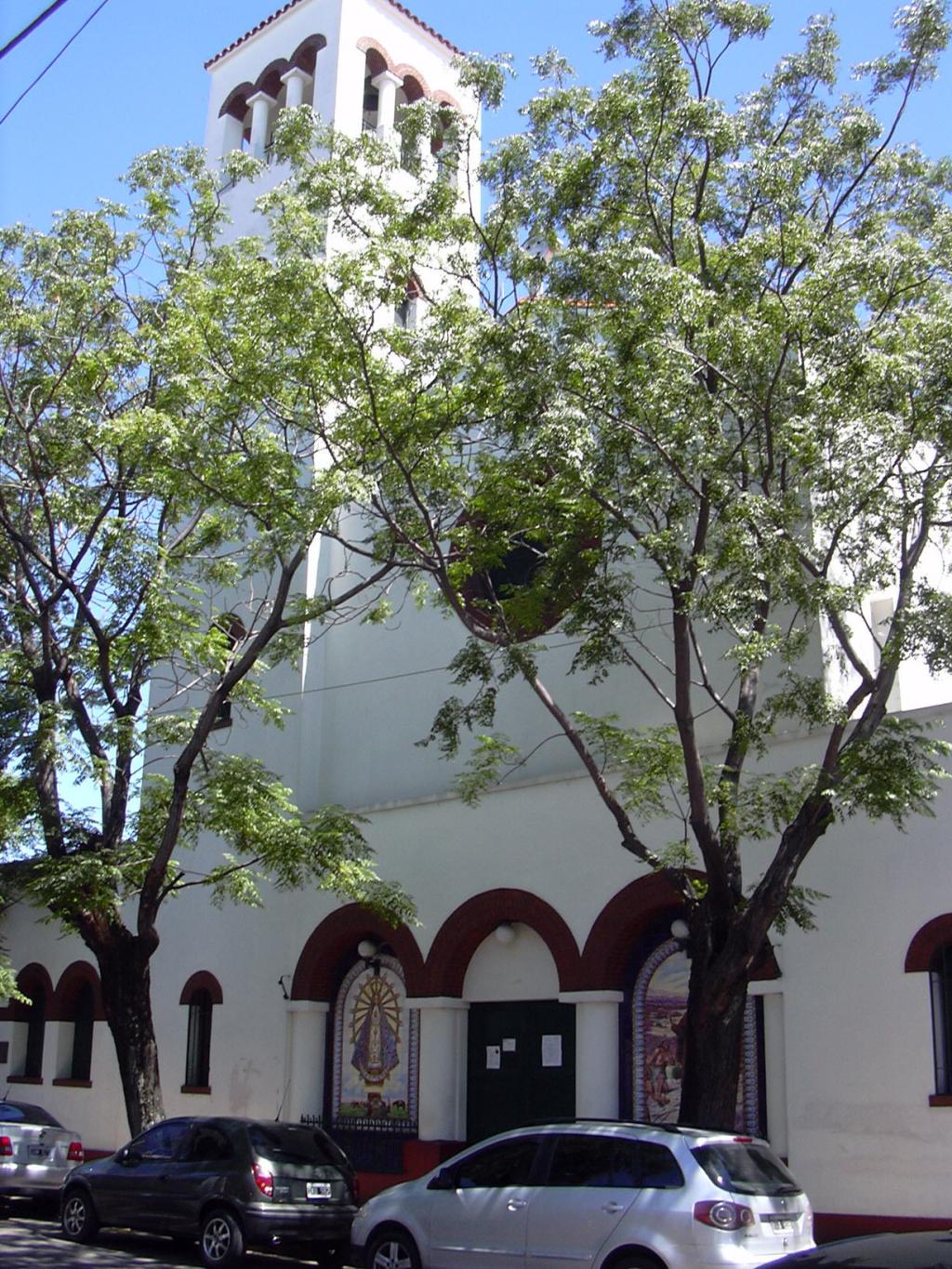
Featured image credit: “File:Villa Luro-San Francisco Solano1.jpg” by Dggionco is licensed under CC BY-SA 4.0.
 Retrospect Journal