
Written by Yael Frankie
While we are approaching the fiftieth release anniversary of Edward Said’s Orientalism, his arguments remain relevant as ever. In this article, I aim to sketch how the emerging medium of photography in the nineteenth century played a crucial role in shaping the Western perception of the ‘Orient’. Photography not only served as a reflection of Orientalist prejudices but also functioned as a mechanism for perpetuating Orientalist ideas. However, Orientalist photography was not monolithic — there were pluralistic perspectives, revealing complexities in the colonial encounter.
– Orientalism
Edward Said’s concept of Orientalism describes the West’s construction of the Orient as the ‘Other’ to justify colonial domination, with the Orient pertaining to the area roughly around the Middle East. Said thus argues that the Orient was not discovered but produced by the West, specifically as ‘[being] since antiquity a place of romance, exotic beings, haunting memories and landscapes and remarkable experiences’. This ideology was deeply embedded in the artistic and scholarly tradition of the West, including photography making Orientalism indispensable to understanding of nineteenth-century photography, in both its production and dissemination.
– Photography as a Reflection of Orientalist ideology
Since the invention of the daguerreotype (the first commercially successful camera, creating images on silvered copper plates) there has been a link to the Middle East, with the presenter stating at the daguerreotype’s introduction: “the extraordinary advantages that could have been derived from so exact and rapid a means of reproduction during the expedition to Egypt.” In line with the nineteenth century’s passion for cataloging, collecting and explaining the world in scientific terms, various institutions of knowledge-gathering used photography to further research on the Orient, resulting in the Middle East becoming the most popular site for the practice of photography.
While the photograph had the ability to record life-like details, its content often projected fantasy rather than reality. Photographers imposed their dominant understanding of the Orient into their images, reinforcing European superiority by depicting the Orient as stagnant, backward, and in need of Western intervention. Common themes in these photographs were monuments, landscapes, and people classified according to type. These ‘type’ photographs were often done in studio backdrops with props and poses, taking away from the reality and leading into the fantasy. In some photographs, taken in the same studio, the same model appears posing for two different roles – a rabbi and a cotton carder. Moreover, photographs perpetuated the eroticisation of Oriental women and excised the mystery and curiosity surrounding harems.
When European audiences viewed these images, they were not just engaging with artistic interpretations, but consuming what was presented as factual evidence of Eastern inferiority. Photography was especially effective at transferring this message considering the purpose of photography of the Middle East during this time was to provide European audiences with truthful images. As a result, Orientalist photography became a tool of colonial knowledge production, reinforcing narratives of European cultural superiority. Moreover, photography democratized access to Orientalist imagery by liberating it from elite circles and bringing it into wider circulation, further cementing these stereotypes in the European imagination.
– Capturing Absence: Constructing the Orient Through the Camera Lens
Photography was not just a passive reflection of Orientalist thought but an active participant in shaping Western perceptions of the Orient. Particularly, the ways in which historical sites and natural scenes were photographed reinforced ideas of European superiority and dominance. A common practice was the deliberate exclusion of local people from photographs of historical landmarks, portraying these sites as depopulated, timeless relics rather than living cultural spaces. By erasing local inhabitants, photographers reinforced the notion that these lands were frozen in time, belonging more to history than to their contemporary inhabitants. This visual strategy aligned with colonialist narratives that framed the Middle East as a space ripe for Western exploration and intervention.
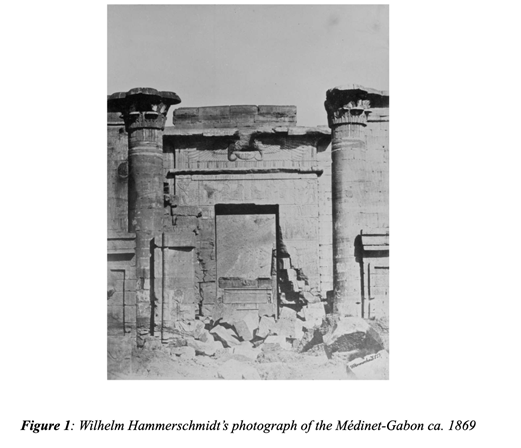
A striking example of this perspective is evident in the words of Professor Charles Piazzi Smyth, who commented on Orientalist photography: ‘[T]he ghost-like figures of the Arabs might as well have been omitted, for with their black, unphotographable [sic] faces they make very bad ghosts; and besides, the modern Arabs of Egypt are such ephemeral occupiers of the soil, that they have no right to any place amongst the more ancient monuments of Egypt.’ This statement encapsulates the broader Orientalist sentiment that viewed modern Middle Eastern populations as temporary and irrelevant to their own heritage, positioning European observers as the rightful heirs to these ancient civilizations.
– Counter-Narratives in Orientalist Photography
Despite the prevalence of Orientalist photography, there were inconsistencies and ambivalences within these images that reveal a more complex interaction between colonizers and the colonized. Eastern subjects were not merely passive victims of Western visual discourse—they actively pushed back by creating their own narratives and representations. A comparison between two prominent photography studios, Bonfils in Beirut and Sébah in Istanbul, illustrates this divergence.
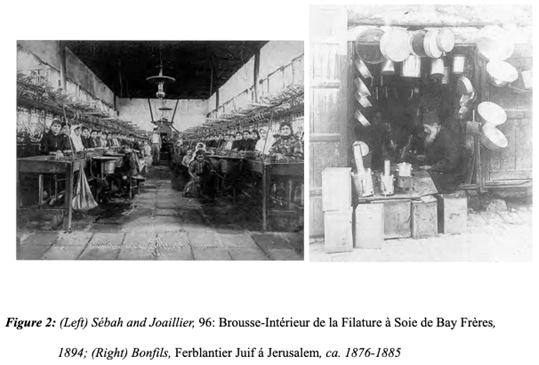
The Bonfils studio was deeply entrenched in Orientalist conventions. Their photographs were carefully staged to reinforce European fantasies of an unchanging, exotic Orient on the brink of disruption by modernity. The Bonfils family was not interested in documenting contemporary Middle Eastern life but rather sought to capture an idealized vision of the past that aligned with European expectations.
Conversely, Sébah’s studio in Istanbul challenged these stereotypes through a different photographic approach. Sébah’s work often employed the ‘community portrait’, a style that depicted groups of people in public spaces, engaging with the camera rather than being passively observed. These portraits presented an orderly but not explicitly Western image of Turkey. However, even Sébah was not entirely free from Orientalist influence; his studio also produced staged images catering to European tastes, illustrating the complex pressures of both resistance and adaptation faced by local photographers. Furthermore, the Sébah studio had hired a Frenchman, Joaillier, reflecting even more the diversity of the perspectives within the sphere of photography.
When comparing his community portraits to Bonfil’s studio photographs, it becomes evident that while Bonfils is focused on a stereotype known to Europeans, the Sebah community portrait style, emphasises a group of individuals and their connections to a larger society. This dichotomy is exemplified in the two pictures seen in Figure 2, with the left being a photograph of a workplace taken by the Sébah studio while the right being a photograph of a workplace from the Bonfils studio.
– Conclusion
Although nineteenth-century Orientalist photography may seem like a relic of the past, its legacy continues to shape contemporary visual culture. The tendency to portray the Middle East through exoticized, romanticized, and often dehumanizing imagery persists in modern media. A striking example of this continuity is National Geographic’s famous 1985 cover featuring the ‘Afghan Girl’ with green eyes — a photograph that, while celebrated, also echoes many of the same Orientalist tropes of mystique and otherness that characterized nineteenth-century photography.
The role of nineteenth-century photography in shaping Orientalist discourse was profound, operating as both a mirror and a mechanism for colonial ideology. While many photographers reinforced dominant narratives of the Orient as exotic, stagnant, and inferior, local photographers offered alternative representations that challenged these stereotypes. By critically examining these photographs, we can better understand how visual culture has historically constructed and perpetuated power dynamics — and how it continues to influence perceptions of the ‘Other’ today.
Bibliography
Behad, Ali. “The Orientalist Photograph.” In Photography’s Orientalism: New Essays on Colonial Representation. Getty Publications, 2013.
Gregory, Dereck. “Emperors of the Gaze: Photographic Practices and the Productions of Space in Egypt, 1839-1914.” In Picturing Place: Photography and the Geographical Imagination, edited by Joan M. Schwartz and James R. Ryan. Routledge, 2003.
MacKenzie, John. “The Orientalism Debate.” In Orientalism: History, Theory and the Arts, 1–19. Manchester University Press, 1995.
Maxwell, Anne. “Framing the Non-West: New Approaches to the History of Photography.” Journal of Colonialism and Colonial History 16 (2015).
Said, Edward W. Orientalism. 1978. Reprint, London: Penguin, 1978.
Woodward, Michelle L. “Between Orientalist Clichés and Images of Modernization.” History of Photography 27, no. 4 (December 2003): 363–74.
 Retrospect Journal