

Written by Daisy Gillam
In 1975, German artist Rebecca Horn carried out a performance art piece titled Touching the Walls with Both Hands Simultaneously. The piece was a part of a longer series of performance pieces titled Berlin-Exercises in Nine Parts that involved the artist creating what she referred to as ‘body extensions’ from sculptures of fabric, wood, and metal. The piece details her walking slowly and methodically back and forth in front of a camera, her arms outstretched, scratching the walls on either side with elongated, claw-like structures attached to her fingers. The piece is unsettling to look at because of the almost animalistic nature of her claws and the visibility of her reflection that makes it seem as if she has four arms; but it is also liberating to look at. With her arms outstretched, the only object in the wide, empty room that she is nevertheless filling, Horn’s occupation of the room serves to comment on the lengths women have – and should – go to occupy space, both literally and figuratively.
The realm of early performance art is one that is historically masculine; when performance started playing a major role in the art world in the 1960s, women were the minority. Since then, the realm of performance art has shifted, and women utilising their bodies and their spaces in art has become instrumental in commenting on their positions in society. In her 2014 novel Dept. of Speculation, Jenny Offill coined the term ‘art monsters’, referring to the perceived immorality of women who dedicated their time and lives to art in an often necessary act of prioritisation over other things a patriarchal society expected of them; such as being a mother or a wife. As Lauren Elkin writes, it is a monstrous gesture to take up space.
The line between performance art and protest in the face of social injustice is often thin; in 2014, Emma Sulkowicz carried out a performance piece she called Mattress Performance: Carry That Weight in protest of her college’s refusal to expel a fellow student who had raped her and other students. The performance adhered to a set of rules; she refused to ask for help supporting the mattress, would only accept it from others if they offered and most importantly would carry out the performance until her rapist had left the campus. The act inspired other students to do the same, and over one hundred and thirty other students carried in their mattresses to protest campus sexual assault.

Rebecca Horn, Touching The Walls with Both Hands Simultaneously, 1974-5.
Sulkowicz’s performance, effectively demonstrating how the private, personal and political are inextricably linked, also aimed to make a point in drawing attention to the perception of women taking up social space – both in protest and in speaking out – and the ‘disruption’ this is viewed to cause by disrupting space in the most literal form. Artist Ann Hamilton followed a similar line of thinking when she assigned her students the task of carrying around a piece of 4×8 wood for a week. The reason, she explained, was two-fold; partly so they could get used to the act of taking up space and partly to bring to their attention how often they as young women apologised for themselves: both their physical presence and the inconvenience they believed they caused others to experience.
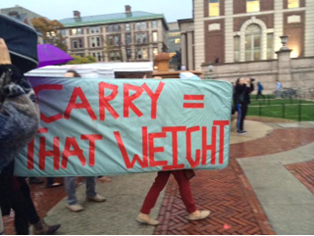
Emma Sulkowicz, Mattress Performance: Carry That Weight), 2014-15.
Hamilton spoke about how her female students often made “tiny, furtive things that expressed something about their condition, including the lack of room they feel free to occupy”. These performance pieces hold the common theme of being physically tiring; Elkin writes that the gesture of taking up space can be draining. In Carolee Schneemann’s performance piece Up To and Including Her Limits, she explores the role her body plays in the space around her. The installation involved Schneemann’s naked body strung up on a harness, reaching out with a crayon and making marks on the white surfaces around her as she swung back and forth. She described how she ‘surrender[ed] to the ebb and flow of the harness in relation to her body’. The piece is deliberately physically uncomfortable for her as an artist, and the marks on the walls create a sense of distress and discomfort.
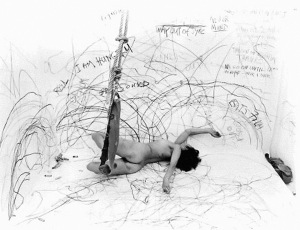
Carolee Schneeman, Up To and Including Her Limits, 1973-6.
Schneeman, who was instrumental in influencing the performance art scene and was the subject of controversy for her often vulgar pieces (such as a performance piece that involved her slowly extracting a scroll from her vagina), establishes that the act of taking up space, whether that be physically, visually, or verbally, is often uncomfortable but that it is something that should be done regardless. The act of making oneself larger – as established in Sulkowicz’s mattress performance –especially as a woman, is inconvenient to a society that refuses to make space for them.
The recent national exhibition Women in Revolt! which appeared in National Galleries across the UK involved a 1977 performance piece from artist Gina Birch titled 3 Minute Scream. The video features a close-up image of the artist’s face staring directly into the camera and screaming over and over. During the exhibition it plays on a loop, and as viewers walk around the exhibition the sound of the artist’s shrill scream is impossible to ignore, creating a deliberate disruption of the typically quiet gallery environment. The gallery space is occupied by this sound, forcing viewers to listen to the distress of her voice. A similar effect was created in the three-week long performance art piece carried out by Suzanne Lacy and Leslie Lebowitz in 1977, titled Three Weeks in Mau. During it, while viewing the art itself, such as a lamb carcass strung from the ceiling, viewers were forced to listen to a series of tapes of women detailing their assaults. In both instances, the spaces are injected with the deliberately uncomfortable, distressing and unpleasant voices of women in a place where art is typically assumed to simply be viewed; they control the space.
These pieces, and the culture of women’s performance art as a whole, reflect the cultural refusal of women to see their contributions to their space as invaluable, both in and out of the art world. Artists who have been labelled ‘art monsters’ have spoken of public perception of their choice of art over children; they are viewed that way because their actions in relation to art – their act of physically creating something that is not deemed they should in sacrifice of what the patriarchy expects of them – are a disruption to the natural order of a society. The act of the viewer being made to feel uncomfortable when a piece of woman’s performance is centred entirely around the act of taking up physical space confronts them with an unavoidable question; why are you so uncomfortable with it? Horn exemplifies this in her series; the extensions are artificially created, suggesting implicitly that the occupation of space is something that does not come naturally, but nonetheless are created by her. The performances suggest that the act of taking up space on the part of women is something that has to be improvised, actively built and created rather than something that passively exists. It is something that should always be done regardless of the inconvenience caused to a society that refuses it.
Bibliography
Elkin, Lauren. Art Monsters: Unruly Bodies in Feminist Art. First American edition. New York, NY, Farrar, Straus and Giroux, 2023.
Forte, Jeanie. “Women’s Performance Art: Feminism and Postmodernism.” Theatre Journal, vol. 40, no. 2, 1988, pp. 217–35. JSTOR, https://doi.org/10.2307/3207658.
Featured Image Credit: Mattress Performance Rules of Engagement. https://commons.wikimedia.org/wiki/File:Mattress_Performance_rules_of_engagement.jpg
 Retrospect Journal
