
Written by George Purdy
Built on the shared ethnolinguistic and historical heritage of the five so-called Nordic nations, Norden (literally ‘the North’) has become a foundational concept in the national identities of these nations, nowhere more so than in Sweden as the most populous country in the region. Nonetheless, despite its modern reimagining in the pan-Scandinavian movement of the nineteenth century, the concept of Norden was slow to gain political traction in Sweden, being long side-lined by politicians and diplomats alike. It was only during the socio-political upheaval of the Second World War and the establishment of the Cold War world order that nordism had a tangible political impact not only in Sweden, but across the entire region. The founding of the Nordic Council in 1952, alongside the implementation of the Scandinavian welfare state model and the adoption of the Swedish ‘third way’ policy during the Cold War all owe their existence to the collective trauma of the Nordic countries during the twentieth century and the integration of this period of insecurity into national memory. As the only Nordic nation to avoid invasion due to its policy of neutrality, Sweden led the way in the implementation of this revived socio-political phenomenon, galvanising the sense of Nordic unity and cooperation which remains a guiding ideology in the current climate of political instability.
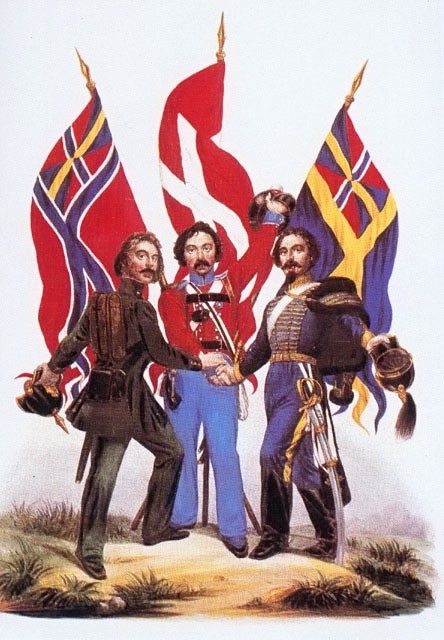
Following its earliest political expression under the Kalmar Union of 1397 to 1523, ideas of a common Nordic identity were largely ignored by the political class, having little influence on intellectual thought until the arrival of romantic liberalism during the seventeenth century. This led to the rise of a pan-Scandinavian movement among academic circles, a movement which sought greater political ties, or even a tripartite union, between Norway, Sweden and Denmark based on their ethnolinguistic proximity. Despite some success among intellectuals, this movement failed to gain the popular support necessary for the implementation of its radical ideas, being dealt a serious blow by the end of the Swedish-Norwegian free trade area in the 1880s. The pan-Scandinavian movement soon lost its limited political relevance, being consigned to history by the end of the union between Sweden and Norway in 1905. The breakdown of this union marked the beginning of a period of greater Swedish isolationism regarding its Nordic neighbours, with interest in Nordic cooperation reaching an all-time low. Viewed through the prism of broader geo-political changes, the cessation of Norway from its union with Sweden can be viewed as the most consequential event in a series of disputes which would split the Nordic nations into separate political camps. Diplomatic conflicts between Sweden and Finland over the Åland archipelago, between Denmark and Norway over eastern Greenland, Denmark and Iceland over Iceland independence (achieved in 1918) constituted the demise of Nordic cooperation, with each nation seeking stronger ties with other foreign powers to account for this loss. Nordic cooperation became so unpopular among the Swedish political class that foreign minister Carl Hederstierna was forced to resign in 1923 after suggesting a defence union with Finland during a formal dinner with diplomatic colleagues.
The early twentieth century was therefore defined as a period of relative isolationism in Swedish foreign policy, a trend which was only reversed by the onset of the Great Depression. Given the earlier disengagement of the Swedish and Norwegian economies and the multitude of other diplomatic disagreements in the wider region, the ability of the Nordic region to withstand the economic crisis was significantly reduced, necessitating the creation of a new economic status quo. As such, during the twenty-eighth session of the previously founded Inter-Parliamentary Union a permanent grouping was suggested to facilitate greater economic cooperation among the Nordic nations and the alignment of their disparate fiscal policies. Beyond economic pressures, the 1930s also bore witness to seismic political events, among them the success of the Nazi Party in Germany in 1933. Renewed fear of their southern neighbour was yet another catalyst for the revival of greater Nordic cooperation for the mutual protection of the region’s small nation states.
Despite significant changes in opinion among both the Swedish political class and Swedish society more generally, the series of economic and political events transforming Europe outpaced the creation of new policies, overcoming all attempts on the part of the Nordic nations to protect their national and regional integrity. However, this did little to slow the revival of Nordic sentiment in Sweden. Only a few days after the beginning of the Winter War with the Soviet invasion of Finland, the journal Nordens frihet (The Freedom of the North) came into print, advocating Swedish assistance for Finland. Utilising the nostalgic place Finland occupied in Swedish national memory as a country in which Swedish language and culture continued to survive many years after the Russian conquest of Finland in 1809, Finland’s close ties with the Scandinavian nations were emphasised by contributors to the journal. As such, this journal provides clear evidence of the expansion of the ideals of the earlier pan-Scandinavian movement to the whole Nordic region. In an early article the words of Nazi ideolog Alfred Rosenberg calling for the German domination of smaller nations were published, driving home the necessity of mutual Nordic assistance to its readers. Successfully galvanising Swedish support for Finland, Nordens Frihet helped secure five hundred million kronor for the Finnish war effort as well as the acceptance of Finnish refugees. During the Winter War around seventy-five thousand Finnish refugees arrived in Sweden, forty-one thousand of which were children. The finska krigsbarn (Finnish children of war) became emblazoned in Swedish national memory, greatly increasing popular support for Finland. Refugees also arrived from Norway during the Second World War following its invasion by Nazi Germany, with sixty thousand Norwegians arriving to the Swedish provinces on the other side of the border, among them the writer Carl E. Norrman. While in Sweden, Normann published the book Fred og Forsvar (Peace and Defence) which promoted the idea of a Nordic Union whose creation he believed was best led by Sweden as the only Nordic nation to avoid invasion. Contact with the 185,000 refugees who arrived in Sweden during the Second World War brought the Swedish population at large into direct contact with the plight of neighbouring nations, galvanising popular support for Swedish involvement in intergovernmental organisations, particularly those in the wider Nordic region. In 1952 the Nordic Council was founded, realising the prioritisation of Nordic cooperation on the part of national governments across the region.
As the new Nordic direction of Swedish foreign policy became embedded, its political expression was informed not only by domestic and regional affairs, but also by the new global order characterised by the ideological struggle between capitalism and communism. Published in 1942 as the Cold War era began to dawn, the book Nordens förenta stater (The Nordic Region’s United Nations) was published arguing that the Nordic nations were well-placed to provide a counterbalance to the USA and the USSR on the grounds of their welfare state models. Within Sweden this approach to the bipartite world order became known as the ‘third way’ model. Between 1942 and 1944 alone over twenty books on this subject were published in Sweden, each espousing the values of the folkhemmet (‘the people’s home’) ideology which rejected participation in the Cold War. In recent years historians have reevaluated the Swedish reaction to the Cold War world order, arguing that it should not be characterised as an attempt to make the Nordic region a third player in the conflict, but rather to create a neutral grouping. Wilhelm Carlgren’s book Mellan Hilter och Stalin (Between Hilter and Stalin) illustrates this approach as it proposed a Nordic union as a political organisation equally attractive to both capitalist and communist powers.
A product of what is known within regionalism theory as ‘old regionalism,’ (the bipolar world order of the Cold War), the political expression of Nordic identity became a necessity in Sweden and across the wider Nordic region following the socio-political turmoil of the Second World War. Whilst nordism has its roots in the pan-Scandinavian movement of the seventeenth century, itself an offshoot of the romantic liberalism of the period, its modern form was forged in the heat of international conflict and insecurity during the twentith century, forcing the Swedish government to utilise its relative stability as the only Nordic nation to avoid invasion to pursue closer relations with its neighbours. Retaining its political currency in the current climate of international political insecurity, Nordic unity remains a guiding principle for each of the Nordic nations as they seek mutual protection in an increasingly authoritarian world order.
Bibliography
Braskén, Kasper, Kaihovirta, Matias och Wickström, Mats. “Antifascismen i Norden: ett nytt forskningsfält.” Historisk Tidskrift för Finland 1, (2017): 3-16.
Byström, Tora. “Nordens förenta stater: Debatten under andra världskriget om en nordisk union.” Aktuellt om historia 2, (2005): 145-166.
Doyuran, Pinar. “Nordic regionalism from ‘below’.” Master Thesis, Lund University, 2012.
Duregård, Agnes. “Nordiskt samarbete: Nordiska rådets verksamhet och framtidsvisioner.” Magisteravhandling, Uppsala Universitet, 2016.
Hallberg, Markus. “Finska Krigsbarn: studie om hur mottagningen av finska krigsbarn organiserades under andra världskriget.” Magisteravhandling, Karlstads Universitet, 2012.
Larsen, Knud. “Scandinavian grass roots: from peace movement to Nordic Council.” Scandinavian Journal of History 9, no. 2-3 (2008): 183-200.
Schiller, Bent. “At gun point: a critical perspective on the attempts of the Nordic governments to achieve unity after the Second World War.” Scandinavian Journal of History 9, no. 2-3 (2009): 221-238.
Strang, Johan. Nordic Political and Economic Cooperation: Context, History and Outlook. University of Helsinki, 2016.
Strang, Johan. Nordiska Gemenskaper: En Vision for Samarbetet. Nordiska rådet, 2012.
Featured Image Credit: A 19th-century poster image of (from left to right) Norwegian, Danish and Swedish soldiers joining hands via Wiki Commons.
 Retrospect Journal
