
Written by Ailsa Fraser
09/03/25
Part IV of V of Natural Contracts: Historical Partnerships Between Humans and Other Animals
On a bright Friday morning in February, I’m walking to a morning seminar. Barely ten metres from my front door, a large bird glides down in front of me, then shoots up and off over the rooftops. From the brief glimpse I got, it had a flecked chest of white and grey, with a beautiful blue-grey back. I suspected what it was already, but when I checked a guide for birdwatchers later, it was confirmed. It was the same bird I’d similarly caught only a glimpse of the day before, too, and I’ve since seen it several other times as it hunts over the park and street alike. It was a sparrowhawk.
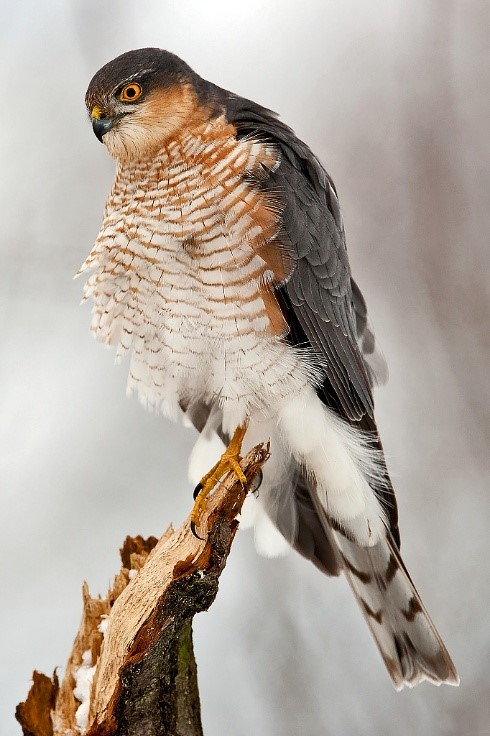
Figure 1: An adult male Eurasian Sparrowhawk, photographed in Slovakia.
Birds of prey, or raptors, are always a treat to see. Where I live, there are kestrels, peregrine falcons and buzzards to see as well as sparrowhawks, but the buzz doesn’t wear off. Falcons are birds of prey that hunt from high in the air, with long, pointed wings, and kill their prey by impacting on them at speed. Hawks, in contrast, are only distantly related. They hunt relatively low to the ground and kill prey by grasping them with their talons. In the UK, raptors took a dive in population during the nineteenth and twentieth centuries. Because some of them, like goshawks, hunt game birds like grouse, gamekeepers would lay traps for them and shoot them; deforestation stripped back many birds’ traditional habitats; and later, the use of pesticides like DDT had a disproportionate effect on raptors, as toxins accumulate in the bodies of animals at the top of the food chain. They’ve been on the rise more recently, though, whether from birds that escaped from falconry, were intentionally brought over and released, or just migrated from continental Europe. But their habitat is often still limited. Increasingly, raptors have moved into cities—goshawks in Berlin, peregrines in London, and the sparrowhawk that flew over my house.
But they’re not just distant, elusive birds that have only now started to come out into the open. Humans and raptors—mainly hawks and falcons—have worked alongside each other for millennia. Today, falconry is still a thriving, if you’ll pardon the pun, hobby. If you’ve visited a lot of castles in your lifetime, which I imagine you have if you’re reading Retrospect Journal, they may have put on a falconry display, where the falconer flies a raptor to show how they hunt. I most recently saw one at Dunrobin Castle in Sutherland, where the falconer flew a peregrine falcon, explained many of the traditional methods of trapping and training a bird, and—most significantly—how they hunt with them, which varies by bird species. Falconers must train the bird to fly, to hunt, and to return to the fist when unsuccessful. It is a test of patience and tradition. As a sport, as historian and falconer Helen Macdonald admits, falconry is old-fashioned, full of arcane terminology, and often obscure. It looks like it belongs in castles like Dunrobin, flown by royalty of centuries past. While that isn’t always the case today, it certainly used to be.

Figure 2: Falconer and peregrine falcon in front of Dunrobin Castle, May 2024.
The origins of falconry are contested and unsure, but it stretches back at least six thousand years. There are records of falconry in ancient Egypt, Antolia, and India. It was definitely practiced in China by the second century CE, and it was introduced to Europe in the fifth century CE. In medieval Europe it was particularly popular. The falconer I met at Dunrobin spoke of how any man was allowed to trap and train a raptor, usually a hawk, and use it to assist him in hunting and feeding his family. But the reality of training raptors was time-consuming and intense. Macdonald gives an overview of training their own goshawk, Mabel, and references a range of traditional, out-of-date accounts: some gentle, some blatantly abusive toward the hawk. And to buy a raptor could cost a tenth of a knight’s annual wage. Monarchs like Harold Godwinson were known to be avid falconers, and alongside other forms of hunting, it was a pastime of the elite, who could enjoy the natural world in ways those who worked it to feed themselves could not. It wasn’t a sport restricted to men: noble women would often fly raptors as well. The training of a falcon was an expression of the power humans had over nature, and that sense of domination stuck with the sport for a long time. By the late Middle Ages, there was a complex culture around falconry, with elaborate terminology, rituals, and artefacts to accompany it, represented by extensive literature and artwork.
From the seventeenth century, however, its popularity waned in Europe, although it held prestige in much of Asia. Increasing awareness of cruelty to animals led to some staunch opposition by the nineteenth century, though most falconers today aren’t in any way abusive—as raptors are not social birds, they don’t respond well to negative reinforcement, so positive reinforcement is more effective. There was also the issue of propriety: in the nineteenth century, the RSPCA insisted that falconry coarsened young ladies’ minds, and the idea of connecting with and dominating nature, or more specifically wildness, seemed uncivilised. They still had uses in military contexts, however. In the First World War, peregrine falcons hunted and intercepted messenger pigeons, though in Britain this didn’t meet enormous success, and still today the US Airforce uses them to clear airfields of gulls. However, by then they had lot a great deal of cultural capital and although falconry continued as an oddball art, such as by people like the fantasy author T. H. White, it only started gaining more followers more recently. Raptors are still rebounding from years of hunting, poisonings, and habitat loss.
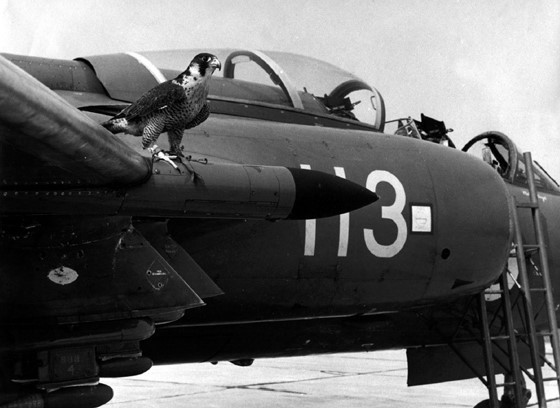
Figure 3: A peregrine falcon sitting on a military plane.
But we lived alongside them before. We can do it again.
Falconers today live by stricter standards than they once did. Once, the birds would have been punished, deprived of sleep, and sometimes hurt; that is no longer the case. Many people find uncomfortable the fact that falconry by necessity requires hunting—small birds for sparrowhawks, small rodents for kestrels, pigeons for peregrines, and even mammals as large as a hare for goshawks. Falconers argue that their bird would have hunted similarly in the wild anyway. On the other hand, where there’s discomfort with keeping a wild bird captive—some birds are bred, but others are caught, especially in America—falconers argue that the bird flies free. It could fly away at any time. The history of domination, the symbolism of control over nature, haunts the sport—but a quick overview of modern environmental history shows that domination over nature haunts much of today’s cultural landscape. And across the ages, falconers insist it is impossible to domesticate a raptor. They regard their humans as allies, not as masters.
Falconry is an interesting conundrum for our modern view on the nonhuman world, particularly hunting. Is it an example of humans collaborating with other animals? Is it a further example of domination of nature? Either way, raptors are returning from the brink of extinction, and they’re here to stay. And they’re wild. Even birds that have been trained by humans and hunted with them for years are still wild. Whether they’re lurking in forests or on clifftops, in a farmer’s field or on the roof of a London skyscraper, or even atop a falconer’s fist—they’re right on our doorsteps.
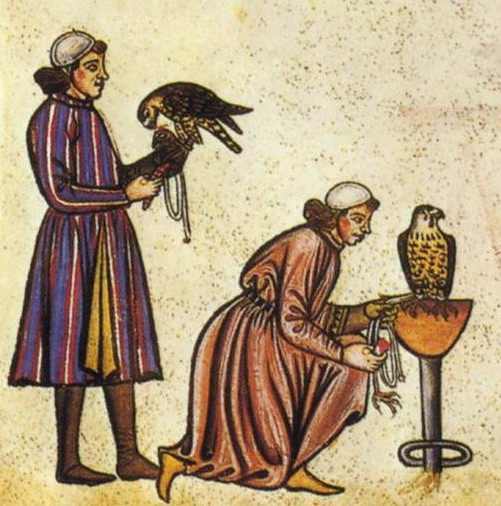
Figure 4: Two falconers illustrated in De arte venandi cum avibus, 1240s.
Bibliography
Allsen, Thomas T. The Royal Hunt in Eurasian History. Philadelphia: University of Pennsylvania Press, 2001.
Birkhead, Tim. Birds and Us: A 12,000-Year History from Cave Art to Conservation. Princeton: Princeton University Press, 2022
Greenoak, Francesca. British Birds: Their Folklore, Names, and Literature. Melksham: Cromwell Press, 1997.
Macdonald, Helen. Falcon. London: Reaktion Books, 2016.
Macdonald, Helen. H is for Hawk. London: Vintage Books, 2014.
Macdonald, Helen. “Military Falcons.” https://www1.essex.ac.uk/lifts/memory_maps/articles/helen_macdonald_military_falcons.html (Accessed March 1, 2025)
Svensson, Lars, Killian Mullarney, and Dan Zetterström. Collins Bird Guide: The Most Complete Guide to the Birds of Britain and Europe. Third edition. London: Harper Collins, 2022.
Van den Abeele, Baudouin, and An Smets. “Falconry.” Medieval Studies. Oxford University Press, 2014. https://doi.org/10.1093/obo/9780195396584-0122.
Image credits:
Figure 1: By Bohuš Číčel (https://www.flickr.com/photos/bcicel/) – Own work, CC BY-SA 3.0, https://commons.wikimedia.org/w/index.php?curid=12765564
Figure 2: Photograph by author.
Figure 3: By Unknown author. https://www1.essex.ac.uk/lifts/memory_maps/articles/helen_macdonald_military_falcons.html
Figure 4: By Unknown author – http://www.wga.hu, Public Domain, https://commons.wikimedia.org/w/index.php?curid=8540211.
 Retrospect Journal