
Written by Ami John
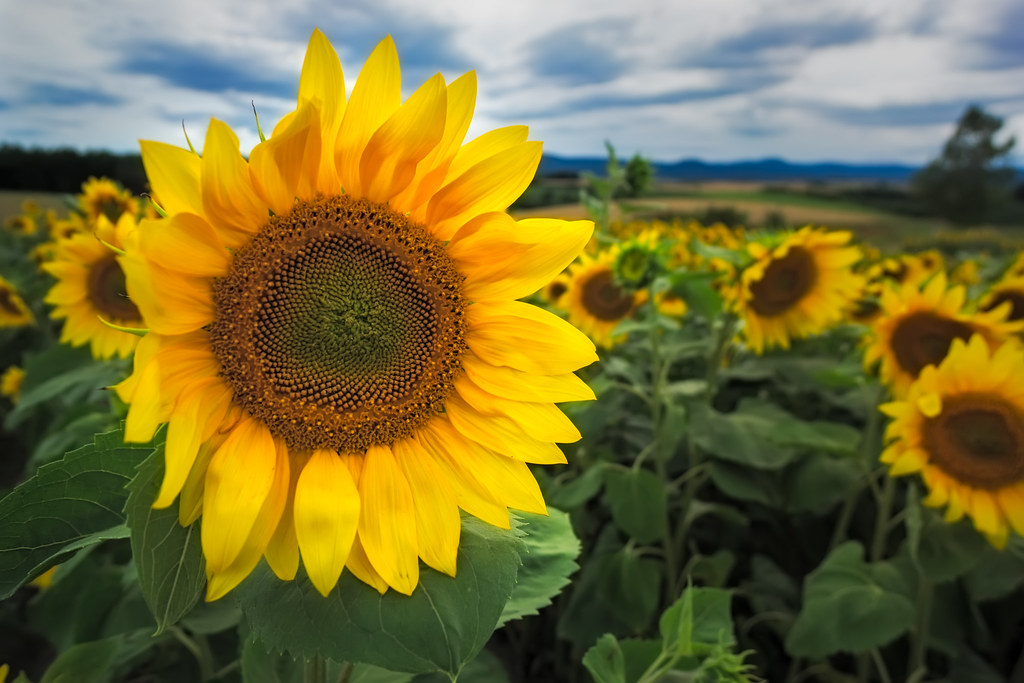
The sunflower, known as Himawari in Japanese, has been cultivated in Japan since the seventeenth century. In classical Japanese literature, the flower is celebrated for its connection to light and the sun’s movement, representing positivity, growth, hope, and the path toward success. As it blooms towards the sun, Himawari embodies a spirit of progress and unwavering optimism. This flower is often given as a gift to convey feelings of adoration, loyalty, and happiness.
Culturally, the Himawari holds great significance in Japan. For instance, the Hokuryu Sunflower Village grows nearly two million sunflowers each summer, from late July to mid-August, showcasing the beauty of the season. The number of sunflowers here surpasses the local population, creating a stunning landscape of vibrant blooms that brighten the Japanese countryside from summer to fall. These sunflowers have even been known to make the Japanese sun smile.
The Himawari’s radiating positivity has inspired countless works of art. A notable example is Vincent van Gogh’s Sunflowers, painted in 1889 during his time in Arles. The hope conveyed by the sunflower resonated deeply with Van Gogh, who, amidst his struggles with depression, found moments of optimism and painted five versions of the piece, in three different shades of yellow.
Though the Himawari is often associated with Japan, sunflowers are native to North America, where they were likely cultivated even before corn. The seeds were valued for their high-fat content, making them a sought-after crop across Europe and the world around 3000 BCE. The sunflower itself is sensational as though it appears to be a single flower, it is actually a cluster of one to two thousand smaller flowers. Every part of the plant is valuable: the leaves can be used as cattle feed, the stem provides fibres for paper production, and the seeds are a rich source of protein, potassium, iron, and vitamin E. Some sunflowers can even grow to heights of six to ten feet.
Furthermore, the sunflower plays a vital role in promoting biodiversity by attracting pollinators such as bees and butterflies with its vibrant yellow petals, fostering a healthy ecosystem. Spiritually, the sunflower is seen as a beacon of faith, known for its tendency to follow the sun, a sign for the pursuit of divine enlightenment. This ability to turn toward the sun is often viewed as a metaphor for the human quest for self-realization, a core teaching of Buddhist principles.
Beyond its beauty and utility, the sunflower has remarkable healing properties. It has the ability to remove toxic substances, such as lead, arsenic, and uranium, from the soil. This remarkable ability was observed after the Chernobyl disaster in Ukraine, where sunflowers were found to absorb radioactive materials like cesium-137 and strontium-90. This happens because cesium-137 resembles potassium (kalium), a common fertilizer, and in its absence, sunflowers absorb cesium instead. This unique healing property earned the sunflower its place as Ukraine’s national flower.
Inspired by Ukraine’s success, Japan launched a campaign to plant sunflowers around the Fukushima Daiichi nuclear power plant. After the plants are harvested, they will be decomposed, leaving behind only a small amount of radioactive waste. This initiative has turned the Himawari into a powerful symbol of hope and recovery for Japan.
In both Japanese real-life and animated series, sunflowers are used to represent characters who radiate positivity and embody hope in the face of adversity. These characters are often referred to as “sunflower characters” a personality type symbolizing warmth, optimism, and the bright energy of the sun. The name Himawari has become a popular baby name, connoting a child who faces the future with a bright outlook and embodies hope for the family.
The sunflower is also a global icon for hidden disabilities, which can include autism, chronic pain, learning difficulties, mental health conditions, mobility challenges, speech impairments, and sensory losses such as hearing or vision impairment. The sunflower serves as a subtle reminder that although these disabilities may not be visible, they still exist. It acts as a discreet identifier, signalling that the person may need extra support, time, or assistance in public spaces, on transport, or in shops.
Therefore, the Himawari, the sunflower, the smiling flower creates a space where those who encounter it are reminded to smile and look forward to life, embodying strength of character and optimism.
Bibliography
Bulger, Day. “August’s Nature Spotlight: Soaring Sunflowers, Himawari Havens.” Dreamerbyday (blog), August 31, 2021. https://dreamerbyday.ca/2021/08/augusts-nature-spotlight-soaring-sunflowers-himawari-havens/.
Everley, Joy. “The Joy of Sunflowers.” Joy Everley (blog). Accessed March 9, 2025. https://www.joyeverley.co.uk/blogs/news/the-joy-of-sunflowers.
Muza-chan. “Muza-Chan’s Gate to Japan.” Accessed March 9, 2025. https://muza-chan.net/japan/index.php/blog/himawari-hope.
Travel Japan. “Hokuryu Sunflower Village | Travel Japan – Japan National Tourism Organization (Official Site).” Japan National Tourism Organization. Accessed March 9, 2025. https://www.japan.travel/en/spot/1882/.
Featured Image Credit: “Himawari” by ‘DJ’ Villanueva is licensed under CC BY-NC-ND 2.0.
 Retrospect Journal