
Written By Logan McKinnon
23/02/25
Adapted from a series of short talks delivered as part of the Royal Portraits: A Century of Royal Photography exhibition at the Kings Gallery, Palace of Holyroodhouse.
Of the works of Andy Warhol, what is most notable is not only that they speak to us as the viewer as a piece of cultural commentary, but also that they encourage us as the viewer to speak. His ability to spark a conversation is precisely because his works are acutely grounded in the discourses of his time and because of their dual discourse-creating ability in a manner that often reshaped the lens of cultural and what could be considered cultural. For instance, his prints of the dollar bill challenged the relationship between art and the commercial and positioned the two as forever interlinked fields of consumer culture and commercialisation became more ingrained. When Warhol, a man who notably declared, “I want to be as famous as the Queen of England,” this took on a similar role – marking the entry of the monarch into culture, rather than being above culture, and, where Warhol encourages us to think of the Queen as a cultural icon in herself.

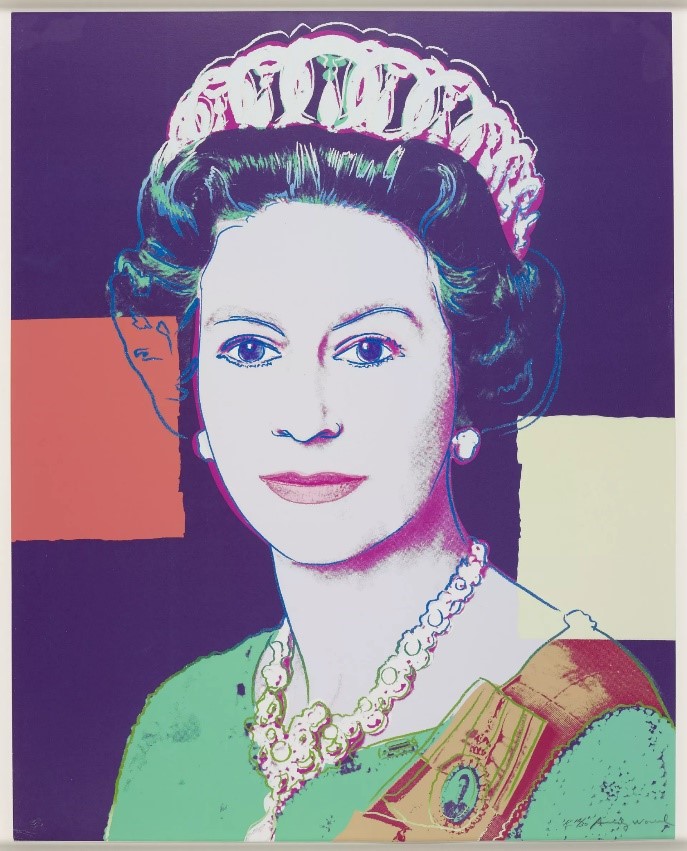
Figure 1: Andy Warhol, Reigning Queens (Royal Edition): Queen Elizabeth II of the United Kingdom, 1985.
The print featured above is unmistakably a ‘Warhol’, standing on the fine line between kitsch and high culture. Behind such a style is Warhol’s very particular pioneering form of silkscreen printing where he combined photographs, torn strips of paper, lines with pen, and strokes of the brush to build stencils. These stencils were then carefully applied layer by layer in various colours in an extremely labour-intensive process representative of Warhol’s unmatched skill in the medium.
The focus on the late Queen, and indeed three other Queens – Margarethe II of Denmark, Beatrix of the Netherlands, and Ntombi Twala of Swaziland – come from the almost royal obsession of Warhol, who famously commented “I want to be as famous as the Queen of England.” Warhol was captivated by Queen Elizabeth II and the universality of her image with her depiction almost stamp-like in drawing attention to the popular image of the late Queen rather than being truly representative of her, herself – rendering her akin to a brand as a symbol of Britishness. Art historian Cecil Whiting even notes Warhol’s paintings are not about “real people at all, but about their public image in its purest form.” This subversion of the royal image draws parallels with Warhol’s subversion of advertising imagery in his infamous depiction of Campbell’s soup tins.
Warhol’s technical approach deliberately enhances the glamour and femininity of the monarch to create a romantic impression of her that underscores a strong emotional bond manifesting within culture between the people and their monarch through photography. The Official Silver Jubilee Portrait by Peter Grugeon is transformed into an abstract and exaggerated vision of royalty that emphasises her changing role and a changing nation by extension – it is a blend of traditional portraiture and imagery reminiscent of advertisement. His work is closely linked to Warhol’s central themes of celebrity culture, consumerism, and social hierarchy, further underscored by the ‘diamond dust’ creating the sparkling effect that consists of fine particles of ground up glass applied when wet to the Royal Editions of the series which, through artificiality, blends consumerism and regality.
Warhol’s depiction is the first ‘pop’ image of the Queen and represents her role as one of the defining cultural symbols of the twentieth ‘pop’ century and the monarchy’s shift away from high culture. He crucially received permission from the Royal Household to use the official likeness of Queen Elizabeth II, although it was noted that she “dare not comment” on its production.
From early childhood Queen Elizabeth II was fully integrated with popular culture beginning with a 29 April 1929 front cover feature in Time Magazine that I have bought a copy of. Behind the cover is a grand tale of royal succession but ends with a brief anecdote from the Selfridges Department Store showing an early representation of the Queen’s cultural image, “We used to have pink, blue, and white, but now almost every mother wants to buy a pale-yellow dress or hat like Princess Elizabeth’s.”
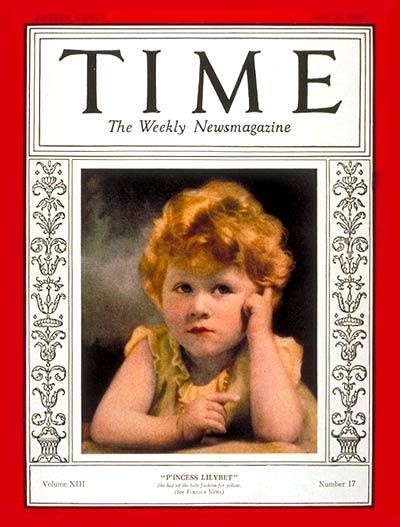
Figure 2: Time Magazine Cover, “P’incess Lilybet,” April 29, 1929.
Amongst the tumultuous twentieth century, the ability of our late Queen to develop a cultural image that resonated with the people was crucial in her enduring popularity, even as monarchies across the continent declined and the position of Britain in the world shifted. When we think of Queen Elizabeth II, her enduring legacy is in stamps, books, tea towels, fine china, and of course, in portraiture and photography, and her position as a figure, and more crucially a presence beyond political action.
The replicability of this image of the late Queen restricted her image no longer to high culture but created an image of the Queen tied to and to be enjoyed by the masses in Britain. This often has become kitsch with Pauline MacLaran of Royal Holloway University noting that when it comes to the Royals, “there is a market for everything, even the most absurd.” This does not lessen the image and grandeur of the monarchy but represented a more crucial development for the monarchy amongst the climate of the ’pop’ century. The ubiquity of the image of the monarch made the monarch seem more grounded in the people with the monarchy of the ‘pop’ century being tied up with the ‘pop’ image of Queen Elizabeth II.
The toned-down image Warhol presents in his screenprint reminds us of a postage stamp, but this gives commentary on the sheer quantity and prevalence of her image – with the Grugeon portrait widely presented across Britain as the image of the Queen. This is just an image nonetheless, something Warhol is trying to draw attention to with Alexandra Shulman, lately Editor-in-Chief of British Vogue, describing the Queen in the portrait as “…at once instantly recognisable but entirely unknowable.” The monarch in this sense plays into the cultivation of an image with the monarchy no longer, say, ‘speaking for itself,’ in terms of its cultural power, in stark transformation to the role of an earlier monarchy where cultural developments often stemmed directly from it.
It is natural our monarchy shifted from being ‘of culture’ from an elite culture-setting position, for any other presentation of monarchy appears detached. Instead, it recognises the modern role of the monarchy which is centred around ideas of ‘a people with a Queen’ rather than the historic ‘Queen with a people’, where in the monarch British identity conveys and allows a clearer focus on pursuits such as humanitarian missions that recognise modern British values. The image of the monarchy is clouded in an ‘air of artificiality’, but it is a necessary image for a modern monarchy representative of the modern position of the monarchy within society. Warhol recognises this and presents the Queen within such a framework and where her defining legacy will lie – as a cultural icon of the ‘pop century.’
Thus, we should embrace the kitsch, for it represents a modern monarchy whose power and status originates from the people, and which is therefore firmly grounded in the people. Queen Elizabeth II declared in 1947 that “…my whole life whether it be long or short shall be devoted to your service”, establishing her position in relation to the people that enabled her cultural position. Warhol’s work is what brings this conversation to life, and Warhol’s greatest works are those that encourage us to think about our society and the nature of it – and this is certainly achieved in this portrait where Warhol positions the late queen as a cultural icon.
Bibliography
Journal Articles
Schwarzenbach, Alexis. “Royal Photographs: Emotions for the People.” Contemporary European History 13, no. 3, August 2004: 255-280. https://doi.org/10.1017/S0960777304001729
Willis-Tropea, Liz. “Glamour Photography and the Institutionalisation of Celebrity.” Photography and Culture 4, no. 3, 211: 261-275. https://doi.org/10.2752/175145211X13068409556646
Book Chapters
De la Pena, Manuel Alejandro Rodriguez. “The Cultural Power of Medieval Monarchy: Politics, Learning, and Patronage in the Royal Courts of Europe, 1000-1300.” Routledge, 2024. pp. 1.
Saumarez Smith, Charles. “The National Portrait Gallery.” National Portrait Gallery, 1997. pp. 217.
Shulman, Alexandra. “Elizabeth II: Princess, Queen, Icon.” National Portrait Gallery, 2021. pp. 109.
Articles
Balmer, Professor John. “How Queen Elizabeth II Made the British Monarchy into a Global Brand.” September 13, 2022. How Queen Elizabeth II made the British monarchy into a global brand | Brunel University of London
Bliske, Maria. “Queen Elizabeth II of the United Kingdom.” Tate. March 2006. ‘Queen Elizabeth II of the United Kingdom‘, Andy Warhol, 1985 | Tate
Garber-Paul, Elisabeth, Angie Martoccio, Andrea Marks, Miles Klee, CT Jones, EJ Dickson, and Lisa Tozzi. “18 Times Queen Elizabeth II Ruled Pop Culture.” September 09, 2022. Queen Elizabeth II: 18 Times the Monarch Starred in Pop Culture
Gosalvez, Patricia. “Elizabeth II: A Queen for a Pop Century.” September 08, 2022. British monarchy: Elizabeth II: A queen for a pop century | International | EL PAÍS English
Government Art Collection. “Queen Elizbeth II of the United Kingdom.” Government Art Collection, 2016. Queen Elizabeth II of the United Kingdom – Government Art Collection
Halcyon Gallery. “Andy Warhol | Queen Elixabeth II of the United Kingdom.” Halcyon Gallery. Andy Warhol | Queen Elizabeth II of the United Kingdom | Halcyon Gallery
Halcyon Gallery. “Collecting Guide: The Silkscreen.” Halcyon Gallery. Collecting Guide: The Silkscreen | Andy Warhol | Halcyon Gallery
National Portrait Gallery. “Queen Elizbeth II.” National Portrait Gallery. 2021. NPG 5882(4); Queen Elizabeth II – Portrait – National Portrait Gallery
Royal Collection Trust. “Reigning Queens (Royal Edition): Queen Elizbeth II of the United Kingdom.” Royal Collection Trust, 2012. RCIN 507013 – Reigning Queens (Royal Edition): Queen Elizabeth II of the United Kingdom
Thorpe, Vanessa. “The Queen in Culture: How Art Puts a Public Face to a Private Life.” The Observer. June 05, 2022.” The Queen in culture: how art puts a public face to a private life | Queen’s platinum jubilee | The Guardian
Featured Image Credit: Andy Warhol, Reigning Queens (Royal Edition): Queen Elizabeth II of the United Kingdom, 1985.
 Retrospect Journal