
Written By Helene Chaligne
23/02/25
Upon visiting the British Library in London in January, I was faced with a most remarkable object: a Medieval birth girdle. This object was one of many illustrated pieces of cloth believed to be used to protect pregnant women during the period. Having found this small insight into birthing practices of the period captivating, I set out to unearth the very limited literature on birth during that era. I offer a glimpse into the historiography and the practices, medical and spiritual, related to Christian and Jewish women.
Monica Green, a renowned scholar on women’s healthcare and plagues, wrote an essay in 1989 offering an overview of the contemporary scholarship on medicine relating to women during the medieval to early modern period. She stresses that women had an almost constant need for care, especially with childbirth being the leading cause of death. Green challenges the view that women’s health was solely women’s business and that medical practices were divided by sex. She points to evidence, albeit small and scarce, of women being physicians, surgeons, and apothecaries, debunking the view of them being relegated to only midwifery.
Researching medieval medical practices related to women is already a difficult task; looking at women in medical professions proves even harder. The two are especially affected by the lack of sources, largely due to the few sources written on the subject and those that were almost always being authored by men. A significant event in the story of European women in medicine would be the licensing that began happening in the mid fifteenth century, restrictions thus being imposed upon women. They arose in a time of tension between men and women and tensions within the medical world, between those in higher positions of power like physicians and the less powerful empirics and “old women.” Other tensions between religious groups and the conflicting goals of different ecclesiastical authorities make it, according to Green, hard to determine the true motives and causes affecting women’s involvement in medicine.
A seminal text in the investigation of women’s involvement in medicine during the medieval period is the famous La Trotula, linked to the twelfth century medical centre that was Salerno in Italy. The book is known for bringing Arabic medical practices into the West. The texts from a group of three total ended up circulating across Europe from Portugal to Ireland. There has been speculation about the authorship of these texts, historians being torn between it being authored by men or men and women; furthermore, with translations being an important aspect of the book’s life, different editions of the texts contain different contents. John Benton argues that it was authored by men and women yet written with the purpose of being used entirely for men. Green refutes this by pointing out that the preface of one of the three texts accounts for women who might be ashamed of their condition and would not have dared to reveal their distress to male physicians. She emphasises that, with this purpose in mind, it would be hard to believe that the texts were meant for male use only. Furthermore, the inclusion of a section on cosmetics seems very much geared towards women.
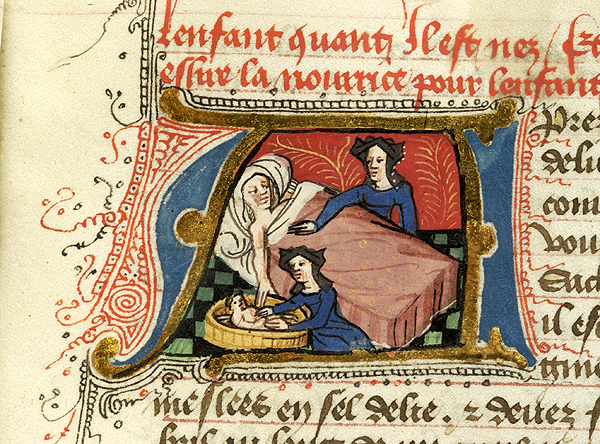
Moving along to now look at certain practices surrounding birth in Western Christian tradition, the preparation of the space and the woman was crucial. Birth was an exclusively female ceremony and the mother would select a number of women to be by her side alongside the midwife. The room would be adequately cleaned up and prepared. A sacred drink, ‘the caudle,’ containing a mixture of ale, honey, and herbs was given to the labouring woman in the hopes that it would help ease the pain. Additionally, before giving birth, women were able to perform pregnancy charms. These charms were discovered in a collection of medieval texts and prayers called Lacnunga, which translates to remedies. It contains a charm to assert her strength and protect her from stillbirth; it instructs her to step on the grave of a dead man and step over her lord, her husband in this case. Women were then instructed to go to church and declare their children’s safe birth before the altar. Another charm from the collection is aimed at a woman who struggled to breastfeed her child, urging them to drink cow’s milk and water from a stream. More tragic charms sought to shelter babies who had passed on their trip to the afterlife.
Following on from charms, women would wrap themselves in clothes known as birth girdles during the labour process. Mainly found to protect against the devil, the girdle was also used as protection during childbirth. The surviving girdles have religious imagery and prayers on them. Don Skemer notes that textual amulets were worn around the neck or as a belt; he traces them as far back as 1900 BC in Egypt. They then ventured out to Greece, the Roman Empire, and Byzantium. It is presumed that one would either have to be literate or instructed by someone who was to recite the prayers. The illustrations allowed for anyone to connect with the story of Christ’s punishment and humanity’s salvation.
The charms and the girdles symbolise the convergence of medicine and faith, as well as also speaking to the anxieties that Western women would have had in regard to pregnancy and childbirth. Items and rare texts have thus permitted historians to decode some of the practices of the period and look more closely at women’s history. While the authorship of the Trotula remains debated and making distinctions between charms and prayers, talismans and charms are complicated, the exploration of women’s healthcare and the rituals surrounding birth are making exciting new advancements.
Another fascinating development is Elisheva Baumgarten’s work on Ashkenazi Jewish women’s lives in France and Germany during the medieval era. In Mothers and Children: Jewish Family Life in Medieval Europe, she outlines the practices surrounding birth. She importantly states that motherhood was central to Medieval societies, both Christian and Jewish. She, similarly to Green, argues that men were never entirely separate from the world of women’s healthcare, and while they were still excluded from the birth chamber, many texts attest to their knowledge of what happened within. She notes the importance of midwives and highlights that their trade was passed down through generations as most of them were not literate.
The most complete evidence of midwifery comes from the writings of circumcisers in the early thirteenth century. The text describes similar herbal remedies and the use of amulets in the form of stones such as rubies or garnets to protect women from miscarriage. Another popular amulet was a rabbit’s heart and wearing one’s husband’s belt. Midwives were charged with the constant care of pregnant women, as they were not supposed to be left alone.
Post birth rituals also underline care and attention for the new mother as they would continue to guard her so that evil spirits would not harm her or the child. After birth, the baby was sprinkled with salt and swaddled. They were then wrapped in cloth nappies which were believed to help shape their bodies.
Baumgarten’s work emphasises the male presence in women’s healthcare through the texts and the role of the circumcisers while also making links between Christian and Jewish women’s traditions. The importance of the midwife in both faiths is made clear, as well as the desire to protect the mother by spiritual means. Evidence of Jewish women having Christian midwives despite restrictions also further exposes birth as an unlikely space for interfaith relations and female solidarity.
Bibliography
Baumgarten, Elisheva. Mothers and Children: Jewish Family Life in Medieval Europe, Princeton: Princeton University Press. 2004.
Blackard, Elizabeth D. B. “Delivered without Peril: Birth Girdles and Childbirth in Late Medieval and Early Modern England.” University of Nevada, Reno. 2020.
Green, Monica. “Women’s Medical Practice and Health Care in Medieval Europe.” Signs 14, no. 2. 1989.
Morse, Mary. English Birth Girdles: Devotions for Women in “Travell of Childe”. Berlin, Boston: Medieval Institute Publications. 2024.
Weston, L. M. C. “Women’s Medicine, Women’s Magic: The Old English Metrical Childbirth Charms.” Modern Philology 92, no. 3. 1995.
“Medieval ‘birthing Girdle’ Parchment Was Worn during Labour, Study Suggests.” 2021. University of Cambridge.
Featured Image Source: France, perhaps Rouen, ca. 1440-1450
 Retrospect Journal