

Written by Harry Child
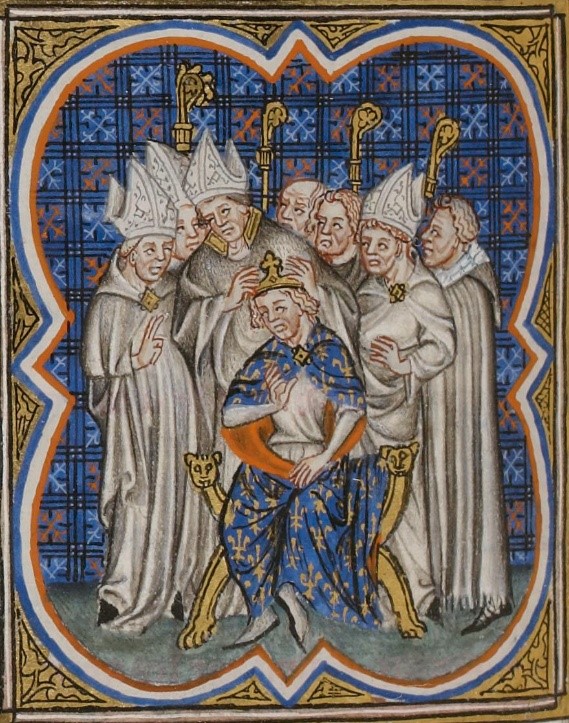
Depiction of the coronation of King Philip V of France at Reims in the Grandes Chroniques de France. Firnhaber-Baker highlights that few turned out to see his coronation, due to his succession issue. In that moment therefore, he must have felt highly troubled and insecure – what I think the depiction of his face in this image demonstrates.
‘A Worthy Son’, is a phrase coined by the eminent historian Jacques Le Goff in his book, Medieval Civilisation, to describe King Philip V of France (r.1316-1322). The phrase was used to make the case that Philip was a competent successor to his father, Philip IV (r.1285-1314). Le Goff does not elaborate on his phrase greatly and as such, I am left wondering whether Philip really was ‘a worthy son’. What would it take to be one then? To me, there are two overarching themes which would indicate worthiness as a King in this era. Domestic stability is the first- and arguably most important – as strife within one’s own country would suggest sub-par leadership. A highly important second would be successful foreign policy, making sure your neighbours know you are not to be trifled with. Within this article, I intend to weigh Philip’s reign against these two categories. The question, therefore, that is left to be asked is: was Philip V really ‘a worthy son’?
Two Act Tragedy
Philip succeeded to the French throne in late November 1316 following two tragedies. The first was the premature death of Louis X, Philip’s elder brother, after a reign of only 18 months.
When Louis died, he left his second wife pregnant. It was decided that a regency would be enacted until the child was born. If the child was a boy, he would become the King, looked after by the regent until he was at majority age. Philip was not the best suited candidate for this, indeed Firnhaber-Baker indicates there were more experienced men, such as Charles of Valois, the brother of Philip’s father, Philip IV. However, Philip V made a pragmatic decision. He rushed to the Royal Palace in Paris when his brother died before anyone else, securing it for himself. This gave him real authority and led the Barons to offer him the regency. The stipulations were that Philip would preside over the country until the child reached 24 years old.
The baby was born in November 1316 and was named John. This was to be the second tragedy though, as only 5 days later John died, and Philip was now King.
Domestic Stability?
Philip was not uncontested for the rule of France though, he had a niece, the daughter of Louis X: Joan. Joan had a good deal of supporters as well, and thus Philip’s reign started with a massive domestic crisis brewing, something he needed to solve.
Both Joan’s uncle, Duke Eudes of Burgundy, and her grandmother, Agnes, were principal supporters of her cause. The two tried together to persuade members of the French nobility to support Joan’s cause instead of Philip’s. Trouble brewed as they used their territories, Burgundy and Champagne, to prepare to take Philip to task over his Salic Law Council in 1317 (see below), which had barred women from acceding to the French throne. Things got even more serious when the Count of Nevers, Louis, got involved in the scheme. Firnhaber-Baker highlights that when Louis joined, the territories loyal to Joan formed almost a wall, which could be used to challenge Philip. Philip noticed the way this was going, and, taking a proactive approach, intervened. He started by mobilising troops on the Champagne border, before invading the County of Nevers, taking control of Louis’ castles and preventing him from becoming a real threat. Philip then used this proactive action to encourage Burgundy and Champagne into negotiations, threatening invasion if they refused.
Deliberations ensued, and ultimately Philip got what he wanted. Although this came at a cost, agreeing to grant Joan a royal territory – that of Angouleme, which he ratified in 1318. He also married her to a royal son, Philip, son of Louis of Evreux. He may have even ‘sweetened’ the deal for Eudes, by offering him the hand of marriage of his eldest daughter, Joan. Philip was left alone after that, no longer contested for his throne. Hemhad just solved largest threat he would face – his succession, and domestic stability in this department was secured, an act of ‘a worthy son’.
This leads nicely into another element of domestic stability for Philip: securing the succession after his death. This he achieved through the introduction of ‘Salic Law’ – the idea that a woman could not rule France. Philip introduced this a few days after he had been crowned at Reims. As we have seen, Philip still had to bargain to secure his right to rule, but when it came to his death as Firnhaber-Baker claims, it was an easy succession, the precedent he had set granting the throne to his brother, Charles IV. This suggests that Philip’s actions here, whilst brought on by his own situation, prevented crisis from developing in France after his death. This was true, in the short term at least. What Philip could never have realised were the implications of this decision, for when Charles died prematurely, only six years later, quite literally a hundred years of war began. When no direct Capetian male heir was found, the throne was passed to Philip of Valois, who became Philip VI. The English king, Edward III was unhappy about this, and felt he had a claim to the French throne, driving him to start the Hundred Years war. This may suggest that Philip’s Salic Law was a rash decision, but I find myself agreeing with Firnhaber-Baker, that there was no way Philip could have known this was going to happen. When he convened the council, not only did he have his younger brother Charles, who, only in his mid-twenties was bound to have children, but Philip also had an eight-month-old son, Louis. So, to Philip, future succession was not a problem, he was trying to avert an impending civil war with his actions (even if it did not help the situation entirely) and the action did have some short-term successes.
Nowhere does Philip come across as a greater pragmatist than solving the issue of the Pope. Just before Louis X’s death, Philip had been in Lyon, pushing the cardinals there to elect a new pope. Philip had witnessed the difficulties not having a Pope could cause – he had seen his brother Louis’ reign which was devoid of a Pope. This problem was manifest in the difficulty Louis X found in annulling his marriage to his first wife, Marguerite, after she had committed adultery, his problem only solved after she died rather suddenly. Philip was successful, the cardinals did elect a Pope, John XXII. This new Pope aided Philip significantly in one of the other serious domestic troubles of his reign, the County of Flanders. Flanders had been a thorn in the side of the Capetians since the latter years of Philip IV’s reign, and Philip V wanted to stop this. The pope put pressure on the Count of Flanders, going as far as to excommunicate him, to get him to come to terms with Philip V. The Count caved at this, paying homage to Philip, and solving the problem (temporarily). This clearly demonstrates Philip’s pragmatism, and how it then led to domestic issues being solved, presenting him as ‘a worthy son’.
A blunder which Philip made was undoubtedly the treatment of the ‘popular crusaders’, the ‘Shepherds’. These were everyday people who were keen to get involved with Philip’s crusade (see below). When these came to him, wishing to join, he pushed them to one side, calling for the arrest of their leaders. Fury ensued amongst the Shepherd’s, who rioted, attacking royal servants, even going into Languedoc in the South of France to massacre the Jews. Whilst this was a serious blow to domestic peace, it is important to note that it was a temporary event, and in comparison, to the massive civil crisis Philip faced and averted with his succession, I do not think this event greatly hampers his overall worthiness.
Another violent episode was Philip’s execution of the lepers in 1321, after their alleged involvement in a poisoning of a water supply in France. Whilst this could be seen as a rash action, the potential popular rioting that could have been caused by this rumour, had Philip not taken such action, could have considerably damaged domestic peace. As such, whilst this was a deplorable action to take, in a Medieval context, it could be seen as Philip once again being pragmatic.
Successful Foreign Policy?
The first and foremost consideration in Philip’s foreign policy, is his relationship with his dear neighbour, the King of England. At its core, Philip’s policy towards England was a success, as war did not break out between the two. Philip went one better though, he received homage from King Edward II, for Edward’s lands in Aquitaine, which occurred in 1320 at Amiens Cathedral. This was a major success, as neither of Philip’s brothers, Louis X or Charles IV succeeded in obtaining homage from Edward – especially potent in the case of Charles, as he had almost the same length reign as Philip. This would suggest that Philip had the ability to command authority, as if he was weak, Edward would have felt he could ignore Philip’s demands. This concept is reinforced by Pole Stuart, who highlights that Edward had a bit of a habit of putting off paying homage to the late Capetians, constantly asking for ‘postponements’ on the grounds that England was in a dire situation. It must be said though, that this success should not be overstated as whilst Edward did pay homage, McKisack notes that he refused to swear an oath of fealty to Philip, on a personal basis, so Philip was not able to use his authority to get exactly everything he wanted. Overall, Philip seems to have been successful, especially in comparison to his brothers. Fundamentally, he had exerted his authority, whilst retaining peace. A move of someone who could be seen as ‘a worthy son’.
The second factor that is worth considering is Philip’s attitude to crusading, something that fits into the foreign policy category, as it involves the invasion of a foreign area. Both Firnhaber-Baker and Barber indicate that agreeing to go on crusade was a prominent aspect to late Capetian Kingship. Indeed, Barber highlights that between 1312-1320, a crusade was agreed almost every year. Philip did not buck this trend, indeed one of the first things he did when he became king was pledge to lead a Crusade. In 1318 he even nominated a leader for his crusade, a member of the royal family, Louis of Bourbon. This would convey (and is indeed argued by Firnhaber-Baker) that Philip was serious about going on crusade, he genuinely would have gone.
‘Would have gone’, this gives it away really, as Philip died before he could lead his crusade, passing barely a couple of days after the arrival of the new year, 1322. A third tragedy to add to the two that began this article, especially as he was only 31. Philip’s efforts to organise a crusade indicate that he lived up to the crusading element of his foreign policy, even if his premature death did not allow him to go. As such, a ‘worthy’ successor to his father.
‘A Worthy Son’?
I think it is fair to say that in consideration of our two themes, Philip V presents himself as a ‘worthy son’. Granted, not everything was smooth sailing during his reign, but I do feel that the evidence tips the scales in Philip’s favour: his decisions appear to have been more right than wrong, by the standards of his time. He was both a pragmatic and proactive man, who kept domestic peace in his country for the most part. He also managed to successfully deal with foreign powers, not causing war, but exerting his authority. On balance then, it seems as though Le Goff’s description of Philip as a ‘worthy son’, is justified.
Bibliography
Barber, Malcolm. The Two Cities, Medieval Europe 1050-1320, (London: Routledge, 1993).
Brown, Elizabeth A R. ‘Philip the Fair and His Family: His Sons, Their Marriages, and Their Wives, Medieval Prosopography, 32, (2017), 125-185. Retrieved from: https://www.jstor.org/stable/26629996 [Last Accessed: 13/02/2025].
Firnhaber-Baker, Justine. House of Lilies: The Dynasty That Made Medieval France, (Penguin Random House, 2024).
Kitchin, G. W. A History of France, vol. 1: B.C. 58 – A.D. 1453, (Oxford: The Clarendon Press, 1899)
Le Goff, Jacques. Medieval Civilization, 400-1500, (trans.) Barrow, Julia. (Oxford: Basil Blackwell Ltd., 1988).
McKisack, May. The Fourteenth Century, 1307-1399, (Oxford: The Clarendon Press,1959).
Philips, Seymour. Edward II, (London: Yale University Press, 2010).
Stuart, E Pole. ‘The Interview between Philip V and Edward II at Amiens in 1320’, in The English Historical Review, 41:163, (1926), 412-415. Retrieved from: https://www.jstor.org/stable/552553 [Last Accessed: 13/02/2025].
 Retrospect Journal
