
Written by Lavinia Bird
17/02/2025
There is a tendency, within the intersection of literary canon and historical study, to favour the image of tortured, male genius over the practical, strategic woman. As Turkevich so succinctly puts it: ‘the role of women as members of society has always been eclipsed by the more spectacular role of men’. This article seeks to interrogate the role of the Russian literary wife in the particular instances of Sophia Tolstaya and Anna Dostoevskyaya, re-positioning their contributions to the editorial process, their part in the successes of their husbands Tolstoy and Dostoevsky, and the female ideology of literary wifedom. Alexandra Popoff, in an influential biography of six Russian literary women titled The Wives, calls ‘a writer’s wife […] a profession’ and a ‘tradition […] unmatched in the West’. It is this crucial aspect of the Russian literary wife’s position – ‘comfortable in secondary roles’ out of duty, rather than inferiority – that constitutes a key part of its female ideology. Popoff illustrates a more recent trend in recognising female historical contribution in the literary work of their husbands, but it remains an understudied and under-represented corpus of work.
While both Sophia Tolstaya and Anna Dostoevskaya have long been considered central to the creative processes of their husbands, the extent of their influence has often been understated. Anna Dostoevskaya’s talent as a stenographer and her fierce dedication to Dostoevsky’s work, having been raised in a family of avid admirers, is well known. She rescued him from a contract that forcefully took copyright by completing The Gambler in record time, working through the night for twenty-six days straight. She was the first Russian female stenographer in her class to be recommended for work, a fact that is less often praised. She had an active hand in reworking passages from her husband’s later novels and took on the mammoth responsibility of his financial affairs. Dostoevsky was a gambler at heart, which drove him to the brink of destitution on many occasions. In Baden during their trip around Europe, Anna’s clothes, jewellery and other possessions served to pay off another gambling debt, having already sold her dowry to raise funds for travel. Her dedication to her husband’s craft, while shielding him from financial responsibility and ruin, played a far larger role in his literary success than biographical literary criticism appears to remember.
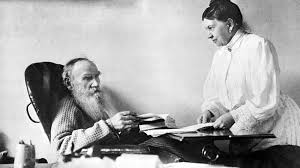
Sophia Tolstaya’s role in her own husband’s success echoes that of Anna Dostoevskaya’s. Sophia, in the same vein as Anna, is often remembered as a dedicated copyist, who had a significant hand in War and Peace by copying and editing it front to back seven times. Her influence, however, is far vaster than her ability to copy out manuscripts. Tolstoy used his wife’s diary entries as close inspiration when writing several of his most famous female protagonists, including Anna Karenina. A culmination of Tolstoy’s long spiritual awakening, choosing to renounce the Orthodox Church and any sense of property or financial gain in his later years, he gave his entire literary, financial and property estate over to Sophia. Despite being explicitly against her wishes, she maintained his estate in every sense, to great financial and literary success. Such an intense pressure for a woman who had birthed thirteen children, Sophia possessed the same talent for business affairs that Anna did.
Beyond the process of writing itself, Anna Dostoevskaya was instrumental in the publishing industry. Dostoevsky had toyed with the idea of opening a publishing business years prior to their marriage, but it was Anna who researched, implemented, and took on business matters while Dostoevsky continued to write. In 1873, the married couple officially opened a publishing business, producing The Possessed. It was a rare and difficult thing for an author to publish his own work in early nineteenth-century Russia, and it was only made possible by Anna’s meticulous research, posing as a customer in bookshops to question booksellers on their relationships with print houses, average costs etc. The beginning of her publishing career was an utter success, having created a business model that was among the first of its kind. Dostoevsky himself granted her the rights to his copyright and allowed her to receive money orders at the bank, a sign of recognition for her entrepreneurial abilities. Anna took on the role of proofreader, stenographer, editor and publisher – the dividing line between publisher-side and author-side responsibility had been crossed. As a nineteenth century woman in control of solo business affairs, Kaufman praises her for “rewr[iting] the script of what it meant to be a feminist in nineteenth- and twentieth-century Russia”.
Sophia Tolstaya’s relationship with her husband was notoriously fraught with tension, difficulty and spiritual differences. Tolstoy’s moral evolution, renouncing any type of luxury including university education for his children, created a divide between them that outlasted his death. Sophia would not relinquish the financial stability of her children, nor cease promoting and distributing Tolstoy’s prose. In all senses, she insisted on practicality. Tolstoy went on to write the Kreutzer Sonata, a short story that argues for sexual abstinence and sharply criticises marriage and marital relations, a sentiment many attributed to his own marriage at the time. Despite her deep personal objections, Sophia worked to obtain a meeting with the Tsar in 1891 in order to lift the censorship ban on the novella, due to its depiction of uxoricide. She succeeded, protecting Tolstoy’s art and ensuring its lasting legacy over her own, ever-worsening, reputation. Popoff’s so-called ‘tradition’ of the literary wife therefore emerges in the selfless, relentless dedication to the husband’s work that both Anna Dostoevskaya and Sophia Tolstaya embody so well.
Anna’s own devotion to Dostoevsky’s literary legacy is perhaps one of her most vital roles in her husband’s lasting success. Not only did she tirelessly work on a bibliographic index of Dostoevsky’s novels after his death, but she rewrote her own diaries for publication in order to preserve his public reputation. Anna enacted a self-inflicted sense of historical erasure, cutting passages from their Europe trip of his hostile and selfish behaviour, so that his reputation remained intact. In Europe, Dostoevsky chose to clothe himself in summer attire and left his wife in an old, unfashionable black dress – a socially punishable crime. Anna re-drafted the entire diary entry to praise Dostoevsky’s patience, humility and generosity in choosing summer fabrics for her wardrobe, an entirely fabricated event. Her intent focus on his legacy surpassed any sense for her own feelings, in a similar manner to Anna’s protection of the Kreutzer Sonata. It is this self-effacing dedication that defines the literary wife’s position.
Though the position of literary wife was complex and devotional, it was also fragile. Anna and Sophia both endured criticism after the death of their husbands. The social respect afforded to a wife, even Anna who was very well regarded across Russia, seemed only to extend the breadth of the husband’s life. Popoff comments that Anna was labelled ‘tight fisted’ and ‘shrewd’ due to her continued control of Dostoevsky’s financial and literary affairs. The position of a strategic woman seemingly constitutes a threat to social hierarchy, particularly if they are not in active subjugation to a man. Having violated the social expectation of wifedom by prioritising financial practicality and the legacy of Tolstoy’s work over his own desires to live off the land, Sophia became crucified in the forum of public opinion during Tolstoy’s life as well as his death. Tolstoy fled the family estate in the last few weeks of his life, and died surrounded by his spiritual disciples, who barred Sophia from entering the room. As Modell aptly highlights, Sophia published Tolstoy’s letters in ‘desire for self-vindication’ after the ‘conjectures and lies’ circulating in public opinion after his death. Natalya Solzhenitsyn would much later go on to defend Tolstoy in an interview with Popoff: “[Sophia] should have followed him and lived in a hut, as he had asked”, which says more perhaps about the strength of female ideology and conviction behind the role of the literary wife than I have been able to summarise in this brief article.
Popoff applies Nabokov’s own expression for his wife Vera to Sophia and Anna, who formed ‘”a single shadow” with the writers’. In this sense, willingly and with satisfaction, the Russian literary wife placed the work of the husband above themselves to such an extent that the delineation between husband and wife began to blur. In typical fashion, aligning with a female ideology that sees the literary wife as both secondary and ‘collaborator’, Anna edited or omitted any comments from Dostoevsky that elevated her position during his writing process. She sought to purify him, and thought nothing of her own position, just as Sophia thought to prioritise the work. Alspaugh illustrates that the literary wife was a position of devotion rather than suppression by commenting: ‘to insist that these women were unfulfilled is to misconstrue the Russian literary marriage’. Simultaneously, the extent male success has relied on female practicality should be explored more frequently beyond the simple fact that she was his wife.
Bibliography
Alspaugh, Leann D. “Married to Their Work”, The New Criterion, Vol. 43, No. 6, 2013. Married to their work | The New Criterion
Bader, Haley. “Dostoyevsky’s Brilliant Wife Anna.” Russian Life, 2021, russianlife.com/the-russia-file/dostoyevskys-brilliant-wife-anna/.
Feuer, Kathryn B. Tolstoy and the Genesis of War and Peace. Cornell University, 1996.
Kaufman, Andrew D. The Gambler Wife: A True Story of Love, Risk, and the Woman Who Saved Dostoyevsky. Riverhead Books, 2021.
Kirkus Reviews. “The wives: the women behind Russia’s literary giants.” Kirkus Reviews LXXX.14, 2012.
Modell, David A. “Tolstoy’s Letters to His Wife.” The North American Review, vol. 200, no. 707, 1914, pp. 592–602. JSTOR, http://www.jstor.org/stable/25108272.
Popoff, Alexandra. The Wives. New York: Pegasus Books, 2012.
Popoff, Alexandra. “Sophia Tolstaia’s and Anna Dostoevskaia’s autobiographical writing.” Aspasia, vol. 7, annual 2013, pp. 19+. Gale Academic OneFile, dx.doi.org.eux.idm.oclc.org/10.3167/asp.2013.070103.
Turkevich, Ludmilla B. “Russian Women.” The Russian Review, vol. 16, no. 1, 1957, pp. 24–36. JSTOR, https://doi.org/10.2307/126156.
Featured Image Credit: https://www.rbth.com/literature/2014/01/20/writers_and_their_wives_together_in_love_work_and_legacy_33367.html
 Retrospect Journal