
Written by Sarah Zhou
Temples hold profound cultural significance in China, where their construction is meticulously executed through traditional carpentry methods and a careful selection of colours. Its storytelling nature and its broader impact on not only domestic temples but also those of other regions underscore the notion that the role of temples exceeds mere shelter, serving as guardians of China’s rich heritage. The nuanced use of colours in temples further contributes to the creation of a harmonious environment. Colours in Chinese temples extend beyond practicality, carrying symbolic significance in Chinese culture and reflecting regional influences. This essay aims to explain the pivotal roles played by colour in Chinese temples.
Colours are selected in temples for practicality, such as being used to balance the local climate. For example, in southern regions with warmer climates, warm-toned hues are rarely used; instead, cooler tones provide a more balanced and calming environment, especially in the summer. For example, grey is predominantly used in Longshan Temple in Fujian. However, it should be noted that such a rule is not conclusive as temples in the south could be painted with bright red colours, such as Pilu Temple in Nanjing. Nonetheless, cooler tones are mostly used in temples in southern China, whereas warm tones are used in the North. For instance, the main decorative elements of Banruo Temple in Changchun are entirely in red, creating a warmer environment despite the cold weather. Colours in Tibetan temples are selected for practicality as well, which is shown through the black window frames that absorb heat for ventilation, and the use of white to resist the ultraviolet radiation on the plateau.
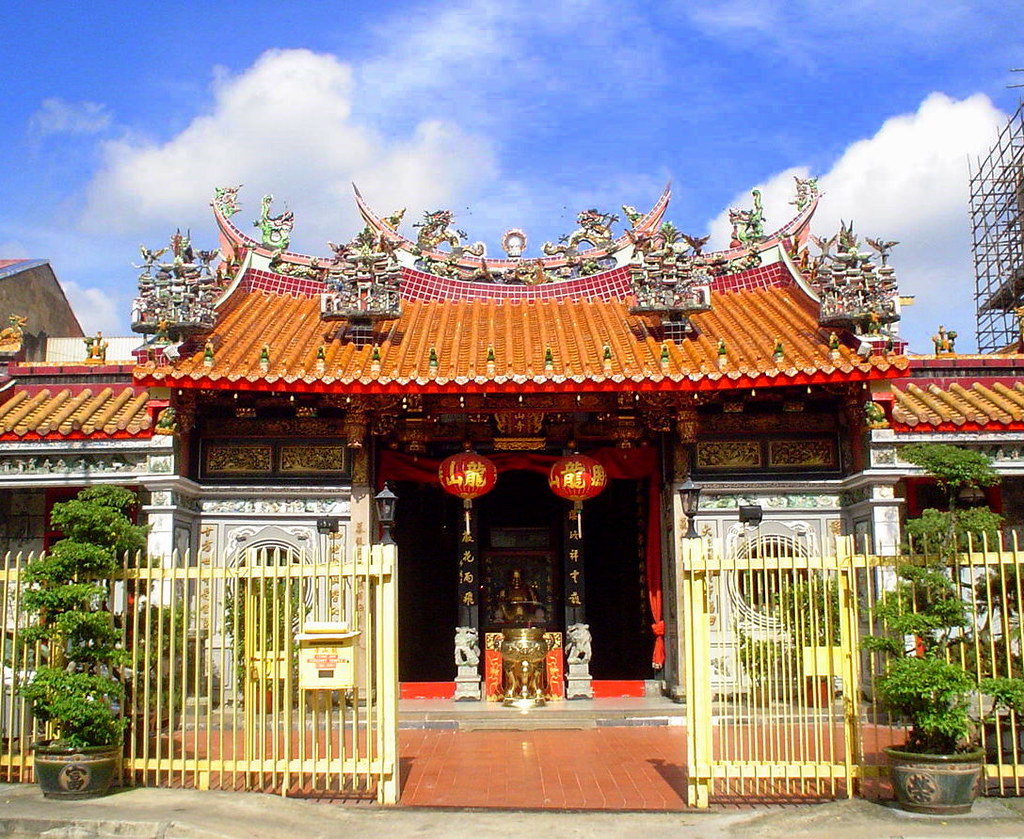
Colours are used in Chinese temples according to their symbolic meanings, which creates an immersive environment for all visitors, regardless of their faith. The most significant hues for Chinese Buddhism are black, white, red, yellow, and cyan, corresponding to Buddha’s five dharmas. Thus, Buddhist temples primarily use these five colours. For example, yellow and gold denote wealth, nobility, and solemnity. Since most temples were originally appointed by emperors, and yellow was used by emperors exclusively, temples were painted yellow to display nobility. For instance, the roof of the Hall for Worship of the Ancestors in the Ancestral Temple was golden. Additionally, red signifies auspiciousness and joy and is mainly used on the body of temples, such as the Temple of Heaven. Blue is predominately used on roofs, such as the blue-glazed tiles on the roof of the Foguang Temple, representing sky and heaven. Colours are also used according to traditions. For instance, columns are lacquered and protected by dying them black with iron sulphate or vivid red with cinnabar, which is a tradition preserved since the Tang dynasty and suggests that carpenters tended to use local resources for painting. However, in temples, colours are not simply put together according to their meanings without any other considerations. They are also used in temples to balance each other to convey a sense of tranquillity. For example, the basic colours used in Qingjing Temple in Changling are black, white, and yellow, with the gate being vibrant red, and the roof being rose red, establishing a strong visual contrast and achieving overall visual balance.
Colours used in temples could reflect local cultures. Unlike most Chinese temples, which use yellow extensively, common Tibetan temple hues are white and red, with white symbolising the heavenly god Bainianshen, used on the main bodies of temples, and red honouring the earth god Hongnianshen, used on the outer walls of temple buildings to show solemnity. Moreover, although yellow is not used as extensively as in other Chinese temples, it is still used on the outer walls of scripture halls in Tibetan temples. The roofs are typically golden, with metal decorations, reflecting the strong sunlight on the plateau to create a dazzling effect, making the temple sacred. Therefore, it is clear that there are significant distinctions between the use of colour on temples in different regions, due to the cultural and climate differences. Despite the regional differences in the use of colour on temples, the different cultures interact with each other, indicating the way cultural and religious ideas spread in China. As Tibetan Buddhism spread eastwards to Mongolia and China after the 13th century, it became one of the most important religions among the Mongols. Therefore, before conquering China in 1644, Manchu rulers of the Qing dynasty advocated Tibetan Buddhism to appease the Mongols. With red being predominant in Tibetan temples, the walls of Chinese temples gradually turned red, implying the crucial role of Tibetan Buddhism, and how colour was used in temples.
In conclusion, the use of colours in Chinese temples unveils a narrative far beyond the structural or aesthetic realm. These meticulously crafted and adorned temples stand as living testaments to China’s cultural legacy. Through the stories engraved in the construction and the symbolism of every hue, temples emerge not merely as a place of worship but as guardians of a heritage that transcends time and borders. As historians gaze upon these sacred structures, the preservation of a profound legacy unfolds. In their silent expression, the temples reveal that in every beam, every shade, China’s rich history is eternally enshrined.
Featured image credit: “Chinese Temple” by Mystic Lens is licensed under CC BY-NC 2.0.
 Retrospect Journal