
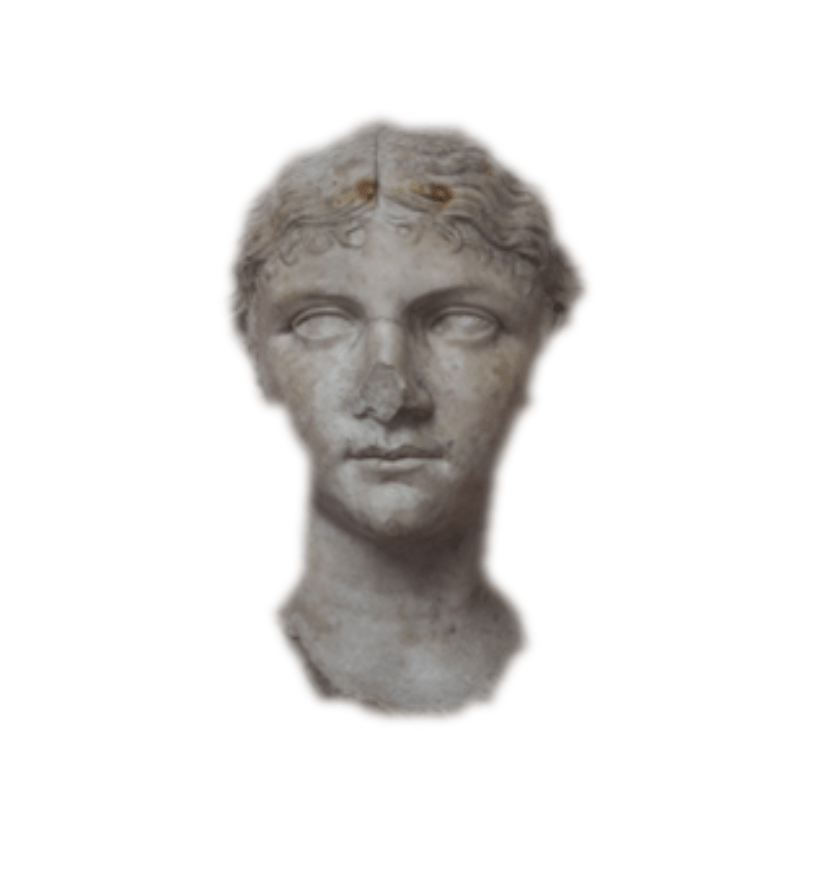
Written by Georgie Nisbit
“PRINCESS AND THE PAWN”
What lay at the heart of Livilla’s downfall?
Claudia Julia Livia’s reputation has been so thoroughly besmirched that she can no longer be viewed simply as a minor member of the Julio-Claudian dynasty. Murderess? Adulteress? Conspiring princess? Or passive pawn? In this week’s edition of ‘Salve! Spotlight’, our editor-in-chief Georgie Nisbet gets to grips with the real Livilla, shining new light on the scandal which tarnished her name forever.
Claudia Julia Livia, aka. Livilla, aka. ‘Little Livia’ has been redefined over the years by certain male historians claiming to be experts on the woman they never knew. Cassius Dio (author of the bestselling Roman Histories) and Tacitus (Sunday Times multi-best seller) are two such men. Though they provide critical insights into her life and times, their accounts of Livilla are tainted by the rampant misogyny of the day. So, I would like to enlighten you all with a more rounded account of her character. As Livilla is how she is best known to the dearest readers of Salve! this is how I too will address her. Daughter, wife, and mother in the imperial family, she falls under the trap of ancient literature, as one of many women conveniently positioned as scapegoats for the empire’s many shortcomings.
In this issue of Salve! Spotlight I will peel back the layers of gossip to attempt a closer examination of her life. Despite our magazine’s ethos of protecting the reputation of defamed women, it may well be the case that we have to conclude that she really is indefensible. The evidence may well suggest the worst, and so I will draw out a conclusion by the end of this exposé.
Was Livilla a mere pawn in the imperial court?
Adulteress, and murderess, were not the titles Tiberius had in mind when Drusus and her wed. We can determine that once, she was slaying in the imperial family! Being named after your granny, royal icon par excellence and first to gain the title Augusta, seems to indicate a great deal of promise. Was this nickname attached because of certain similarities with her grandmother, commanding great respect in the family? Or was the name created by the experts, to influence their readers to view Livilla in the way they wanted; another conniving woman of imperial Rome, just like they had depicted the murderess, Livia. Diminutive’s like ‘Livilla’ frequented Suetonius’ works. However, these diminutives were not for flattery, rather they demeaned the women of power he chose to gossip about. Tacitus, meanwhile, compared Livilla directly to her grandmother, Livia, under the guise of Tiberius’ words. The subtle links between grandmother and granddaughter creates a mirror image of character, attributing similar traits to each woman. This structure was also used with the notorious (made so by Tacitus) Julias, both Elder and Younger. It seems Tacitus found it easier lumping women under the same guise, a continuous stream of negative portrayals of imperial women – shock!
‘She was obviously slaying in the imperial family’.
Livilla was first pawned off to Gaius when she was 12 (cradle snatcher much!). This marriage, no love match, as put very astutely by an informer, was a political move for the interest of Gaius Caesar (heir to Augustus). Rumours circulated after Gaius’ untimely death in A.D 4, insinuating his stepmother Livia’s involvement. It seems women could barely escape suspicion! In the same year she was quickly pawned off to her first cousin Drusus. This union, while largely advantageous for the Julio-Claudian family, also lifted Livilla closer to power, and as we shall see, scandal.
The exclusive material evidence suggests that within Tiberius’ principate she was far from a pawn but rather one of his qweens. Reading the Senatus Consultum de Cn. Pisone patre, one can comprehend the relationship of respect towards Livilla, as she is exclusively thanked. Glamorous across the empire; in the east she was dedicated as ‘Divine Aphrodite of Anchises’. Characterised as a goddess, even connected to the founding family of Rome signifies her position as a figurehead not a mere pawn. At this stage no one could have predicted that this goddess would eventually suffer from Damnatio Memorae and be virtually erased from Julio-Claudian history. She even had her own day of the Kaisareia Festival, dedicated to the ‘Aphrodite of Drusus’. Several later historians neatly omit such demonstrations of her popularity. Admittedly, in a very backhanded way, Suetonius does give credit to Livilla’s stature, marking Tiberius’ mass persecution a consequence of her scandal, suggesting Livilla’s value and trust once held by Tiberius.
Never centre stage in the accounts produced, Livilla is presented to us either in contrast to Agrippina, or under the long shadow cast by Sejanus, further undermining her true position. Tacitus, it seems, set the precedent for the portrayal of female imperial figures. Outlining Livilla’s flaws as a matrona of the principate was of greater importance to him than her successes, due to her position as a public figure. Tacitus wanted to reveal to his audience all the faults of the imperial system, discussing the faults, true or false, of their predecessors. Livilla and Agrippina the Elder grew up concurrently as cousins. Tacitus’ gossipy statements regarding the ladies is difficult to trust. Livilla is branded as being inferior to her female counterpart, in so many personal ways I couldn’t hope to list them all (fertility and fame). Regarding fame, the official government statement indicates they were equal.This alone allows us to shut out Tacitus’ toxic voice regarding the two women’s public image.
The material evidence forces us to accept that once Livilla was an icon. Even more, she was not an imperial pawn, but rather a pawn used by the later narratives of antiquity to spice up their stories, after all Tacitus was prone to ‘include a contemporary rumour’. Identifying Livilla as a literary pawn we can grasp a fuller picture of her before her fall.
‘No one could have predicted that this goddess would eventually suffer from damnatio Memorae and be erased from Julio-Claudian history.’
Was Livilla really the adulteress and conspiratress people thought her to be?
Livia, blessed in marriage to Drusus
and in children, rushed into callous crime
and the punishment due.
What was this ‘callous’ crime of Livilla’s? Looking at the events of 31 A.D is crucial to grasping the bad-ass behaviour of 23 A.D. The loss of Annals book 5 is a real heartbreaker in our search for greater understanding. The chronology of the events of 31 A.D is delicate, as Dio and Tacitus’ disagreements prove! Hate to sound like a broken record, but Tacitus’ timeline is most widely accepted, concurring with other sources. Ultimately, she committed both adultery and mariticide but even more romantic, a secret marriage!
The same year Drusus died, 23 A.D, Sejanus’ relationship with his wife Apicata fell apart. This change in Sejanus’ relationship could have been a result of our temptress Livilla. Apparently even in 23 A.D she was looking more and more beautiful: did looks or power entice Sejanus? After all, following the death of Drusus, he is the man whispering in Tiberius’ ear, and gets the family treatment. Some even say a letter was composed, driven by Livilla, to petition a marriage, between the two deviants. Of course, although Sejanus is said to have been the seductor, Livilla is now handed back the fault as she is the one driving the marriage. But alas! It is rumoured that Tiberius wasn’t too hot on the idea, but no definitive denial is ever given. The lack of a definite NO lets us hope that their love was consolidated in marriage.
The speculation continues as we reach the expert I put most faith in, the Fasti Ostienses, which suggests that Sejanus’ wife died eight days after him. Apicata and Sejanus’ marriage had already dissolved, so who was this mysterious maiden? Since someone decided to get rid of the name of Sejanus’ wife on the inscription, we must play a game of who could it be? Surely it is none other than Livilla! The inscription tells us that Sejanus’ ‘wife’ took her own life eight days after his death, 18 October 31. Apicata took her own life, following the death of her own children, which according to the Fasti, was some time after Sejanus’ death which complicates our understanding of the inscription. There is no evidence of how Livilla died, apart from speculatory remarks from historians: suicide, starvation, execution. The only material evidence of Livilla is from the epitaphs dedicated by her slaves. Apicata’s manner of death aligns with the inscription more than Livilla. But the timing does not! We can’t define Livilla as the suicidal wife of Sejanus so simply. Gossipers attest that Livilla lived until Apicata had released her viperous document following the death of Sejanus. Tiberius is said to have handed the responsibility of Livilla’s death to her mother Antonia Minor. This would support Josephus’ idea, that Antonia had stopped Sejanus’ rise to power, even further. Tiberius would have held Antonia in great esteem following this event and therefore treated Livilla with greater respect so as not to shame Antonia completely. This would remove Livilla from the contenders for the inscription as the wife of Sejanus, however.
But really my dear readers, after Sejanus was executed, because of his greediness for power it would make sense for Livilla to have taken her own life. Whether she had been married to him or not, she had still been involved in his self-promotion (despite Sejanus’ letter to Tiberius’ affirming that his relationship with Livilla was not to increase his power). Her hands had blood on them as her physician was also involved in Drusus’ death. Her heart too, according to my beliefs, would have been broken. After her suicide on the 26th of October A.D 31 the reason was given for her suicide, as the truth of Drusus’ death was revealed. Tiberius made it impossible for us to ever extrapolate the truth of her death, as she was erased from memory.
A woman of such stature, funds, faculty, and fame, why would she throw it all away? It is hard to grasp why she would commence a fling with a lowly praetorian guard when she would have been able to become empress alongside her husband. Regarding her marriage to Drusus, we are given no reason to believe they were engaged in an unhappy marriage. Why would Livilla engage in adultery and mariticide unless she indeed was manipulated by those above her, or if she was in a position of great unhappiness that we are unable to uncover. Perhaps however, as I have suggested to you darlings, she was indeed enthralled, in love, and eventually married to an overly ambitious man.
Her posthumous cancellation speaks volumes on her once elevated status. She knew she was about to be destroyed following Tiberius’ elimination of her lover (husband), Sejanus. Livilla would have been next in his line of punishments, as she knew the rug was being pulled from under her feet. So concludes our renewed image of Livilla; a conniving princess, adulteress, and murderess.
XOXO G.M.L.N
 Retrospect Journal