

Written By: Ishaabhya Tripathi
Orange trees are emblematic of the Mediterranean climates that inform the term ‘sunshine state’. Naturally, they are found in hot, dry areas that get a lot of sunshine, making them especially emblematic of the states of Florida and Andalusia, in the United States and Spain, respectively. In the collective psyche, oranges have always had positive associations. The taste of the fruit, its association with warm and sunny weather, and even its rarity in colder climates have made it an iconic feature of the countries in which they grow.
The citron—a rough-skinned, lemon-like fruit from which oranges and all other citrus fruits evolved—is our starting point for tracing the history and cultural importance of oranges. It’s possible that oranges inherited their positive connotations from this ancestor: in India, citrons were sacrificed to Ganesha, the God of Knowledge. The inclusion of oranges in religious ceremonies suggests that they were considered holy and something to be revered. The citron tree’s strong scent, appearance, and evergreen nature meant that it caught the attention of Europeans once it was introduced to and traded throughout the Mediterranean region.
Arab influence in the Mediterranean may explain the presence of oranges in this area. It is recorded that citrus fruits, including citrons, sour oranges and lemons, were being cultivated in Spain and North Africa by AD 1150. The Second and Third Crusades may have been what exposed people from Northern Europe to citrus trees. The third crusade is especially relevant when considering the introduction of the citrus tree to Northern Europe, since this religious conflict—fought from 1187 to AD 1192 —brought troops from England and France to the southern Mediterranean (modern day southern Portugal and Spain). The fact that sour oranges, limes, and lemons only feature in European records after the Crusades suggests that these religious wars played a role in their introduction to the north of the continent.
During outbreaks of the Black Death, doctors in Europe-soaked linen in citrus oil and incorporated this in their medical gowns. This is another example of the positive connotations of citrus trees: it stands to reason that there was a belief that citrus had some sort of medicinal quality. In the present day, there exists evidence to support this: scientists have discovered that citrus generally has antibacterial properties, to the extent that it can act as an alternative to chemical antibacterial drugs. The medicinal capacity of citrus has been recognised throughout history, with oranges and lemons being used to treat scurvy in sailors for the last five hundred years, as well as sources from the early twentieth century detailing the use of dried orange peels for medical purposes. The presence of citrus trees implies health and healing as much for humans as they do for the landscapes in which they grow. A 1914 record of Spain’s orange industry describes a horticultural pest known as ‘black scale’ that severely impacted the horticulture in Valencia. The black scale’s impact was seen more in the north of Valencia. Since the coastal winds counteract the warmth of the Mediterranean summer, the climate is more suited to the spread of the black scale in seaside regions. The pest cannot survive in hot climates. This suggests that in non-coastal regions, orange trees would not be affected as much and therefore could imply good health for the landscape and local horticulture.
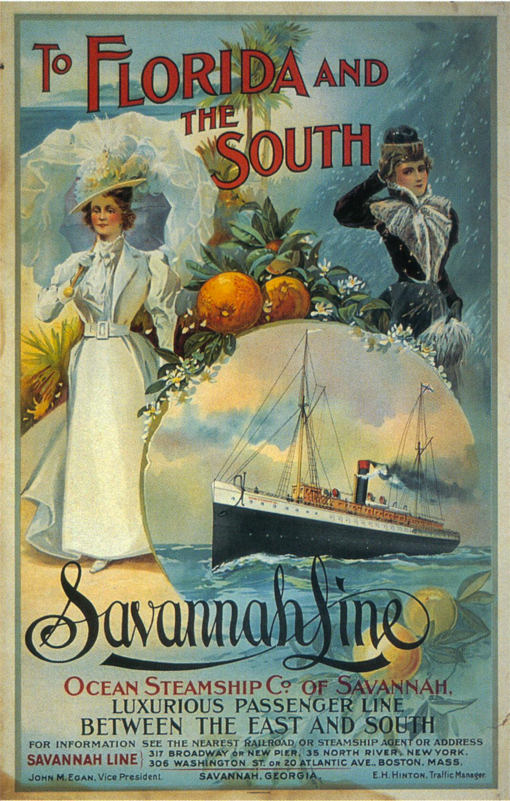
Fig 1. Advertisement for a Ship Traveling Between the Eastern and Southern United States, 1900
The positive connotations of citrus fruits have been established, but it was the orange tree specifically that captivated horticulturists all over the world in the nineteenth century. American horticulture enthusiast Reverend Theophilus Wilson Moore published a manual on the cultivation of orange trees in 1886, in which he stated that the ‘aesthetic cultivator’ would find great joy in an orange grove, to the extent that they would consider it “a relic and reminder of paradise”. The state of Florida became the home of the orange tree in the United States, since its warm weather and temperate climate provided the perfect environment for them to grow. Orange trees became an iconic feature of Florida, with postcards and advertisements depicting them throughout the twentieth century.

Fig 2. Postcard depicting an Orange Grove, Circa 1942
Oranges have always implied health, prosperity, and fortune. The striking appearance of orange trees makes them emblematic of the cities in which they are planted even before one has time to consider their history and positive associations. Although orange trees have been in the southern region of the Iberic Peninsula for multiple centuries now, it is interesting to think about their origins, how they spread across the world, and the processes that led to their arrival here. As someone who currently lives in the south of Spain, part of Seville’s charm is the ability to walk down any street and see scores of orange trees, lining each side.

Fig 3. Orange trees in a city square in Seville
Bibliography
Britannica, T. Editors of Encyclopaedia. “orange.” Encyclopedia Britannica, December 17, 2024. https://www.britannica.com/plant/orange-fruit.
Cartwright, M. “Crusades: definition”, World History Encyclopaedia, October 12, 2018 https://www.worldhistory.org/Crusades/
Lin, X., Cao, S., Sun, J., Lu, D., Zhong, B., & Chun, J. (2021). “The Chemical Compositions, and Antibacterial and Antioxidant Activities of Four Types of Citrus Essential Oils”. Molecules (Basel, Switzerland), 26(11), 3412. https://doi.org/10.3390/molecules26113412
Baron J. H. (2009). Sailors’ scurvy before and after James Lind–a reassessment. Nutrition reviews, 67(6), 315–332. https://doi.org/10.1111/j.1753-4887.2009.00205.x
Kohen, Helen L. “Perfume, Postcards, and Promises: The Orange in Art and Industry.” The Journal of Decorative and Propaganda Arts 23 (1998): 33–47. https://doi.org/10.2307/1504162.
“THE ORANGE INDUSTRY OF SPAIN.” Journal of the Royal Society of Arts 62, no. 3223 (1914): 859–60. http://www.jstor.org/stable/41341705.
Scora, Rainer W. “On the History and Origin of Citrus.” Bulletin of the Torrey Botanical Club 102, no. 6 (1975): 369–75. https://doi.org/10.2307/2484763.
Scora, Rainer W. “On the History and Origin of Citrus.” Bulletin of the Torrey Botanical Club 102, no. 6 (1975): 369–75. https://doi.org/10.2307/2484763.
Image Credits
1942 postcard: Historical Museum of Southern Florida, in the following article: “Kohen, Helen L. “Perfume, Postcards, and Promises: The Orange in Art and Industry.” The Journal of Decorative and Propaganda Arts 23 (1998): 33–47. https://doi.org/10.2307/1504162.”
1900 ship advertisement: The Mitchell Wolfson Jr. Collection, the Wolfsonian, Florida International University, Miami Beach, Florida, in the following article: “Kohen, Helen L. “Perfume, Postcards, and Promises: The Orange in Art and Industry.” The Journal of Decorative and Propaganda Arts 23 (1998): 33–47. https://doi.org/10.2307/1504162. ”
Orange trees in a city square in Seville: author’s own photograph
 Retrospect Journal