

Written by Elida Lyons
The height of the witch trials in England dominated the early modern period, a clear manifestation of early modern England’s overwhelming preoccupation with witchcraft, and by extension, superstition. People were heavily influenced into feeling a sense of vulnerability against what they could not understand. Through ideas of grotesque demons and doom, the Church certainly indoctrinated early modern English people into fearing the vulnerability of their souls. Folklore was also fundamental for nurturing these anxieties, providing people with superstitious ways to understand the powerlessness they felt for the unpredictability of life. Subsequently, early modern English people developed curious methods to protect the home against real beliefs of the workings of witchcraft and the supernatural. Archaeological records of witch-bottles, dried cats, and concealed shoes in domestic spaces uniquely illuminate these practices, enriching our understanding of the superstitious anxieties of early modern English society and demonstrating their unusual methods of protection.
One anti-witchcraft object typically buried in the house was the witch-bottle. As of 2019, 294 examples of witch-bottles have been found and documented in England, with fifty per cent of these bottles discovered under the hearth. Usually, these bottles were Bartmann stoneware, colloquially known as Bellarmine bottles, but the use of glassware increased following the eighteenth century. In terms of stoneware, the Charing Bottle (see Fig. 1) which was discovered under a hearth in Kent, dating to the seventeenth century, is typical of the composition of found Bellarmine bottles. They consisted of a large rounded “belly” decorated with a medallion, in addition to a mask on the bottle’s neck of a menacing bearded man, supposedly mimicking tales of the menacing Cardinal Bellarmine, where the bottles get their name. The human masks transformed these Bellarmines into anthropomorphic pieces, indicating a magical nature fit for counter-witchcraft purposes. Archaeological finds and examinations also reveal the typical contents of Bellarmine bottles, as well as pointing to their magical purpose. The Greenwich Bottle (see Fig. 2 and 3), found in 2004 and dating to the seventeenth century, is a great example of typical contents found, containing traces of urine, twelve bent iron nails, eight pins, fingernails, hair, and leather pierced by a nail. The inclusion of urine reinforces the Bellarmine bottle’s apotropaic purpose because Puritan clergyman Increase Mather had denounced the use of urine in a bottle as unlawful “white” magic in 1684. Another indication of their magical purpose is the predominance of witch-bottles buried under the hearth. This highlights the hearth as a point of vulnerability in the home, especially as it was open to the sky. Early modern English folk believed the evil spirit of a witch was airborne at night, travelling through the “otherworld” to attack their victims, and by following the victim’s scent they would enter through a houses’ openings such as the hearth. Thus, as witches were believed to be unable to move in reverse, a witch-bottle with its victim’s urine and human-like appearance planted under the hearth would trick and trap the witch, protecting the household. Furthermore, bent pins and iron nails also functioned to trap the witch’s spirit. The ritual killing of objects is an ancient practice, seen in votive offerings to deities. Therefore, in bending them, pins and iron nails were ritually killed, becoming ghost pins, effective in the spiritual world where the witch travelled and could be trapped. Thus, witch-bottles were a popular way to combat the superstitious anxieties of early modern English folk.
Another counter-witchcraft item commonly discovered throughout English houses in roofs, walls and floors is dried cats, with 139 documented in England as of 2004. These cats can be considered apotropaic objects because a significant amount have been manually posed with wiring in sometimes menacing hunting positions. One exceptional example of a dried cat found under a house in Borough Street, Southwark, London dating to the sixteenth century shows the cat in a menacing position. The cat grips a dried rat between its jaws and another under its front foot, both artificially manipulated to appear struggling, victimised and defeated (see Fig. 4). However, to fully appreciate this anti-witchcraft practice, one must understand the unique development and role of cats in early modern England. Their supernatural reputation was first introduced to Britain by the Romans, who had themselves been influenced by the spiritual sacrality of cats in Egypt. Thus, through the Middle Ages to the Early Modern period, cats had developed a paradoxical association with both the Devil and witches (as their familiars) and with prosperity and luck. The nature of cats was also mysterious, with their fast reflexes, nocturnal habits, unique eyes and independence, so along with influences from the East, early modern English people may have naturally turned to folk tradition to understand them, giving them a supernatural nature. Additionally, cats served a utilitarian role, their quick reflexes and independence leading them to be useful vermin catchers in the household. Therefore, it is strongly plausible that in death, cats would enter the “other” spiritual world, especially due to their connection to the supernatural. In this “other” world, where evil spirits would travel and attack people, dried cats continued their ability to interact with the supernatural and their utilitarian role, acting as a decoy against spirit vermin and other evil spirits, such as witches. This conclusion reinforces that discovered dried cats, even ones not as elaborately positioned as the one found in Borough Street, were typically not accidental and were placed and used with obvious magical intent. The practice of concealing dried cats is therefore another example of early modern English folks’ practices in resisting the malignant supernatural with homemade barriers against evil spirits lurking at night.
By far the most frequently discovered and recorded concealed counter-witchcraft objects in households across England are concealed shoes. According to the Concealed Shoe Index at the Northampton Central Museum, over three thousand shoes have been recorded from around two thousand locations, primarily from Britain between the seventeenth to nineteenth centuries. Thus, it is likely the most popular superstitious practice following the Middle Ages. June Swann, a pioneer in the field of concealed shoes and founder of the Concealed Shoe Index, reported in her 1996 article about the most common locations within a building, concluding that 26.2% of concealed shoes were discovered under the chimney or hearth, 22.8% were discovered under floorboards, 18.8% were discovered behind walls, and another 18.8% from the roof, indicating them to be of an apotropaic nature. Despite being a dated article, these figures have remained relatively consistent through to 2019. Records provided by Swann also prove a predominant number of discovered shoes are well-worn, and this fascinatingly retains the characteristics and essence of the shoe’s owner. For example, a woman’s leather tie shoe dating to 1750 and discovered in Lower Harlestone, Northamptonshire, shows significant wear and tear seen in the uniquely misshaped sole, backstay, and vamp (see Fig. 5), holding the owner’s foot shape, wearing patterns, and personality beyond use. This shoe was discovered hidden in a chimney flue along with three other concealed shoes which, following patterns of the previous concealed apotropaic items detailed earlier, suggests a superstitious practice. Importantly, leather shoes in this period were very expensive for most and therefore continuously repaired and repurposed to make a pair of shoes last as long as possible. Shoes were valuable items, not to be discarded easily which implies that when shoes were concealed in the house, it was for an even more valuable purpose such as protection against the supernatural. The vast time span and locations of these documented concealed shoes make it plausible that they belonged to an array of different superstitions. However, common discoveries in the hearth, such as the previously discussed woman’s shoe from Northamptonshire, allude to protective purposes against evil air-borne spirits that would exploit vulnerable areas to gain access to their victims, identical to witch-bottles and dried cats. Furthermore, shoes were considered effective spirit traps because of the influence of England’s unofficial saint, John Schorn. The fourteenth-century parish priest was renowned for having conjured and trapped the devil in his boot. Considering the influence of religion on early modern English folk, in addition to the fact that shoes retained their wearer’s scent, as well as their essence, which witches would follow to locate their victims, it is very likely that shoes were used as protective spirit traps.
In conclusion, the discovery of witch-bottles, dried cats, and concealed shoes provides a unique lens through which to understand the superstitions and anxieties of early modern English society. These counter-witchcraft methods, often strategically placed in exposed areas like hearths, reveal how people sought to combat the vulnerability they felt, guarding their homes against witchcraft and malevolent forces. Together, these practices offer a fascinating glimpse into the ways early modern English people navigated their world through superstition and the desire for safety in an uncertain age.

Figure 1. Pete Burton. Charing Bottle. Photograph. Historypin. August 24th, 2017. https://www.historypin.org/en/the-concealed-revealed-witch-bottles/geo/52.355518,-1.17432,6/bounds
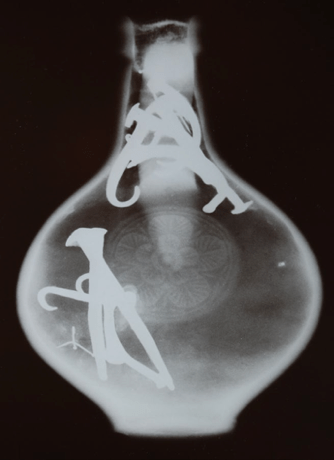
Figure 2. Alan Massey, Greenwich Bottle, 2004, in Brian Hoggard, Magical House Protection The Archaeology of Counter-Witchcraft (New York, NY: Berghahn Books), pg. 21.
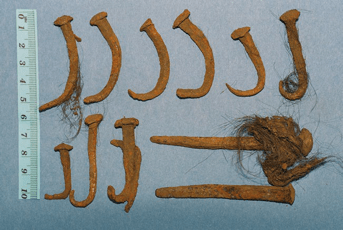
Figure 3. Alan Massey, Greenwich Bottle, 2004, in Brian Hoggard, Magical House Protection The Archaeology of Counter-Witchcraft (New York, NY: Berghahn Books), pg. 22.
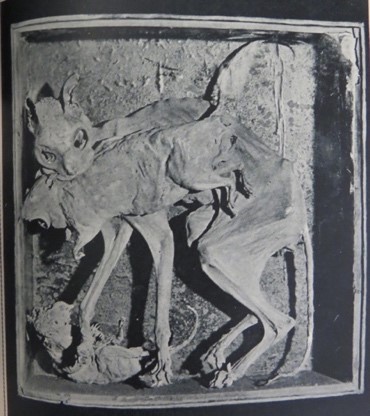
Figure 4. Cat with Two Rats, in Illustrated London News, 693, London, 1948.

Figure 5. Northamptonshire Shoe, 1750. Northampton Museum and Art Gallery, Northampton. https://www.northamptonmuseums.com/info/3/collections/61/shoes-2/4.
Bibliography
Blagrave, Joseph. Blagraves Astrological Practice of Physick, London: Printed by S.G. and B.G. for Obad. Blagrave, 1671.
Dixon-Smith, Denise. “Concealed Shoes”, Archaeological Leather Group Newsletter, 1990. https://archleathgrp.org.uk/wp-content/uploads/2022/05/6_Spring1990.pdf
Glanvill, Joseph, 1636-1680. Saducismus Triumphatus, London, 1681. https://www.proquest.com/books/saducismus-triumphatus-full-plain-evidence/docview/2240907371/se-2.
Hoggard, Brian. Magical House Protection: The Archaeology of Counter-Witchcraft. 1st ed. New York, NY: Berghahn Books, 2019.
Hoggard, Brian. “The archaeology of counter-witchcraft and popular magic” in Owen Davies and Willem de Blécourt, eds. Beyond the witch trials: witchcraft and magic in Enlightenment Europe (Manchester University Press, 2004): 167-186
Howard, Margaret M. “252. Dried Cats.” Man 51 (1951): 149–51.
Kelly, Eamonn P. “Trapping witches in Wicklow”. Archaeology Ireland. Vol. 26. Archaeology Ireland Ltd, 2012.
Merrifield, Ralph. The Archaeology of Ritual and Magic / Ralph Merrifield. New York: New Amsterdam, 1988.
Merrifield, Ralph. “Witch Bottles and Magical Jugs.” Folklore 66, no. 1 (1955): 195–207.
Swann, June. “Shoes Concealed in Buildings.” Costume30, no. 1 (1996): 56–69.
Featured image credit: The Devil in Britain and America from Wellcome Library, London. Accessed via Wikimedia Commons: https://commons.wikimedia.org/wiki/File:The_Devil_in_Britain_and_America,_1896_Wellcome_L0000137.jpg
 Retrospect Journal
