

Written by Olivia Norbury
The Red Scare was a highly prolific campaign, championed by Joseph McCarthy during the early years of the Cold War, that targeted alleged communists working in the federal government. The Red Scare often overshadows the Lavender Scare, an equally impactful congressional witch-hunt, in the historical narrative. The Lavender Scare derives from the term “lavender lads”, that Senator Everett Dirksen regularly used to refer to gay men. It targeted LGBTQ+ employees in the federal government, legitimising their removal from their positions as they were deemed security threats who were more susceptible to manipulation, and thus blackmail. The Lavender Scare capitalised on fears of communism by portraying LGBTQ+ employees as communist sympathisers and security risks, intertwining homosexuality with the era’s anti-communist paranoia.
Until the 2000s, both scholarly attention and popular memory neglected to properly acknowledge the Lavender Scare. The popularity of McCarthy led to an overemphasis of his role in the Lavender Scare, creating a paradoxical narrative that framed the purges as merely a product of his incompetence. This narrative obscured the broader, ongoing history of discrimination and persecution that followed, thus contributing to the marginalisation of the Lavender Scare that arguably impacted more lives but has been suppressed in the archives.
Post-World War II, an influx of young people into American cities fostered diversity, offering new freedoms and opportunities to explore sexuality. The period saw the rise of vibrant lesbian and gay subcultures in urban hubs like Washington. However, increased visibility did not equate to increased acceptance, as evidenced by the Lavender Scare, and the broader context of the period. In 1947, U.S. Park Police initiated a “Sex Perversion Elimination Program” in Washington, targeting homosexuals who were deemed ‘perverted’ by law enforcement. 1948 saw Congress pass an act for the “treatment of sexual psychopaths”, facilitating the arrest and punishment of those who behaved in a homosexual manner, and deeming them mentally ill. Legal framework thus entrenched systematic discrimination against LGBTQ+ individuals, actively suppressing non-heterosexual identities and embedding prejudice into the fabric of governance.
The Lavender Scare began in the late 1940s and continued through to the 1960s. Thousands of homosexual employees were fired or forced to resign from the federal workforce because of their sexuality. In February 1950, the Undersecretary of State, John Peurifoy, explained that the State Department had allowed ninety-one homosexual officers to resign. In the same month, McCarthy delivered his famous speech claiming to identify 205 known Communists working in the State Department. In two cases, McCarthy implied that the men had been susceptible to Communist recruitment because they were homosexuals and had “peculiar mental twists”. Political discourse increasingly linked “Communists and queers”, a connection often overshadowed by the focus on anti-Communist suspicions. This discourse was particularly damaging as it posited individuals as both psychologically disturbed and undermining traditional nuclear families. Indeed, in 1950, Republican National Chairman, Guy George Gabrielson, said that “sexual perverts who have infiltrated our government in recent years” were “perhaps as dangerous as the actual Communists”. Linking antinationalism and homosexuality thus vilified alleged homosexuals, positioning them as dual threats, both moral and political.

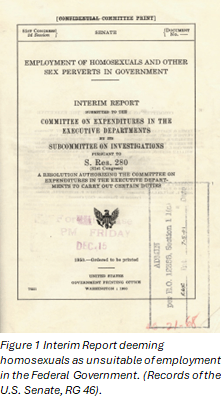
The Senate Subcommittee on Investigations, led by Senator Clyde Hoey, was established in the early 1950s with the sole purpose of investigating the employment of homosexual officers in the federal government. Government employees faced invasive investigations without legal representation, violating their privacy through intrusive questions about their private sexual lives. Questionnaires across the military and fifty-three civilian agencies revealed widespread opposition to employing homosexual individuals. The Subcommittee culminated in the Hoey Report, published on December 15, 1950, stating that intelligence agencies were “in complete agreement that sex perverts in Government constituted security risks”, and that those who “violate the laws or the accepted standards of morality” had no place in the U.S. Government. The report was highly influential, creating bipartisan support for anti-homosexual policies and standardising the practice of ejecting homosexual employees from government. It further legitimised and authorised the notion that gay and lesbian people threatened national security, and shaped government agency security manuals, as well as foreign U.S. embassies and intelligence agencies, for many years.
In 1953, President Eisenhower issued Executive Order 10450, that encoded into national law the investigation and systematic removal of gay men and lesbians from the federal government. David K. Johnson identifies that the policy was based on the unfounded fear that gay men and lesbians posed a threat to national security because they were vulnerable “to blackmail and were considered to have weak moral characters”. The impact of the order extended further than those in the federal government, because similar discriminatory practices had infiltrated to local levels, affecting over twenty percent of the U.S. workforce. Whilst an estimated five to ten thousand people lost their jobs, the impact of these policies extended far further, as many people ‘voluntarily resigned’ after invasive interrogations, and others took their own lives. The policy further deterred any LGBTQ+ people from applying to a government position; thus, quantifying the number of people fired does not capture the full extent of the legislation, that ultimately institutionalised discrimination against gay men and lesbians.
Some individuals exercised resistance against these repressive policies. Frank Kameny was fired in 1957 from his job as an astronomer for the U.S. Army Map Service due to his sexual orientation. He subsequently picketed and rallied outside the White House and dedicated his life to the gay rights movement. His activism reveals a broader impact of the Lavender Scare beyond legislation and discrimination. It sparked the creation of the first sustained gay organisation in the U.S., in California in 1951, and further radicalised the movement in 1960s Washington, long before Stonewall, that is often considered the beginning of the gay rights movement. Thus, a story of marginalisation, persecution, and systematic removal comes to be a story of the origins of the gay rights movement.
Therefore, information about LGBTQ+ intelligence officers remains practically non-existent between the mid-1950s until the early 2000s. The lack of evidence illustrates the impact of the legacy of the Lavender Scare, that has made inaccessible records of the subsequent lives of fired individuals, and the ability to understand how and when cultural attitudes towards homosexuality began to change. Broader legislation throughout this period can illuminate how some of the progress happened, albeit from a top-down approach. In 1973, a federal judge ruled that sexual orientation could not be the sole reason for terminating federal employment, although it could be a reason. In 1975, the Civil Service Commission ruled that LGBTQ+ people could not be excluded or fired from federal employment because of their sexuality, although discrimination continued in other agencies that necessitated the employee to have security clearance. The 1970s therefore constituted a step in the right direction in terms of lifting restrictions on LGBTQ+ employment, although the legislation evidently caveated the complete reversal of the Lavender Scare, by prolonging the legitimisation of discrimination and banning in certain conditions. For example, the 1980 CIA memo, “Homosexual Investigations” gave government officials advice on how to “ferret out” gay colleagues by laying out “types of homosexuals” and how to identify them.
Only in 1988 was the first known openly gay intelligence employee allowed to continue to work. Tracey Ballard founded ANGLE (Agency Network for Gay and Lesbian Employees) and was empowered to keep her job by LGBTQ+ officers who came before her. In 1995, President Bill Clinton signed an executive order that banned discrimination based on sexual orientation when granting security clearances, and only in 1998 was such discrimination banned in government employment, repealing Order 10450. It is shocking that such extreme legislation remained in effect until less than thirty years ago, and that the order was only explicitly repealed when Obama signed Executive Order 13764 in 2017.
Nonetheless, LGBTQ+ discrimination persists in U.S. government policy. President Donald Trump banned transgender people from serving in the military, and any current transgender officer serving could be discharged based on their gender identity. The ideology used by Trump is reminiscent of that used during the Lavender Scare: both policies sought to demonise a specific community and prosecute them based on perceived differences. Thus, the frightening realisation is that despite decades of campaigning about gay rights, the ability to legally discriminate against the LGBTQ+ community has remained entrenched in local and federal laws.
However, some efforts have been made since 2012, the Intelligence Community (IC) holds a yearly Pride Summit, that brings around one thousand employees together in sessions such as “Queer People of Colour” and “Exploring Intersectional Identities”. Furthermore, the IC social media has made conscious efforts to advertise LGBTQIA+ diversity, with LGBTQIA+ officers praising the efforts made to help them feel a sense of belonging and community at work. There has unsurprisingly been some backlash for appearing too “woke”, but nonetheless, the progress in representation is undeniable. Bridget Rose Nolan calls for the need to know more about LGBTQIA+ identities in the IC, as well as other marginalised identities, through more interviews, or classified documents that may, in the coming years, become unclassified. There is undeniable progress to be made if LGBTQIA+ federal employees are going to feel fully accepted in their jobs, but hopefully these policies constitute steps in the right direction, leaving the Lavender Scare in the past.
Bibliography
Adkins, Judith. ‘“These People Are Frightened to Death”: Congressional Investigations and the Lavender Scare. Prologue Magazine 48, no. 2 (2016) https://www.archives.gov/publications/prologue/2016/summer/lavender.html [accessed November 8, 2024]
Haynes, Suyin. ‘You’ve Probably Heard of the Red Scare, but the Lesser-Known, Anti-Gay ‘Lavender Scare’ is Rarely Taught in Schools’. Time (2020) https://time.com/5922679/lavender-scare-history/ [accessed November 8, 2024]
Johnson, David. The Lavender Scare: The Cold War Persecution of Gays and Lesbians in the Federal Government. Chicago: University of Chicago Press, 2004.
Nolan, Bridget Rose. ‘From the “Lavender Scare” to “Out and Equal”: LGBTQIA+ Diversity in the U.S. Intelligence Community.’ International Journal of Intelligence and Counterintelligence 35, no. 4 (2022): 713-725.
‘Perverts Called Government Peril: Gabrielson, G.O.P. Chief, Says They Are as Dangerous as Reds – Truman’s Trip Hit Gabrielson Warns Industry,’ New York Times, 19 April 1950. https://www.nytimes.com/1950/04/19/archives/perverts-called-government-peril-gabrielson-gop-chief-says-they-are.html
Featured image credit: https://commons.wikimedia.org/wiki/File:McCarthy_Cohn.jpg
 Retrospect Journal
