
Written by Fleur O’Reilly
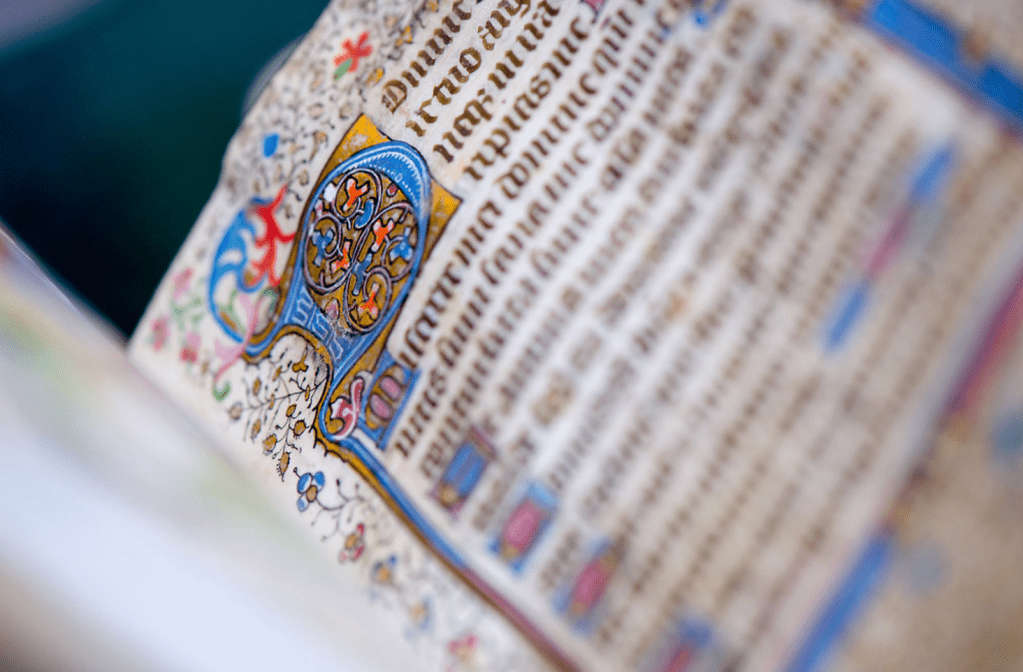
If you have ever glanced at a medieval manuscript, you will have most likely seen the curious images to the side of the text, and quietly admired this unostentatious artistry. Even if you have never looked at an actual medieval manuscript, their drawings of rabbits, cats, and snails, with their outlandish nature, seem to gain popularity online every few months. Medieval manuscripts are well known for their elaborate and illustrated writing style, but their margins are equally fun and worth examining. The margins of texts predating the printing press are full of art and illustrations. This art, known as marginalia, has filled page margins since the earliest days of writing, but one particular area of fascination is the doodles of ornate medieval manuscripts. The drawings in question range from depictions of animal musicians to fighting snails to warrior women. The purpose of these drawings remains unclear to historians, motives of the medieval scribes are long lost to history. The wide range of art and the aura of uncertainty is part of the charm, we can never know why they were drawn, so let us speculate!
One theory is these margin arts were made to be memorable in order to aid those in memorising passages, others claim that it made the manuscript easier to understand and parodied what the text discussed. The one thing we can say is that these drawings were done with a purpose, as access to the materials was not as easy as it is now. These works of art focussed on those that the writing often did not, alongside the images of rabbits and snails with swords, they also depicted women, servants and prostitutes.
Another proposed theory is that the origins of these ‘doodles’ may have been pen trials in order to test the nib in an area of the page which the author knew would not be written on and potentially covered over.
There’s a wide range of types of marginalia: religious, sexual, grotesque, drolleries, and everyday scenes. This range of topics often led to them being ignored by scholars until recently; Michael Camille’s 1992 Image on the edge : the margins of medieval art was the first substantial work to discuss them and proposed that they were more than decorative but could provide an insight into medieval culture. They served as social commentary, whether intentionally or not is another matter.
A common theme was the depiction of role reversals, women with weapons, some manuscripts even show men bested by women (see image one below). This role reversal was also shown through animals. Images of rabbits eating meals at tables and performing human tasks are rife throughout the texts (see image two below). Equally, though we see rabbits in vicious roles, perhaps as a playful upside-down world, or as more of a political commentary or warning (see image three below). Harley MS 6563 contains an eight-page narrative of a battle between some cat and mice (see image four below), which can also be understood as a social commentary with the mice coming out victorious, hunters being chased by their prey (the same as with the rabbits mentioned above.) Some images contained moral messages or helped convey the message in the text. Many revealed information about fashion at the time, jobs, or hobbies.
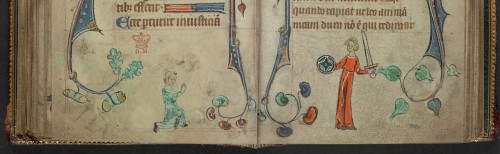
(Image one) Harley MS 6563, ff. 63v-64r
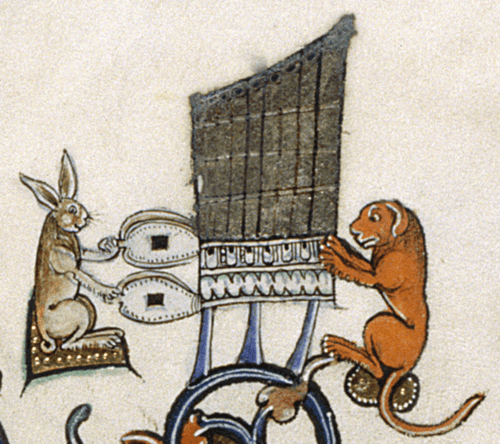
(Image two) Gorleston Psalter, 14th century, f. 106v

(Image three) British Library’s MS royal 10 E IV

(Image four) Harley MS 6563, ff. 71v-72r
Whilst there is plenty of speculation on the nature of these drawings, for the time being, that is what they’ll remain: historians’ speculation. Without the means to go back in time and question the illustrators, we’ll never know the intent behind the drawings. Maybe some were just creative artists with a deep imagination whilst others carried a deeper political meaning. Most likely it was a blend of both with some more overtly political drawings, art has and will always be political, even if it’s a fun drawing of a rabbit fighting another rabbit.
Although there is no clear meaning of what any of these drawings indicate or mean, they’re fun to look at and to imagine someone a thousand years ago drawing them and what thoughts were in their heads at the time. Marginalia can be useful, providing hints on contemporary life in the Middle Ages, from food to clothes. I like to imagine they were simply some drawings that the monks liked to do that reflected their everyday life, worries, and imaginations; a reminder that the people of the medieval world had a more playful view than we think sometimes.
Image credit: “Centuries-old medieval manuscripts added to UBC Library collection” by UBC Library is licensed under CC BY-NC-ND 2.0.
 Retrospect Journal