
Written by Ailsa Fraser
Tennis is a well-known game, played all around the world today. There are many tournaments held for it each year, from the local level to the prestigious Grand Slams, played on courts that use a variety of surfaces. Distinctive features of the game include the iconic yellow tennis ball and the game’s bizarre scoring system. But where did these features come from?
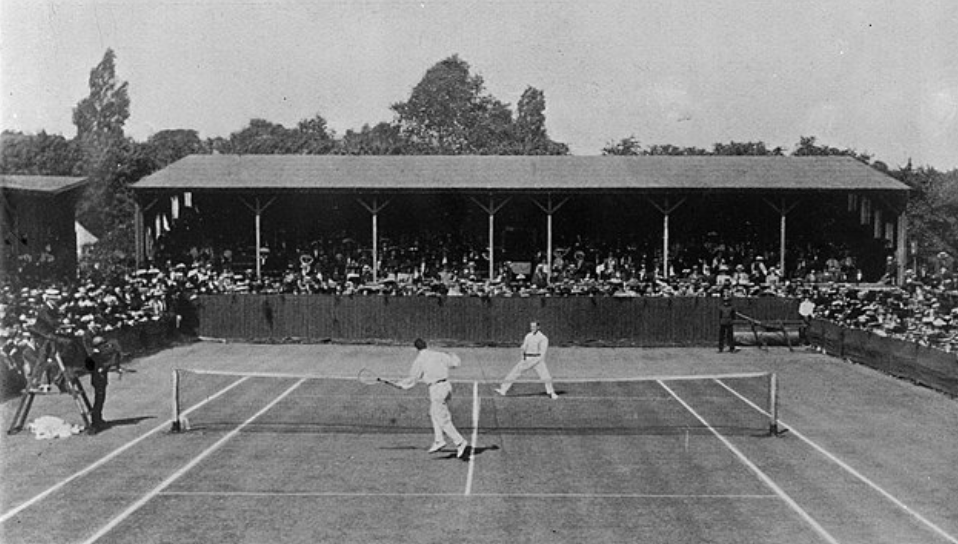
The history of tennis is filled with more legend than fact, but we know some things for sure. We can trace its origins to a game popular in twelfth-century France, jeu de paume, mostly played by monks with their bare hands. By the sixteenth century, its popularity had soared: there were over a thousand tennis courts in Paris alone, and even kings like Henry VIII of England were known to enjoy it. It was new aristocratic players who introduced the racquet, made with cork, string, and leather. This version of the game is today called “real tennis”. The modern version of the game, “lawn tennis”, was invented in the nineteenth century, inspired by real tennis and other similar games. In 1873, Major Walter Clopton Wingfield further developed the game and published its rules, which the International Tennis Federation (ITF) later refined for an international audience.
But where does the bizarre scoring system come from? For those unfamiliar, both players start with no points, called “love”, and “love-all”. At a minimum, a player must win four points against their opponent by either forcing their opponent to miss the ball, hit it out of bounds, or into the net. The points progress from fifteen, to thirty, to forty, to a win. If both players get three points, or forty-all, it’s called as “deuce”, and one player must get two clear points to win the game. This system has been in use since at least the nineteenth century. But in real tennis, the points progressed as fifteen, thirty, then forty-five, rather than forty, though the reason for the change is unknown. The dominant theory is that the medieval points system came from the quarters of a clock face. However, clocks only gained minute hands in the sixteenth century, undermining the theory. Other theories are less satisfactory—that there may have been a complicated multiplication system; that it refers to distances demarcated on the court—so it may forever remain a mystery.
Another iconic feature of tennis, the fluorescent yellow ball, is easier to trace. Indeed, the Wimbledon Instagram page posted a reel about it this year, inspiring this article. Tennis balls were originally white. The Wimbledon tennis tournament was first televised in 1937, and in 1967, colour television was spreading. A young television executive working for BBC Two, David Attenborough, sent colour cameras to the tournament, which made BBC Two the first channel in Europe to broadcast television in colour. But the white ball was difficult to track on coloured screens. Attenborough suggested a fluorescent ball might be more noticeable, and the ITF found that a fluorescent yellow ball worked best. In 1973, the US Open featured the yellow tennis balls for the first time, and they spread rapidly. Ironically, Wimbledon, in 1986, was the last to adopt them.
Modern lawn tennis was originally associated with the upper classes, and much of its appeal comes from its strange systems. The medieval scoring was resurrected at the first Wimbledon precisely because of its history and oddness. But that doesn’t stop it from being one of the most popular sports today—and from producing more legends to add to its history as the tournaments play on.
Bibliography
Alao, Lola Christina. “Why are tennis balls yellow? How colour changed thanks to Sir David Attenborough.” The Standard. Accessed November 21, 2024. https://www.standard.co.uk/sport/why-tennis-balls-yellow-david-attenborough-wimbledon-b1168099.html
BBC Bitesize. “Tennis – an overview and history of the sport.” BBC. Accessed November 21, 2024. https://www.bbc.co.uk/bitesize/guides/zycg4j6/revision/1
Fabry, Merril. “Why Is Tennis Scored So Weirdly?” Time. Accessed November 21, 2024. https://time.com/5040182/tennis-scoring-system-history/
 Retrospect Journal