
Written by Ami John
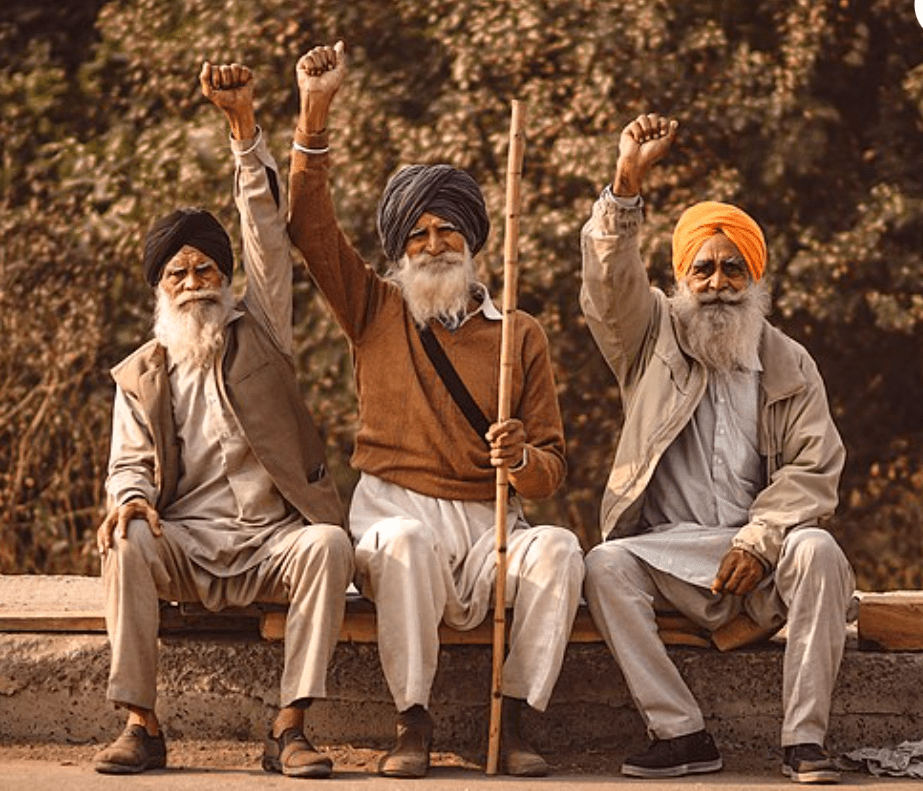
The Farmers Protest in India began when thousands of farmers took to the streets in protest, mainly in the state of Punjab. Part of the ‘Delhi Chalo’ Movement, the phrase roughly translates to “Delhi Walk” or “Walk to Delhi”, which aimed at crossing the state of Haryana and reaching New Delhi, the capital of India, as a form of defiance against the government. The movement began in 2020, sparked by three new governmental laws which aimed to reform the agricultural sector. The three laws were:
1. The Farmers’ Produce Trade and Commerce (Promotion and Facilitation) Act, 2020
2. The Farmers (Empowerment and Protection) Agreement on Price Assurance and Farm Services Act, 2020
3. The Essential Commodities (Amendment) Act, 2020
These laws primarily focused on allowing farmers to directly sell to private corporations, skirting around and bypassing the Agricultural Produce Market Committees (APMC), which were the state-regulated markets that protected farmers from exploitation by potential middlemen. This sparked an outrage among the farmers in Punjab and Haryana (the breadbasket of the country), who are very important to the country’s food security.
During the protest, many participants who were in their sixties and seventies faced tribulations such as having to camp out on open grounds for weeks on end, sleeping on the roadside and using petrol stations as bathhouses and toilets. This was exacerbated by government efforts to stop the protest through tear gas and water cannons deployed by police forces in Haryana as a measure to restrict the march from furthering. Around seven hundred protestors died due to various factors like climate, COVID-19 and sanitation issues.
Why were they protesting these laws?
Although the government argued that these reforms were designed to benefit farmers by providing them with greater freedom to sell their produce and negotiate better prices, many farmers felt that they would be left at the mercy of large, private corporations, unable to compete in an open market. The new laws allowed private players to stockpile produce. This was previously illegal because it could lead to price manipulation. However, while the government claimed to help them reach the larger buyers, the farmers feared a loss of control over their produce.
Through the elimination of the APMC system, the farmers were wary of price manipulations by the private companies, essentially staking their survival on them. Furthermore, this would also mean a loss of legal protections, as the farmers felt they would lose their only bargaining chip without the APMC, as around 80 per cent of Indian farmers are small scale agriculturalists.
The new laws also prevented farmers from approaching the courts and instructed all communication to go through governmental officials who could be more prone to corruption. The lack of financial safety and regulations resulted in one of the largest organised protests the country has faced in recent times.
Responses and Consequences?
After the yearlong protest, Prime Minister Narendra Modi’s government decided to reappeal some of the reformed laws in 2021. Thus, highlighting the impacts of mass protests in challenging governmental systems of law.
This had repercussions for the government: the Bhartiya Janata Party, the current political party in power, lost major support from the country’s agriculturalists. The party had won twenty-three seats in Maharashtra previously but only won a mere nine in the 2024 elections. This pattern followed across the nation, with Haryana banking ten out of ten seats in 2019, only securing five in 2024. In Punjab, the government drew a blank, failing to secure any, leading to their opposition parties gaining dominance in the region. Nationally, the BJP lost its majority after a decade of dominance, winning 240 seats in a house of 543, compared with 303 in 2019. Demonstrating the wider scale impact of the farmer protests in India.
What’s happening now?
In February 2024, the farmer’s movement reignited, with renewed demand for:
- Guaranteed Minimum Support Price (MSP) – A legally binding MSP means that no one can purchase farm produce below the MSP, and doing so would be punishable by the law. Currently, only rice and wheat are purchased with these set prices. So, a new change will ensure everyone is profiting regardless of what they produce.
- Better income and equipment – The 2016 election saw the BJP party promise to double farmer earnings by the year 2022. However, this has not happened, and the prices to cultivate and produce crops have increased, leaving farmers with less of a profit. Further, the farmers want the government to invest in rural infrastructure for better farming conditions (another promise made by the government)
- Minister Son controversy – during the riots, there was an incident where a car belonging to junior home minister Ajay Mishra (his son was driving the vehicle) ploughed into a field in the state of Uttar Pradesh and killed four men. This sparked more intense outrage in an already tumultuous landscape and fuelled anti-government sentiment.
In conclusion, the protests reveal the profound impact one social group can have on the political sphere of a country. They show how the failure of any governmental body to uphold laws can lead to dire consequences. The farmers’ protests reflect the agrarian distress in India, with the struggles of small-scale farmers and the pressures of a free market at the forefront. This incident and its continuation highlight the deep discrimination the agricultural community in India has faced. The fear of exploitation and the insecurity of their livelihoods have led to caution within the group, making them hypervigilant to any changes in agricultural laws.
Bibliography
https://www.bbc.co.uk/news/world-asia-india-58839296
 Retrospect Journal