
Written By Louisa Steijger
23/11/2024
Taiwan’s identity and development have been profoundly shaped by two figures from its early history: Koxinga (Zheng Chenggong) and Shi Lang. They lived during a turbulent period of China’s history, shaped by the transition from the Ming dynasty to the Qing dynasty in the seventeenth century. The lives of Koxinga and Shi Lang played a central role in Taiwan’s political, social, and cultural evolution. Today, their legacies resonate deeply in Taiwan’s complex relationship with China and its struggle to define its own national identity.
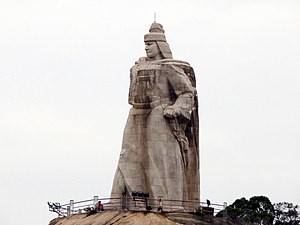
The Ming dynasty (1368–1644) ruled China for nearly three centuries; however, by the mid-seventeenth century, the dynasty faced growing internal problems and threats from the rising Qing dynasty. The Qing, established by the Manchus, an ethnic group originating from Northeast Asia, eventually overthrew the Ming in 1644, seizing control of China. This shift in power drove many loyal Ming supporters to resist the Qing, with some seeking refugee beyond the mainland. Among them was Koxinga, a prominent Ming loyalist, who, determined to oppose Qing rule, retreated to Taiwan in 1661, where he successfully ousted the Dutch East India Company from Fort Zeelandia, founding the Kingdom of Tungning in April 1662. Taiwan, from Koxinga’s perspective, offered an ideal location for sustaining resistance to the Qing while also providing resources essential for the defence of Ming loyalist forces. Some historians suggest Koxinga’s motivations were primarily anti-imperial, aiming to reclaim Taiwan from foreign control and restore it to its ‘motherland’. This interpretation is underpinned by the belief that Taiwan has long been part of China. However, many Taiwanese scholars contest this view, noting that Taiwan was not formally linked to China until the Qing dynasty, therefore, making claims of an ancient connection difficult to sustain. Regardless of the precise motivations, Koxinga’s expulsion of the Dutch from Taiwan became a cornerstone of his historical legacy, symbolising resistance to foreign influence and cementing his role as an early figurehead of Taiwanese sovereignty.
In examining Koxinga’s impact, it is also important to consider how his establishment of the Kingdom of Tungning introduced significant changes to Taiwan’s socioeconomic landscape. Koxinga imported many Chinese agricultural techniques to Taiwan, such as the use of iron tools and cattle farming, which substantially improved the agrarian basis of Taiwan, allowing the island to evolve into an economic hub. Koxinga’s economic legacy extended beyond the scope of farming to include the development of Taiwanese maritime trade, becoming a prominent regional base for trade with Japan, the Philippines, and other parts of East Asia.
Koxinga’s legacy also laid the groundwork for the cultural development of Taiwan, significantly impacting Taiwanese culture, language, and social structures. Koxinga’s administration emphasised preserving Ming traditions and customs. Under his rule, Chinese migrants (mainly Ming loyalists) who fled the Qing’s expansion brought with them Confucian values which helped enrich Taiwan’s cultural and social fabric. However, Koxinga’s administration also encountered resistance from Taiwan’s indigenous groups, leading to periodic conflicts. This social resistance manifested due to Koxinga’s unfair treatment of the Indigenous Taiwanese; for instance, he redistributed land away from them towards Ming loyalists. These cases nuance Koxinga’s legacy, instead painting himself as another proponent of external rule rather than an advocate for local autonomous rule.
Koxinga’s legacy has had a profound impact on Taiwan’s political consciousness. His legacy has evolved over time, particularly in response to changing political contexts. During the Great Qing dynasty, 1639–1911, Koxinga and Ming loyalists were often depicted as rebellious threats to stability. Later, his status evolved, particularly during Taiwan’s postwar years and the Cold War period, when the Guomindang government leveraged Koxinga’s legacy as an example of defiance against Communist rule. In recent decades, as Taiwan’s political landscape has continued to change, Koxinga’s legacy has again been manipulated to conform to differing understandings of the cross-strait relation between China and Taiwan. For instance, the “One Country, Two Systems” model promoted by China utilises Koxinga’s legacy as a symbol of Taiwan’s historical unity with the mainland. Other perspectives in Taiwan, such as the Pan-Green Bloc (a political alliance in Taiwan that supports Taiwan’s distinct identity and leans towards Taiwanese independence) emphasise how Koxinga’s resistance was a precursor to Taiwan’s quest for autonomy. These shifts underscore the adaptability of Koxinga’s legacy, highlighting how historical figures are often re-evaluated to align with contemporary ideologies.
Shi Lang, originally a Ming loyalist and skilled naval commander, was initially aligned with Koxinga’s family and was a trusted subordinate of Zheng Zhilong (Koxinga’s father). However, a bitter personal conflict developed between him and Koxinga, because of Koxinga’s jealousy surrounding Shi Lang’s relationship with Zheng Zhilong. Subsequently, Shi Lang defected to the Qing dynasty in 1646. Koxinga reacted to this defection by brutally killing Shi Lang’s father, son, younger brother, and nephew. This action ultimately intensified Shi Lang’s commitment to the Qing cause, in which he sought to inflict immense harm to eliminate the Ming dynasty and avenge the murders of his family members. Consequently, Shi Lang proposed a military strategy to secure Taiwan, arguing that the island’s inclusion in the empire would bolster the Qing’s defensive capabilities along the southeastern coast. In 1683, Shi Lang’s naval campaign defeated Koxinga’s grandson, Zheng Keshuang, and integrated Taiwan into the Qing Empire.
Shi Lang’s legacy is closely associated with his support for policies promoting Sinicization, a process of promoting and integrating Chinese culture, language, customs, and societal structures into other regions or among different ethnic groups. These policies aimed to integrate Taiwan into the broader Chinese imperial structure. His policies included encouraging migration from the mainland to Taiwan to allow the dynasty to strengthen its control over the island and ensure its incorporation into the Qing administrative system. Shi Lang’s promotion of migration altered the demographic composition of Taiwan’s society, allowing Han Chinese immigrants to enter and gradually replace the Austronesian populations as the dominant group in Taiwanese society. Today, this demographic shift persists, with over 95 per cent of Taiwan’s population identifying as Han Chinese, thus demonstrating the prevailing legacy of Shi Lang’s influence on Taiwan’s social composition.
Shi Lang also played a significant role in the economic development of the island, enabling the integration of Taiwan into the Qing imperial system. Under Qing rule, various economic reforms were implemented, enabling Taiwan to be incorporated into the empire’s tribute system, benefiting from valuable trade routes and economic resources that encouraged agricultural expansion and commercial activity. These developments helped establish Taiwan as a key player in regional trade and contributed to the prosperous economy that characterises the island today.
Despite Shi Lang’s success in promoting cultural and administrative integration, his legacy is complex. Much like Koxinga, Shi Lang’s legacy is subjected to interpretation and manipulation in which he is viewed as both a ‘hero’ and a ‘villain’ within the development of Taiwan. In mainland historical narratives, Shi Lang is often celebrated as a hero who acted as a unifying force that returned Taiwan into the fold of the ‘motherland’. In Taiwan, however, his legacy is viewed more critically by some, with his policies perceived as suppressive measures aimed at eroding local autonomy and distinct identity. The latter interpretation typically stems from a Taiwanese local perspective, where, as Ronald Po describes, Shi Lang is remembered and understood as an ‘incompetent, imperious minister who had caused a series of difficulties for the land’. These interpretations of Shi Lang are not confined to binary perspectives alone but have evolved alongside changing political contexts. For example, during the Great Qing period, Shi Lang was painted positively to reflect his instrumental role in consolidating Qing rule. However, during the Cold War, Shi Lang’s legacy was virtually erased from history due to his associations with the Qing dynasty. Since the 1990s, Shi Lang’s legacy has once again been recast in a positive light, paying homage to the role he played in unifying Taiwan and China.
Ultimately, as Taiwan grapples with its past to navigate the present, the examination of Koxinga and Shi Lang’s legacies offers invaluable insight into the nation’s social, cultural, political, and economic development. From ‘heroes’ to ‘villains’, Koxinga and Shi Lang’s legacies have been appropriated and manipulated both in the past and within the current climate of cross-strait tensions to suit differing agendas within Taiwan’s development, particularly regarding the nation’s relationship with China.
Bibliography
Andrade, T. ‘Koxinga’s Conquest of Taiwan in Global History: Reflections on the Occasion of the 350 the Anniversary’. Late Imperial China, 33(1), (2012): pp.122-140.
Crozier, R. Koxinga and Chinese Nationalism: History, Myths, and the Hero (Cambridge, MA: Harvard University Press, (1977), 12–78.
Dreyer, Edward L. ‘The Myth of “One China”’, in Chow, Peter C. Y. (ed.), The ‘One China’ Dilemma. New York: Palgrave Macmillan, (2008), pp. 26–28.
Hang, Xing. “Contradictory Contingencies: The Seventeenth-Century Zheng Family and Contested Cross-Strait Legacies.” American Journal of Chinese Studies 23 (2016): 173–82. http://www.jstor.org/stable/44289147.
Kang, P. 2016. 15. Koxinga and His Maritime Regime in the Popular Historical Writings of Post–Cold War Taiwan. In: Andrade, T., Hang, X., Yang, A. and Matteson, K. ed. Sea Rovers, Silver, and Samurai: Maritime East Asia in Global History, 1550–1700. Honolulu: University of Hawaii Press, pp. 335-352. https://doi.org/10.1515/9780824852771-017
Ronald C. Po, “Hero or Villain? The Evolving Legacy of Shi Lang in China and Taiwan,” Modern Asian Studies, vol. 53 issue 4 (2019), pp. 1486-1515. – All quotations referred to in this article come from Po’s work.
Weichung, Cheng. “Admiral Shi Lang’s Secret Proposal to Return Taiwan to the VOC,” in Tonio Andrade and Xing Hang (eds.), Sea Rovers, Silver, and Samurai: Maritime East Asia in Global History, 1550-1700. Honolulu: University of Hawai’i Press, (2016), pp. 290-311.
Yao, M. ‘Re‐imagining the ‘Taiwanese’ nation in the interpretation of the Chinese‐oriented heritage.’ Nations and nationalism. [Online] 28 (4), (2022), p.1230–1248.
Featured Image Credit: Koxinga, https://military-history.fandom.com/wiki/Koxinga
 Retrospect Journal