
Written by Ailsa Fraser
Content warning: This article discusses cannibalism and related violence.
The aim of cultural history is to understand past societies on their own terms, even if behaviour or social norms seem strange or abhorrent to us. Robert Darnton epitomises this in his classic study The Great Cat Massacre, a staple of university courses, in which he examines a case where young apprentices found delight and hilarity in torturing and killing their master’s wife’s cats. As historians, we try not to let our own social conditioning interfere with how we interpret the past—an impossible goal, in the end, but a worthy one. But it is one that becomes especially difficult in extreme cases. Cannibalism is one such case. There are genuine examples of its practice across history, including in the Western world that frowns on it, and how it either collaborated or conflicted with the norms of that culture is a rich and revealing area for cultural historians to study. However, there is a paucity of literature on historical cannibalism, although medical historians give a better showing for medical cannibalism. It is a topic historians do not want to touch.
Cannibalism is often considered ‘the universal taboo’. It is not a universal taboo. Here I define it as the consumption of another human’s body, whether that be bone, blood, or flesh. This differs from definitions by scholars like Christian Siefkes, who refer only to consumption of the flesh, but it is necessarily broad to encompass medical cannibalism as well. Cannibalism comes in many contexts, such as in cases of famine, cases of a ritual, cases where the body is used after death for medicine, or in the context of war. Our modern revulsion stems from a Judeo-Christian belief in bodily resurrection, wherein the physical body holds the spirit of the person. But the historical fact is that cultures have practiced it. It is true that European imperialists wielded accusations of cannibalism to create an image of conquered and enslaved peoples as ‘savages’ who needed ‘civilising’. These often stemmed, as Stuart McManus and Michael Tworek demonstrate, from the circulation of Spanish reports of the Tapuya people allegedly eating their relatives in what is now Brazil. Historians like William Arens have even gone so far as to argue that cannibalism was an imperial myth only used to smear such peoples, but a close reading of contemporary sources reveals a more complex story. European travel accounts, for example, reveal there was a society practicing cannibalism in Fiji in the nineteenth century, and some cultures in the Congo engaged in it too. Most scholars today accept that ritual cannibalism has taken place around the world across history. While it is important to keep the imperial context of such anthropological observations in mind, we should not allow revulsion to prevent us from studying the subject in question. Cannibalism is not necessarily something sensational or exotic, and not to those in the past who lived in cultures where it was the norm.
Even in cultures where it was taboo, there would still be cases of it. Ritual cannibalism, for example, has not featured extensively in Britain’s history. However, Angela McShane’s work on the English Civil War revealed an incident in 1650 of a group of royalists cutting off parts of their buttocks to roast and eat in tribute to the late, executed King Charles. The truth of this case, as McShane demonstrates, is difficult to ascertain: it may have been a genuine ritual, meant to draw on religious imagery, or parliamentarian scaremongering in a context where both sides of the war accused each other both of Catholicism and bloodthirstiness. An alternate example comes from Catherine Armstrong’s study of early settlers in Virginia in the seventeenth century. Difficult winters led to individual cases where settlers might consume each other, including one case where a woman’s husband murdered her for food. Some commentators, in writing about these cases, did not publish them. But John Smith openly discussed cannibalism in his 1624 book, which was meant to solidify his reputation as an expert on the American colonies. Both of these seventeenth-century examples existed in a Christian culture which disapproved of cannibalism, but it was still engaged in and even published. This surprising contrast provides fertile ground for the cultural historian to work with, as McShane and Armstrong do.
Furthermore, the medical cannibalism common in early modern Europe was a social norm, and much better studied by medical historians than most forms of cannibalism. In 1680, an English doctor was recorded as making medicines out of corpses, and he was far from the only one. Marsilio Ficino, scholar in the Italian renaissance and son of a physician, recommended the drinking of human blood as an elixir of life; Danish crowds until the nineteenth century would collect blood from executed criminals; and a Franciscan monk in 1679 wrote a recipe for making marmalade out of blood as well. The mummy craze, too, came about because of the belief that consuming powdered mummy inferred health benefits. That this form of cannibalism went unchallenged in Europe even while indigenous peoples recently encountered were reviled as cannibals is a valuable cultural insight. Beth Conklin points out that the difference between European cannibalism and non-Western cannibalism is how personal it was. European cannibalism viewed the body as an item for consumption, while non-Western cannibalism often involved a relationship between the consumer and consumed. This was not always the case—Siefkes argues for the prominence of cannibalism as xenophobia, wherein cannibalism would be used to express power of ultimate destruction over an enemy, not a personal ritual—but this difference is telling about the increasingly commercialised European world. Cannibalism was not always a distant, violent thing in early modern Europe.
It would be remiss, however, not to acknowledge the violence. The indignity, to our modern sensibilities, of having one’s corpse eaten without prior permission is notable. But in cases where a human was killed specifically to be eaten, the violence done to the victims should be just as present in any history of cannibalism as the motivations and social context of those who consumed them. In Fiji, cannibalism was linked to regular wars in which the defeated were consumed, and Patrick Brantlinger in his study of the Victorians’ ‘civilising’ missions even argues that Fijians were more eager to respond to visiting Wesleyan missionaries because they saw conversion as a way out of the violent cycle. Even in the languages of cultures that practiced such cannibalism, such as in Congolese language and in Fiji, the words that refer to a dead enemy are similar to the word for animal meat. This features most in cases where cannibalism occurs in the context of war, but ritual cannibalism was also not free of its violence, nor famine cannibalism as the Virginian woman killed by her husband demonstrates. Even medical cannibalism, where the person did not die for food purposes, expresses violence in how dismissive it is of the person’s autonomy in death. In studying the cultural context of cannibalism, rich as it is, we cannot just look at the experience of the consumers, but also the experience of the consumed.
As cannibalism is so deeply taboo in the Western world today, it is difficult to look at its historical manifestations head-on. But it must be done if we as historians are to fully grasp the cultures in which it manifested. While it may be preferable to avoid it, and even dismiss its reports as racist propaganda on behalf of colonial powers, cannibalism is a practice tied to a culture’s ideas, religion, power structures, and social relations. In cases where it has been recorded, it is very revealing about those that practice it. Even where it is not widely practiced, as seen in the examples from England and Virginia, that it occurred at all produces interesting questions for the historian because of its taboo. In setting aside our own revulsion, however, we should not lose sight of the fact that it is a devastatingly violent act. It reveals much about the culture of the consumer, but it is just as important to investigate the consumed to understand their experience, their relation to the act, and how they came to be involved. Cannibalism is decidedly not the universal taboo we prefer to think of it as—much like how few things in cultural history are constant or true across time and space. It is precisely these differences that cultural history is interested in.
Bibliography
Armstrong, Catherine. ‘Boiled and Stewed with Roots and Herbs’: Everyday Tales of Cannibalism in Early Modern Virginia.’ In The extraordinary and the everyday in early modern England: essays in celebration of the work of Bernard Capp, edited by Angela McShane and Garthine Walker, 161–176. Basingstoke: Palgrave Macmillan, 2010.
Avramescu, Cătălin. An Intellectual History of Cannibalism. Princeton: Princeton University Press, 2009.
Brantlinger, Patrick. Taming Cannibals: Race and the Victorians. Ithaca: Cornell University Press, 2011.
Darnton, Robert. The Great Cat Massacre and Other Episodes in French Cultural History. London: Harmondsworth, 1985.
Dolan, Maria. “The Gruesome History of Eating Corpses as Medicine.” Smithsonian Magazine, May 6, 2012. https://www.smithsonianmag.com/history/the-gruesome-history-of-eating-corpses-as-medicine-82360284/
McManus, Stuart M. and Michael T. Tworek. “A (Dis)entangled History of Early Modern Cannibalism: Theory and Practice in Global History.” Transactions of the Royal Historical Society 30 (2022): 47–72.
McShane, Angela. ‘The Extraordinary Case of the Blood-Drinking and Flesh-Eating Cavaliers.’ In The extraordinary and the everyday in early modern England: essays in celebration of the work of Bernard Capp, edited by Angela McShane and Garthine Walker, 192–210. Basingstoke: Palgrave Macmillan, 2010.
Siefkes, Christian. Edible People: The Historical Consumption of Slaves and Foreigners and the Cannibalistic Trade in Human Flesh. Oxford: Berghahn Books, 2022.
Sugg, Richard. “Corpse Medicine: Mummies, Cannibals, and Vampires.” The Lancet, vol. 371, 9630 (2008): 2078–2079.
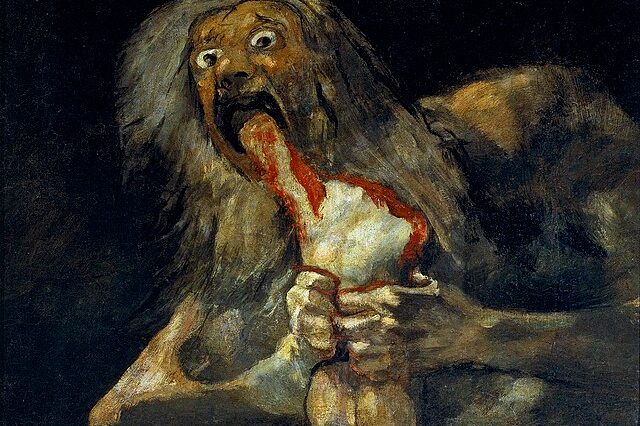
Featured image credit: Francisco Goya: Saturn Devouring His Son (1820-1823). Accessed via Wikimedia Commons: https://commons.wikimedia.org/wiki/File:Francisco_de_Goya,_Saturno_devorando_a_su_hijo_(1819-1823).jpg
 Retrospect Journal
.jpg)